Stock Analysis · Urban Edge Properties (UE)
Overview
Urban Edge Properties is a retail real estate investment trust, or REIT. In simple terms, it owns shopping centers and retail properties and earns money mainly by leasing space to tenants. The portfolio is concentrated in dense, high-income urban and suburban corridors, especially in the Northeast. That focus matters because these locations tend to have limited land availability, high traffic, and a large customer base, which can support rent levels and occupancy over time.
The business model is straightforward: acquire and manage retail properties, keep them occupied, raise rents when market conditions allow, and improve selected sites through redevelopment or re-tenanting. Because it is a REIT, the company is structured around real estate income rather than manufacturing products or selling services directly to consumers.
Its revenue base is not highly diversified by business line. Based on company filings, the overwhelming majority of revenue comes from rental activity tied to shopping centers and related real estate operations.
- Rental revenue from retail properties: approximately 90% to 95% of total revenue. This includes base rent from tenants in shopping centers and other recurring property income.
- Tenant reimbursements and recoveries: approximately 5% to 10%. These are amounts tenants pay back for property operating costs such as common area maintenance, utilities, taxes, and similar items.
- Other property-related income and gains: usually a small and less predictable share. This can include lease termination income, management-related items, or gains connected to asset sales and redevelopment activity.
The overall earnings pattern has been somewhat uneven in recent years, which is common in real estate because property sales, accounting adjustments, and redevelopment timing can affect reported profit. Still, total revenue has generally trended upward from the post-2022 period into 2025, while interest expense has also remained meaningful, showing how important financing costs are for this company.
Key Figures
| Metric | Value | Sector ⓘ |
|---|---|---|
| Date | Oct 17, 2026 | |
| Context | ||
| Sector | Real Estate | |
| Industry | REIT - Retail | |
| Market Cap ⓘ | $2.64B | |
| Beta ⓘ | 1.01 | |
Value (Cheapness) | ||
| P/E Ratio ⓘ | 36.19 | 17.38 |
| P/B Ratio ⓘ | 2.14 | 0.85 |
| FCF Yield ⓘ | 4.89% | 7.38% |
| Dividend Yield ⓘ | 4.13% | 4.85% |
| EBIT / EV ⓘ | 3.53% | 3.78% |
| PEG ⓘ | 6.59 | |
Growth (Business expansion) | ||
| Revenue Growth ⓘ | 7.60% | 5.30% |
| RPS Growth (5Y CAGR) ⓘ | 1.73% | 6.02% |
| EPS Growth (5Y CAGR) ⓘ | 6.70% | -11.37% |
| BVPS Growth (5Y CAGR) ⓘ | 3.88% | 0.45% |
| Margin Growth (5Y Trend) ⓘ | -1.47% | -0.22% |
| FCF Growth (5Y CAGR) ⓘ | 7.81% | 5.40% |
| DPS Growth (5Y CAGR) ⓘ | -7.15% | 5.02% |
Quality (Business durability) | ||
| ROIC (Latest) ⓘ | 4.84% | 5.69% |
| ROE (Latest) ⓘ | 5.66% | 7.56% |
| ROA (Latest) ⓘ | 2.02% | 2.85% |
| ROIC (5Y Median) ⓘ | 6.00% | 4.22% |
| ROE (5Y Median) ⓘ | 7.80% | 6.03% |
| ROA (5Y Median) ⓘ | 2.82% | 2.44% |
| Net Debt / EBIT (Latest) ⓘ | 12.48 | 7.59 |
| Net Debt / EBIT (5Y Median) ⓘ | 9.53 | 8.40 |
| Net Debt / EBITDA (Latest) ⓘ | 6.48 | 5.27 |
| Net Debt / Assets ⓘ | 54.46% | 37.76% |
| EBITDA / Interest ⓘ | 3.74 | 4.10 |
| Operating Margin (Latest) ⓘ | 29.82% | 35.29% |
| Operating Margin (5Y Median) ⓘ | 37.79% | 37.31% |
| Debt to Equity (Latest) ⓘ | 148.07% | 88.87% |
| Profit Margin (Latest) ⓘ | 13.95% | 19.61% |
| Free Cash Flow (Latest) ⓘ | $129.27M | |
Momentum (Price trend) | ||
| 3Y Return ⓘ | +42.75% | +30.75% |
| 12M Return (excl. last month) ⓘ | +1.61% | +4.36% |
| 6M Return ⓘ | -7.88% | -2.52% |
| Price vs. 200-Day MA ⓘ | -7.08% | -2.34% |
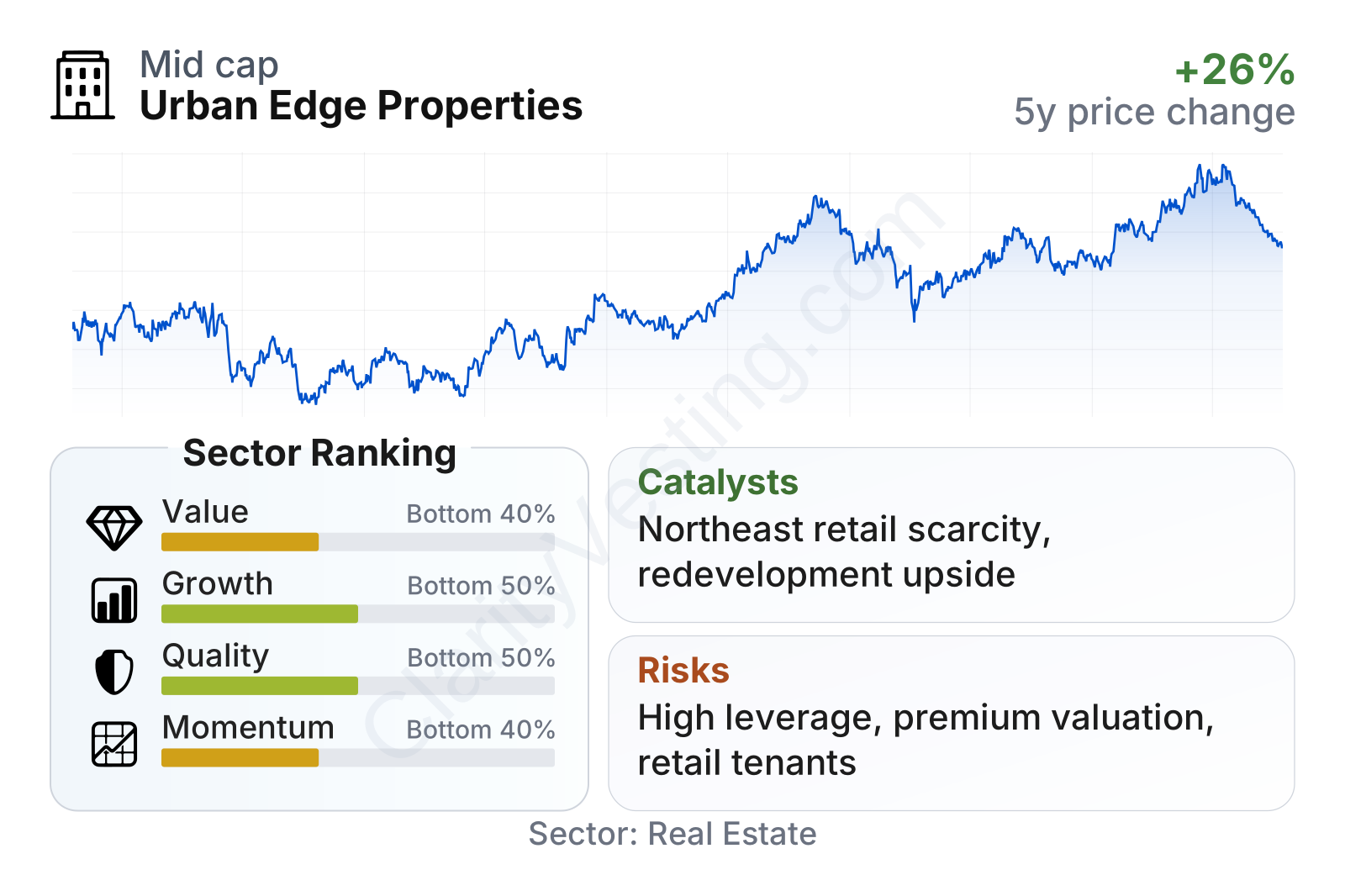
Urban Edge is a mid-sized public REIT with a market capitalization around the low single-digit billions of dollars and a stock beta close to 1, which suggests share-price swings broadly in line with the wider market. The factor profile is mixed. Growth in the most recent year looks respectable, but longer-term expansion is less impressive than the sector median. Quality is also mixed: historical returns on capital and assets were stronger over a multi-year period, yet current profitability and leverage metrics are less favorable. On valuation, the stock screens richer than many peers, with both earnings and book-based multiples above sector medians, while dividend yield and free cash flow yield sit below typical sector levels.
Price performance has improved significantly from the 2022 trough, and the longer three-year return has outpaced the sector median. Even so, more recent momentum looks softer, with the shares recently sitting below their 200-day average. That combination usually signals that the market has already recognized some recovery progress, but is not assigning full confidence to the next stage of growth.
Growth
Retail real estate is no longer viewed as a uniformly declining segment. The better-located part of the market has been holding up much better than weaker malls or low-traffic centers. Urban Edge operates in that more resilient part of the sector: grocery-anchored and necessity-oriented shopping centers in densely populated trade areas. This is a useful niche because tenants selling everyday goods and services usually generate steadier traffic than more discretionary retailers.
The strategy for future growth is sensible on paper. Rather than relying only on major acquisitions, the company can grow through leasing vacant space, signing new tenants at higher rents, redeveloping underused parts of existing properties, and selectively recycling capital from asset sales into stronger locations. That approach tends to be less risky than aggressive expansion into unfamiliar markets.
Revenue per share has increased gradually since 2022, which points to steady operational progress, but not rapid expansion. Over five years, the growth rate has lagged the sector median, so the company’s growth case depends more on disciplined execution and rent improvement than on a powerful structural growth engine. Recent year-over-year revenue growth has been better than the sector median, which suggests near-term momentum has improved.
The dividend pattern also says a lot about the company’s trajectory. The payout was cut sharply earlier in the cycle and has since been rebuilding step by step. That recovery is a constructive sign because it suggests better operating stability, but the dividend still reflects a business that is prioritizing balance sheet management and measured rebuilding over aggressive distribution growth.
A meaningful catalyst is the simple scarcity value of high-density retail real estate in the Northeast. If leasing demand remains healthy, Urban Edge may be able to push rents and improve occupancy without needing exceptional economic growth. Another potential tailwind is redevelopment of existing assets, where management can create additional value from land already under its control. In an environment where new retail supply remains limited, this kind of internal growth can be more attractive than ground-up expansion.
Recent company updates and filings have continued to emphasize leasing, redevelopment, and portfolio optimization rather than transformational deals. That is usually a sign of a management team focused on incremental value creation and cash-flow durability.
Risks
This article is for informational purposes only and does not constitute financial advice. Some content is AI-generated. See Disclaimer


