Stock Analysis · UCB SA (UCBJF)
Overview
UCB is a Belgian biopharmaceutical company focused on severe diseases in three main areas: neurology, immunology, and rare diseases. In simple terms, it develops and sells specialty medicines for conditions such as epilepsy, psoriasis, hidradenitis suppurativa, generalized myasthenia gravis, and other immune-mediated disorders. This is not a broad, mass-market drugmaker; it is a targeted specialist that concentrates on high-value medicines where clinical differentiation matters.
Its revenue base is still centered on a relatively small number of branded medicines. Based on the latest annual reporting, the business is led by newer growth products, while several older drugs remain meaningful cash generators.
- Bimzelx (bimekizumab): approximately 27% of revenue — UCB’s fast-growing immunology medicine, mainly used in psoriasis and expanding into other inflammatory diseases.
- Keppra: approximately 10% of revenue — an established epilepsy treatment.
- Fintepla: approximately 9% of revenue — a rare epilepsy treatment strengthened by the acquisition of Zogenix.
- Briviact: approximately 9% of revenue — a newer epilepsy medicine.
- Cimzia: approximately 9% of revenue — an immunology drug used in inflammatory conditions.
- Evenity: approximately 8% of revenue — an osteoporosis medicine partnered with Amgen in certain markets.
- Nayzilam: approximately 4% of revenue — a rescue treatment for seizure clusters.
- Neupro: approximately 4% of revenue — used in Parkinson’s disease and restless legs syndrome.
- Rystiggo: approximately 3% of revenue — a newer rare disease product for generalized myasthenia gravis.
- Other products and royalties: approximately 17% — includes the rest of the portfolio, partnerships, and geographic mix effects.
Geographically, UCB is diversified across the United States, Europe, and other international markets, but its growth profile is increasingly tied to launches and label expansions in the U.S. and major European countries. The recent mix shift is important: the company is becoming less dependent on aging products and more dependent on recently launched biologics and rare disease assets.
Over the last few years, the business has also shown a clear improvement in profitability. Revenue moved from roughly €5.3 billion in 2023 to about €6.2 billion in 2024 and then to around €7.7 billion in 2025, while operating income and net income recovered sharply after a weaker 2022-2023 period. Research spending has remained high throughout, which is typical for a biotechnology company trying to extend its pipeline rather than simply harvest mature products.
The broad pattern is encouraging: sales have accelerated, gross profit has expanded strongly, and earnings have rebounded much faster than revenue. Research and development remains heavy, but it is being absorbed by a larger revenue base, which suggests improving operating leverage rather than cost cutting alone.
Key Figures
| Metric | Value | Sector ⓘ |
|---|---|---|
| Date | Oct 17, 2026 | |
| Context | ||
| Sector | Healthcare | |
| Industry | Biotechnology | |
| Market Cap ⓘ | $44.98B | |
| Beta ⓘ | 0.19 | |
Value (Cheapness) | ||
| P/E Ratio ⓘ | 17.86 | 24.79 |
| P/B Ratio ⓘ | 4.00 | 3.08 |
| FCF Yield ⓘ | 5.99% | 3.15% |
| Dividend Yield ⓘ | 0.61% | 1.94% |
| EBIT / EV ⓘ | N/A | 0.57% |
| PEG ⓘ | 1.08 | |
Growth (Business expansion) | ||
| Revenue Growth ⓘ | 22.50% | 7.45% |
| RPS Growth (5Y CAGR) ⓘ | 8.17% | 8.61% |
| EPS Growth (5Y CAGR) ⓘ | -28.43% | -17.81% |
| BVPS Growth (5Y CAGR) ⓘ | 7.27% | 3.72% |
| Margin Growth (5Y Trend) ⓘ | 3.20% | -0.62% |
| FCF Growth (5Y CAGR) ⓘ | 15.42% | 1.04% |
| DPS Growth (5Y CAGR) ⓘ | 2.96% | 6.77% |
Quality (Business durability) | ||
| ROIC (Latest) ⓘ | 28.83% | 3.24% |
| ROA (Latest) ⓘ | 18.57% | 3.01% |
| ROIC (5Y Median) ⓘ | 10.80% | 4.60% |
| ROA (5Y Median) ⓘ | 6.48% | 1.89% |
| Net Debt / EBIT (Latest) ⓘ | 0.64 | 1.34 |
| Net Debt / EBIT (5Y Median) ⓘ | 0.68 | 1.84 |
| Net Debt / EBITDA (Latest) ⓘ | 0.50 | 1.00 |
| Net Debt / Assets ⓘ | 13.68% | 5.45% |
| EBITDA / Interest ⓘ | 14.64 | 9.64 |
| Operating Margin (Latest) ⓘ | 28.64% | 9.27% |
| Operating Margin (5Y Median) ⓘ | 21.49% | 7.38% |
| Debt to Equity (Latest) ⓘ | 30.79% | 28.58% |
| Profit Margin (Latest) ⓘ | 25.74% | 3.59% |
| Free Cash Flow (Latest) ⓘ | $2.70B | |
Momentum (Price trend) | ||
| 3Y Return ⓘ | +208.64% | +42.80% |
| 12M Return (excl. last month) ⓘ | +6.12% | +18.50% |
| 6M Return ⓘ | -26.51% | +7.57% |
| Price vs. 200-Day MA ⓘ | -15.74% | +5.12% |
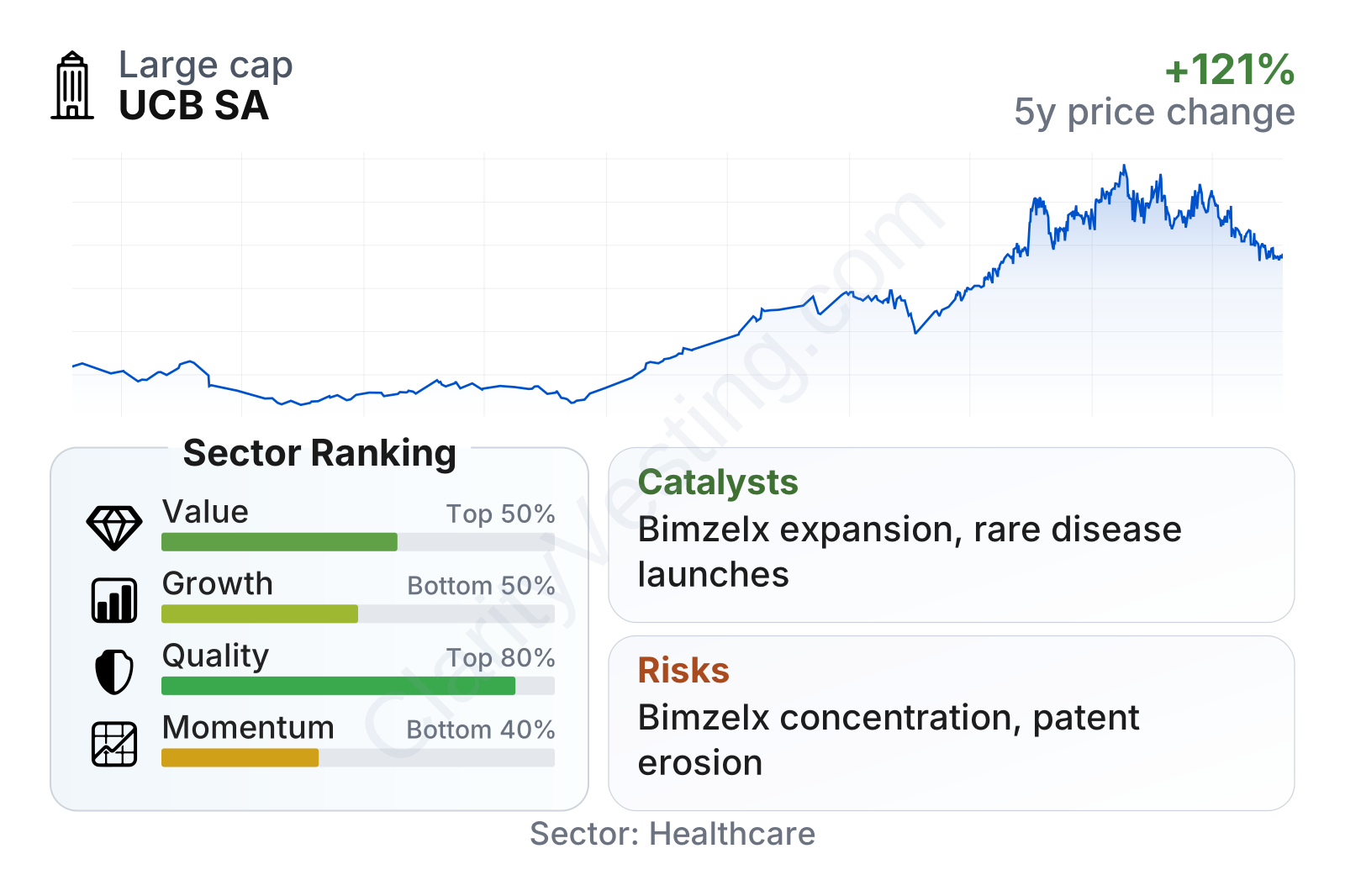
UCB stands out for profitability and balance-sheet discipline more than for pure headline growth ranking. Return on invested capital, return on assets, operating margin, and profit margin are all comfortably above typical sector levels, while leverage remains moderate with net debt around 0.5x EBITDA and interest coverage in the mid-teens. Free cash flow generation is also strong for the sector, which matters because drug development is expensive and unpredictable. The weaker point is market momentum: after a very strong multiyear share-price run, the stock has cooled in recent months and now trades below its long-term moving average. That pattern often reflects a reset in expectations rather than a deterioration in the core business.
Growth
UCB operates in attractive parts of healthcare. Autoimmune diseases, neurology, and rare diseases tend to benefit from long-term demand drivers such as aging populations, better diagnosis, greater biologic use, and the healthcare system’s willingness to pay for treatments that meaningfully improve quality of life. These are not speculative end markets; they are established medical categories with room for innovation and premium pricing when a drug shows clear clinical value.
The company’s strategy also looks coherent. UCB has been shifting from older neurology products toward newer immunology and rare disease medicines. Bimzelx is the central growth engine. Its expanding use across psoriasis and other inflammatory conditions gives UCB a large runway if uptake continues to broaden. In parallel, the rare disease portfolio adds another growth layer, especially in highly specialized conditions where competition is smaller and pricing can be more resilient.
Another supportive point is that recent growth has not come only from accounting effects or acquisitions. Revenue growth around 23% year over year is materially ahead of the sector median, and free cash flow has compounded strongly over the past five years. That combination suggests the company is converting commercial momentum into real cash generation.
Recent company updates have also reinforced the growth case. UCB has continued to highlight commercial traction for Bimzelx and progress in neurology and rare disease launches, while regulatory and label-expansion milestones have broadened the addressable patient pool. For a specialist drugmaker, those events matter because a successful expansion in approved use can unlock meaningful revenue without needing to build an entirely new product from scratch.
Risks
This article is for informational purposes only and does not constitute financial advice. Some content is AI-generated. See Disclaimer


