Stock Analysis · United Bankshares Inc (UBSI)
Overview
United Bankshares Inc. is a regional bank holding company that operates mainly through United Bank. It provides traditional banking services to consumers, businesses, and local communities across the Mid-Atlantic and Southeast. Its footprint includes markets such as West Virginia, Virginia, Maryland, North Carolina, South Carolina, Ohio, Pennsylvania, and the Washington, D.C. area. The business is straightforward: gather deposits, make loans, earn interest on those loans and securities, and add fee income from banking services.
For a bank like United Bankshares, revenue is usually best understood in two large buckets: net interest income and noninterest income. Based on recent annual results, the company’s revenue mix appears to be led by spread-based banking income, with fees providing a smaller but still useful contribution.
- Net interest income: about 80% to 85% of total revenue. This is the money earned from loans and securities after paying interest on deposits and other funding sources. It is the core engine of the bank.
- Noninterest income: about 15% to 20% of total revenue. This typically includes service charges on deposit accounts, wealth and trust fees, mortgage banking-related income, card and interchange fees, and other customer service fees.
- Within lending, commercial and commercial real estate are major categories, alongside residential real estate, construction, and consumer lending. Exact shares can shift by quarter, but business lending is generally the largest loan driver for regional banks with this profile.
Over the last several years, total revenue has moved higher, but the path has not been perfectly smooth. A notable feature has been rising interest expense as the industry adjusted to higher rates, which matters because it can limit how much of higher loan yields turns into profit. Even so, net income has remained relatively steady and improved in 2025, showing a business model that has held up reasonably well through a tougher banking cycle.
The broad picture is that revenue has expanded materially since 2021, while operating costs have been comparatively contained. The larger swing factor has been funding cost, especially the rise in interest expense during the higher-rate period.
Key Figures
| Metric | Value | Sector ⓘ |
|---|---|---|
| Date | Oct 17, 2026 | |
| Context | ||
| Sector | Financial Services | |
| Industry | Banks - Regional | |
| Market Cap ⓘ | $6.24B | |
| Beta ⓘ | 0.74 | |
Value (Cheapness) | ||
| P/E Ratio ⓘ | 12.47 | 12.26 |
| P/B Ratio ⓘ | 1.18 | 1.23 |
| FCF Yield ⓘ | 8.85% | 10.40% |
| Dividend Yield ⓘ | 3.31% | 3.02% |
| EBIT / EV ⓘ | N/A | 8.14% |
| PEG ⓘ | 1.95 | |
Growth (Business expansion) | ||
| Revenue Growth ⓘ | 6.20% | 9.35% |
| RPS Growth (5Y CAGR) ⓘ | 12.10% | 12.19% |
| EPS Growth (5Y CAGR) ⓘ | -10.68% | -9.53% |
| BVPS Growth (5Y CAGR) ⓘ | 1.71% | 4.99% |
| Margin Growth (5Y Trend) ⓘ | -15.03% | -3.86% |
| FCF Growth (5Y CAGR) ⓘ | -5.14% | 4.81% |
| DPS Growth (5Y CAGR) ⓘ | 1.45% | 8.79% |
Quality (Business durability) | ||
| ROIC (Latest) ⓘ | N/A | 9.49% |
| ROE (Latest) ⓘ | 9.40% | 13.90% |
| ROA (Latest) ⓘ | 1.53% | 1.55% |
| ROIC (5Y Median) ⓘ | 6.11% | 7.86% |
| ROE (5Y Median) ⓘ | 8.16% | 12.17% |
| ROA (5Y Median) ⓘ | 1.29% | 1.30% |
| Net Debt / EBIT (Latest) ⓘ | N/A | 0.96 |
| Net Debt / EBIT (5Y Median) ⓘ | -1.08 | 0.73 |
| Net Debt / EBITDA (Latest) ⓘ | -2.09 | 0.92 |
| Operating Margin (Latest) ⓘ | N/A | 22.30% |
| Operating Margin (5Y Median) ⓘ | 35.94% | 24.63% |
| Debt to Equity (Latest) ⓘ | 14.51% | 58.56% |
| Profit Margin (Latest) ⓘ | 41.20% | 26.57% |
| Free Cash Flow (Latest) ⓘ | $551.68M | |
Momentum (Price trend) | ||
| 3Y Return ⓘ | +92.31% | +88.33% |
| 12M Return (excl. last month) ⓘ | +33.54% | +19.38% |
| 6M Return ⓘ | +8.91% | +4.75% |
| Price vs. 200-Day MA ⓘ | +6.55% | +3.50% |
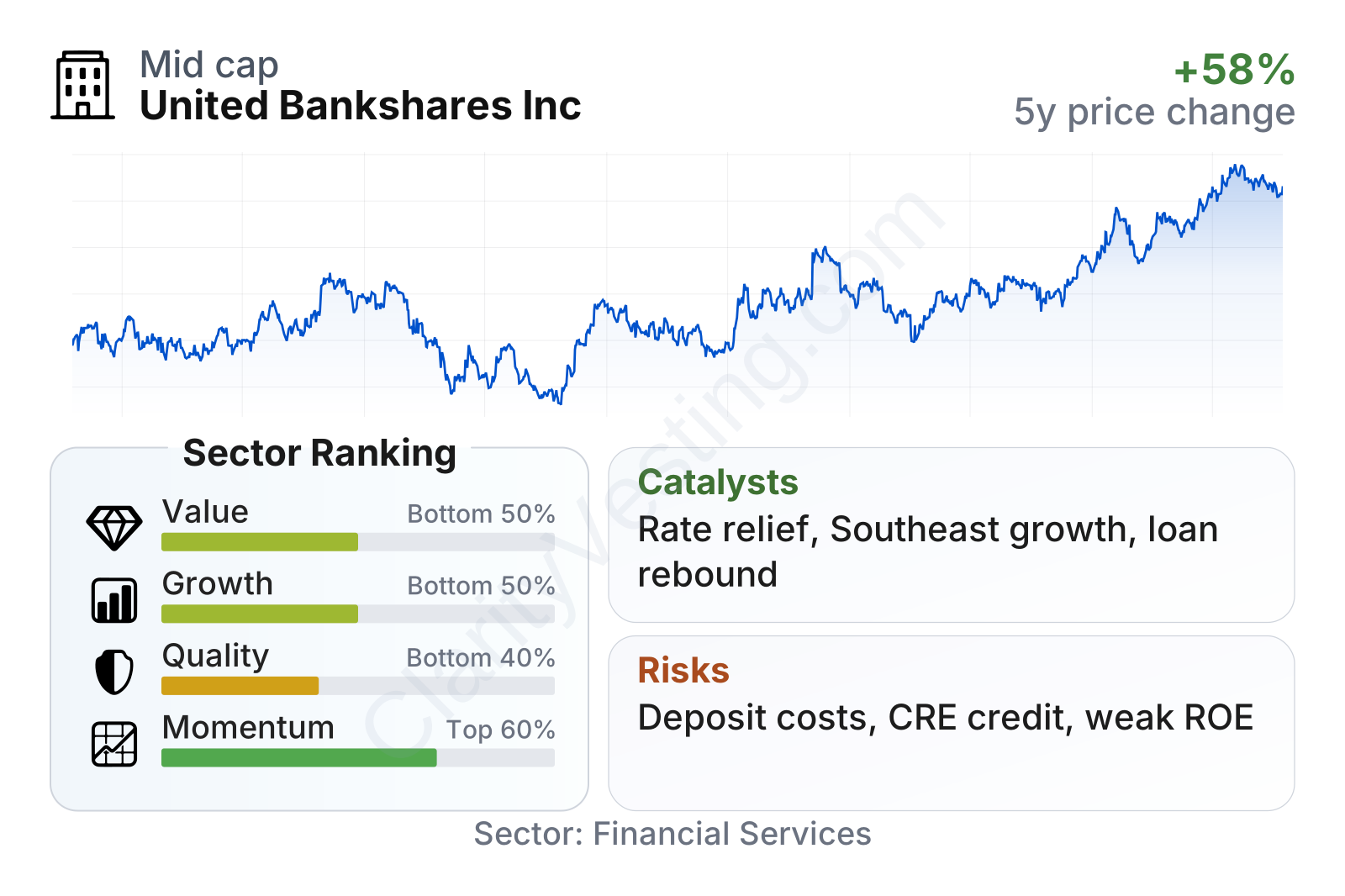
United Bankshares is a mid-sized regional bank with a market value in the several-billion-dollar range and a below-market beta, which suggests the shares have tended to move less sharply than the broader market. On valuation, the stock screens close to sector norms on earnings and slightly below sector norms on book value, while the dividend yield is modestly above the regional bank median. Quality is more mixed: profitability on assets is roughly in line with peers, but return on equity trails the sector median. Growth metrics are also uneven, with recent revenue growth positive but longer-term earnings and book value growth less impressive than many peers. Momentum has been stronger, with share price performance over the past year and half-year ahead of the sector median.
Growth
The regional banking sector is mature, so growth usually comes from disciplined loan expansion, acquisitions, stronger fee income, and a stable deposit base rather than from rapid disruption-driven expansion. That makes this a sector where execution matters more than excitement. United Bankshares has historically used acquisitions as part of its expansion strategy, and that approach fits the economics of regional banking: scale can improve efficiency, deepen local market presence, and spread compliance and technology costs over a larger base.
Its current strategy still makes practical sense. The company has a broad community banking footprint in attractive population corridors, including the Washington metropolitan area and several Southeastern markets that have generally benefited from business activity and migration trends. For a regional bank, those areas can support lending, treasury services, and deposit gathering over time. A larger branch and customer network also gives the bank more opportunities to cross-sell wealth, trust, and payment-related services.
Earnings per share show that the bank went through a softer stretch from 2021 through 2024 before a clear rebound in 2025. That pattern is consistent with what many banks experienced as deposit costs climbed faster and squeezed profitability. The more encouraging point is that earnings recovered rather than continuing to deteriorate, which suggests the company was able to adapt pricing, balance sheet mix, or expense control well enough to restore momentum.
Book value per share has also recovered after the drop seen in 2022. For banks, book value is an important anchor because it reflects the balance sheet strength behind the franchise. The trend here points to gradual rebuilding rather than fast compounding. That is respectable, but it also shows why the company is viewed more as a steady operator than a high-growth bank.
A meaningful catalyst is the interest-rate backdrop. If deposit costs stabilize or decline faster than loan yields reset lower, net interest margin can improve. Another catalyst is continued loan growth in its regional markets without a corresponding rise in credit losses. Recent operating performance also points to improving fundamentals: revenue and earnings strengthened in 2025, and profitability measures have been moving up again in 2026. In a banking business, that combination often matters more than headline expansion plans.
Risks
This article is for informational purposes only and does not constitute financial advice. Some content is AI-generated. See Disclaimer


