Stock Analysis · Ternium SA (TX)
Overview
Ternium S.A. is a steel producer focused mainly on Latin America, with industrial operations in countries such as Mexico, Argentina, Brazil, Colombia, Guatemala, and the United States. The company makes a wide range of steel products used in construction, industrial equipment, home appliances, energy, packaging, and especially the automotive sector. In simple terms, Ternium transforms iron ore, scrap, and other raw materials into steel slabs, hot-rolled and cold-rolled coils, galvanized products, pre-painted steel, tinplate, bars, and other finished products that manufacturers and builders use every day.
The business is mostly driven by steel shipments and steel prices. Based on the company’s recent annual reporting structure, revenue is generated primarily from steel product sales, with a smaller contribution from other products and services. A practical way to read Ternium’s revenue mix is the following:
- Steel products: approximately 95% to 98% of revenue. This includes flat steel products such as hot-rolled coils, cold-rolled coils, galvanized and pre-painted sheets, as well as long steel products and downstream processed steel.
- Other products and services: approximately 2% to 5% of revenue. This generally includes by-products, raw-material-related sales, freight and logistics services, and other industrial activities linked to the steel chain.
Geographically, Mexico is the most important market, supported by automotive, appliance, industrial, and commercial demand. Southern Region markets, especially Argentina, also remain significant, while exports and activity in other Latin American countries provide additional diversification. That said, Ternium is not a highly diversified conglomerate: it is still fundamentally a steel company, and that means its results are heavily influenced by the economic cycle, steel pricing, and input costs.
Over the last several years, the company has combined steelmaking with a meaningful downstream network, allowing it to supply more value-added products rather than only basic steel. This matters because coated, processed, and specialized steel products can strengthen customer relationships and support margins when market conditions are favorable.
The long-term pattern is clear: revenue held up relatively well through 2023 and 2024, but profits compressed sharply from the exceptionally strong levels reached earlier in the cycle. Costs remain the dominant use of sales, so even modest changes in steel spreads can have an outsized effect on earnings.
Key Figures
| Metric | Value | Sector ⓘ |
|---|---|---|
| Date | Oct 24, 2026 | |
| Context | ||
| Sector | Basic Materials | |
| Industry | Steel | |
| Market Cap ⓘ | $11.21B | |
| Beta ⓘ | 1.09 | |
Value (Cheapness) | ||
| P/E Ratio ⓘ | 16.18 | 16.92 |
| P/B Ratio ⓘ | 1.47 | 1.66 |
| FCF Yield ⓘ | -4.23% | 5.83% |
| Dividend Yield ⓘ | 3.69% | 2.07% |
| EBIT / EV ⓘ | 9.91% | 6.38% |
| PEG ⓘ | 0.13 | |
Growth (Business expansion) | ||
| Revenue Growth ⓘ | 10.00% | 11.25% |
| RPS Growth (5Y CAGR) ⓘ | -0.76% | 4.49% |
| EPS Growth (5Y CAGR) ⓘ | -29.64% | -15.24% |
| BVPS Growth (5Y CAGR) ⓘ | -10.81% | 5.49% |
| Margin Growth (5Y Trend) ⓘ | -31.36% | -1.54% |
| FCF Growth (5Y CAGR) ⓘ | N/A | 0.37% |
| DPS Growth (5Y CAGR) ⓘ | -1.77% | 5.91% |
Quality (Business durability) | ||
| ROIC (Latest) ⓘ | 4.65% | 9.59% |
| ROA (Latest) ⓘ | 2.91% | 4.92% |
| ROIC (5Y Median) ⓘ | 8.44% | 7.91% |
| ROA (5Y Median) ⓘ | 3.24% | 3.92% |
| Net Debt / EBIT (Latest) ⓘ | 1.35 | 1.36 |
| Net Debt / EBIT (5Y Median) ⓘ | 0.08 | 1.69 |
| Net Debt / EBITDA (Latest) ⓘ | 0.81 | 0.93 |
| Net Debt / Assets ⓘ | 6.41% | 13.69% |
| EBITDA / Interest ⓘ | 9.53 | 12.38 |
| Operating Margin (Latest) ⓘ | 7.28% | 13.24% |
| Operating Margin (5Y Median) ⓘ | 8.51% | 11.82% |
| Debt to Equity (Latest) ⓘ | 24.42% | 40.30% |
| Profit Margin (Latest) ⓘ | 4.37% | 6.38% |
| Free Cash Flow (Latest) ⓘ | -$473.66M | |
Momentum (Price trend) | ||
| 3Y Return ⓘ | +98.08% | +73.47% |
| 12M Return (excl. last month) ⓘ | +70.50% | +27.59% |
| 6M Return ⓘ | +41.81% | -4.02% |
| Price vs. 200-Day MA ⓘ | +26.45% | -0.65% |
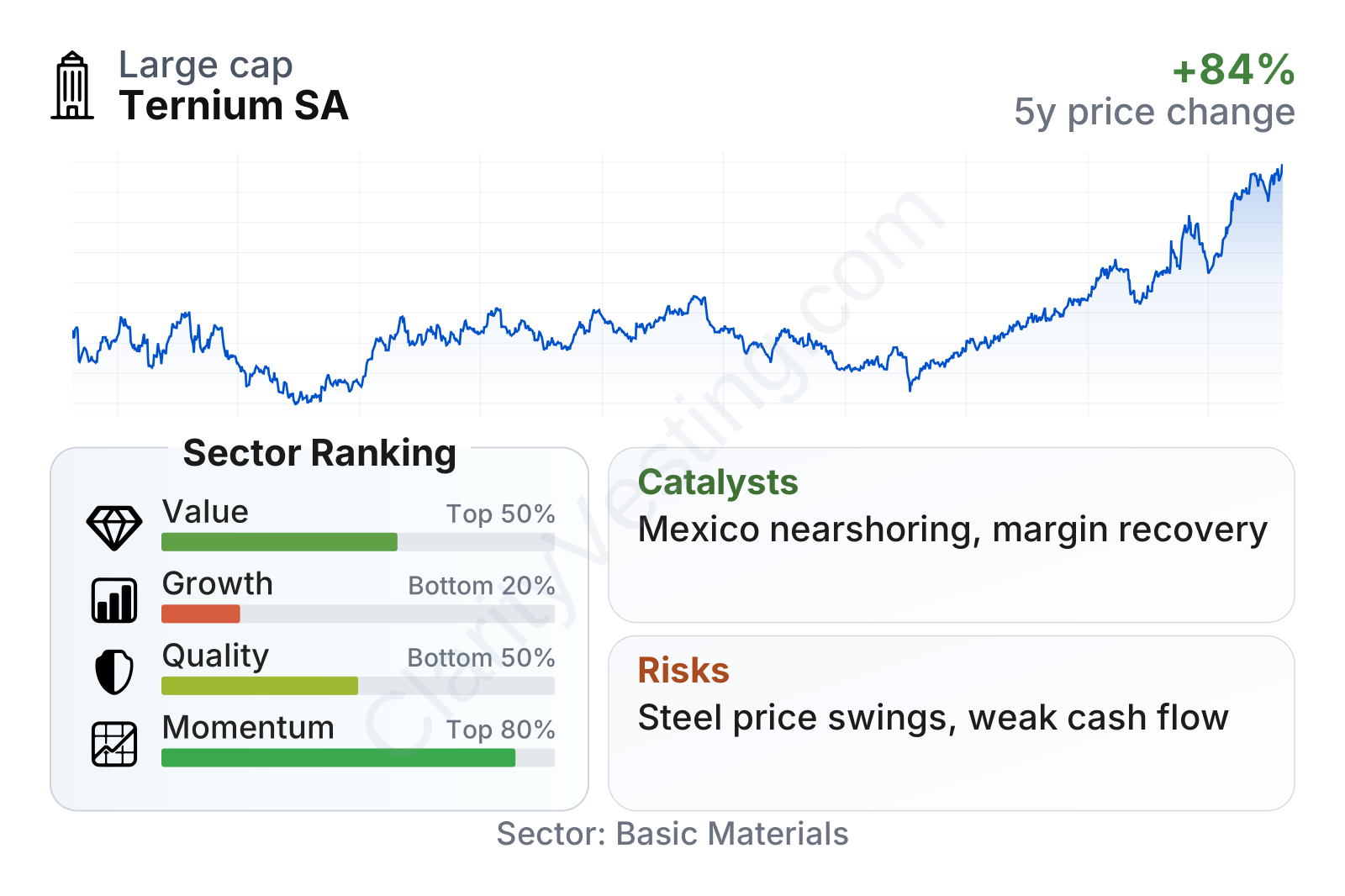
Ternium sits in the large-cap range within the steel space and shows a mixed profile. On valuation, it screens better than many sector peers, with earnings and book-based multiples below sector medians and a dividend yield above the sector norm. On the other hand, growth and profitability indicators are weaker than the median, reflecting how far earnings have come down from earlier peak conditions. Momentum has been notably stronger than the sector recently, suggesting the market has been reacting positively to improving expectations even though the operating profile is not yet back to prior highs.
Growth
Steel is not a fast-growing industry in the way software or semiconductors can be, but it remains essential to economic development. Demand is tied to construction, manufacturing, infrastructure, appliances, and vehicle production. For Ternium, the most attractive structural angle is its exposure to Mexico and the broader North American manufacturing ecosystem. Mexico continues to benefit from nearshoring, regional supply-chain relocation, and industrial investment aimed at serving the United States market. That backdrop supports demand for flat steel products used in autos, appliances, machinery, and construction.
Ternium’s strategy for growth is sensible for this kind of industry. The company has invested in higher-value steel products, downstream capabilities, and a stronger local industrial footprint near customer demand. It also has a vertical integration element through mining and raw-material sourcing, which can help reduce dependence on outside suppliers over time, although it does not eliminate commodity risk. For a steel producer, these are practical growth levers: produce closer to customers, move toward more specialized products, and protect cost competitiveness.
Recent sales growth has been uneven, which is normal in steel. The latest year-over-year trend shows stabilization after a long stretch of declines, with growth turning roughly flat and then modestly positive again by mid-2026. That does not point to a boom, but it does suggest that the downturn phase may be easing.
Free cash flow has been much weaker than earlier years and recently turned negative, which deserves attention. In heavy industry, negative free cash flow is not always a sign of distress because large capital projects and working-capital swings can temporarily absorb cash. Still, sustained negative cash generation would limit flexibility. For Ternium, future growth will look much healthier if revenue stabilization is matched by a recovery in cash conversion.
A meaningful catalyst is the company’s exposure to industrial expansion in Mexico, especially where automotive and manufacturing supply chains become more regionalized. Another potential support is any improvement in steel spreads if raw-material costs ease or if selling prices improve faster than production costs. In addition, company-led expansion projects and modernization efforts can strengthen volumes and product mix over time, particularly in higher-end flat steel.
Recent company communications have continued to emphasize capital investments and industrial development in Mexico, which is important because it aligns Ternium with one of the strongest manufacturing corridors in the region. For a long-term view, that is more relevant than short-term fluctuations in quarterly steel prices.
Risks
This article is for informational purposes only and does not constitute financial advice. Some content is AI-generated. See Disclaimer


