Stock Analysis · Taylor Wimpey plc (TWODF)
Overview
Taylor Wimpey plc is a large U.K. homebuilder focused mainly on building and selling new homes. The group develops land, secures planning permissions, builds properties, and sells them to individual buyers, affordable housing providers, and private rental operators. Its activity is concentrated in the United Kingdom, with a smaller business in Spain.
The company’s revenue comes mostly from housing completions, while land and other items play a much smaller role. Based on recent annual reporting, the mix is approximately:
- U.K. private homes: about 80% to 85% of revenue. This includes homes sold to owner-occupiers and private buyers.
- Partnerships and affordable housing in the U.K.: about 10% to 15%. This usually covers homes sold to housing associations, local authority-related channels, and other institutional counterparties.
- Spain homebuilding: about 3% to 5%. This is a smaller but established regional business.
- Land and other revenue: generally below 3%. This can include land sales and miscellaneous property-related income.
The business model is straightforward but cyclical: buy land at the right price, obtain planning, build efficiently, and protect selling prices and margins. That means long-term performance depends heavily on land discipline, local demand, mortgage availability, and construction cost control.
Over the last several years, revenue and profit have clearly moved with the housing cycle. Sales and earnings were stronger in 2021 and 2022, weakened materially in 2023 and 2024, and then revenue showed a partial rebound in 2025 even though net income remained much lower than peak levels. That pattern matters because it shows Taylor Wimpey can recover volume, but profitability is still under pressure compared with earlier years.
The multi-year picture shows a business with resilient gross profit generation but much lower earnings than at the peak of the cycle. Revenue improved again in 2025, yet the drop in net income versus 2021-2022 suggests that pricing, build-cost absorption, mix, and other charges are still limiting the recovery.
Key Figures
| Metric | Value | Sector ⓘ |
|---|---|---|
| Date | Oct 03, 2026 | |
| Context | ||
| Sector | Consumer Cyclical | |
| Industry | Residential Construction | |
| Market Cap ⓘ | $3.63B | |
| Beta ⓘ | 1.30 | |
Value (Cheapness) | ||
| P/E Ratio ⓘ | 11.67 | 17.04 |
| P/B Ratio ⓘ | 0.90 | 1.61 |
| FCF Yield ⓘ | 7.09% | 9.02% |
| Dividend Yield ⓘ | 4.04% | 2.75% |
| EBIT / EV ⓘ | N/A | 6.69% |
| PEG ⓘ | 0.60 | |
Growth (Business expansion) | ||
| Revenue Growth ⓘ | 1.70% | 5.60% |
| RPS Growth (5Y CAGR) ⓘ | -2.00% | 9.04% |
| EPS Growth (5Y CAGR) ⓘ | -1.52% | -17.44% |
| BVPS Growth (5Y CAGR) ⓘ | -0.05% | 5.73% |
| Margin Growth (5Y Trend) ⓘ | -5.77% | -0.26% |
| FCF Growth (5Y CAGR) ⓘ | -24.21% | 4.91% |
| DPS Growth (5Y CAGR) ⓘ | 3.03% | 10.48% |
Quality (Business durability) | ||
| ROIC (Latest) ⓘ | 13.29% | 12.38% |
| ROA (Latest) ⓘ | 5.48% | 5.54% |
| ROIC (5Y Median) ⓘ | 9.98% | 10.63% |
| ROA (5Y Median) ⓘ | 5.48% | 5.44% |
| Net Debt / EBIT (Latest) ⓘ | -0.17 | 2.16 |
| Net Debt / EBIT (5Y Median) ⓘ | -1.07 | 2.31 |
| Net Debt / EBITDA (Latest) ⓘ | -0.16 | 1.52 |
| Net Debt / Assets ⓘ | -2.18% | 21.74% |
| EBITDA / Interest ⓘ | 21.94 | 9.06 |
| Operating Margin (Latest) ⓘ | 10.35% | 9.12% |
| Operating Margin (5Y Median) ⓘ | 14.20% | 9.56% |
| Debt to Equity (Latest) ⓘ | 3.06% | 76.18% |
| Profit Margin (Latest) ⓘ | 6.43% | 5.30% |
| Free Cash Flow (Latest) ⓘ | $257.12M | |
Momentum (Price trend) | ||
| 3Y Return ⓘ | -5.99% | +11.77% |
| 12M Return (excl. last month) ⓘ | -9.52% | +0.61% |
| 6M Return ⓘ | -11.70% | +1.32% |
| Price vs. 200-Day MA ⓘ | -10.24% | -3.47% |
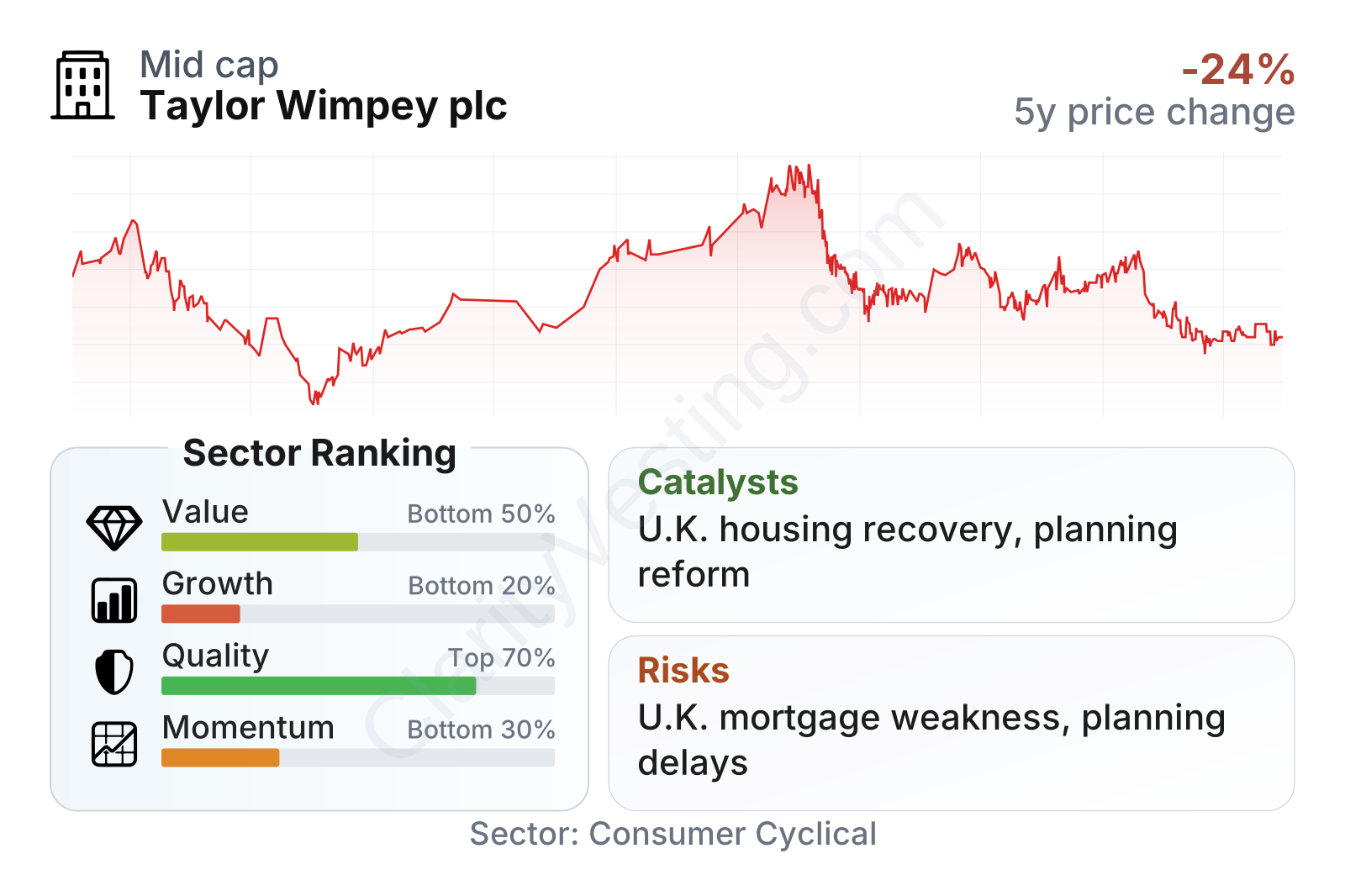
Taylor Wimpey sits in the mid-cap range and its share price behavior has been more volatile than the broader market, with a beta around 1.3. The factor summary is mixed. Valuation measures look cheaper than many peers, helped by a lower earnings multiple and a price-to-book ratio below the sector median. Income is also notable, with a trailing dividend yield above the sector median.
On quality, the balance sheet stands out. Leverage is very low, net debt metrics are better than most peers, and interest coverage is strong. Profitability is still respectable for a homebuilder, with operating and net margins slightly above sector medians even after a tougher market period.
The weaker area is growth. Revenue growth has been modest recently, and the longer-term record for revenue per share, free cash flow, and book value per share has lagged the sector. Share-price momentum has also been soft, which fits the market’s caution toward U.K. housing names.
Growth
Residential construction is a cyclical industry, but the long-term demand backdrop in the U.K. remains supported by structural housing undersupply, population needs, and an aging housing stock. In plain terms, the country still needs more homes than it is consistently building. That does not guarantee smooth annual growth, but it does provide a durable foundation for the sector over time.
Taylor Wimpey’s strategy remains logical for that environment. The company focuses on disciplined land buying, outlet management, cash preservation, and building a pipeline that can support future volumes when affordability improves. This approach is less aggressive than chasing short-term expansion, but it can protect returns across a full cycle.
A major catalyst is the direction of mortgage affordability. When borrowing costs stabilize or decline, monthly payments become easier for buyers to handle, and reservation rates across the sector can improve quickly. A second catalyst is planning reform and any government measures that increase housing delivery in the U.K. Large listed builders such as Taylor Wimpey are among the clearest beneficiaries when approvals and site progress become less constrained.
Another positive feature is the company’s landbank and scale. Large builders with established regional operations are usually better positioned than smaller rivals to restart growth when the market turns, because they already control sites, supplier relationships, and distribution networks.
Recent growth, however, should be viewed as recovery rather than acceleration. The latest year showed only low-single-digit year-over-year revenue growth, which is below the sector median. So the central growth case depends less on company-specific disruption and more on a normalization in U.K. housing conditions, supported by Taylor Wimpey’s ability to convert its landbank into completions at acceptable margins.
Recent company updates have also emphasized build quality, customer service, and selective investment rather than rapid expansion. That may not produce fast headline growth, but it does fit the realities of a market where affordability and planning remain the key bottlenecks.
Risks
This article is for informational purposes only and does not constitute financial advice. Some content is AI-generated. See Disclaimer


