Stock Analysis · Techtronic Industries Ltd (TTNDY)
Overview
Techtronic Industries Ltd, usually known as TTI, is a global maker of power tools, outdoor power equipment, hand tools, floorcare products, and related accessories. Its best-known brands include Milwaukee, Ryobi, AEG, Empire, Homelite, and Hoover. The company sells both to professional users and to consumers, with a particularly strong presence in cordless tools and battery-powered equipment.
TTI’s business is organized mainly into two reporting segments. The largest by far is power equipment, which includes power tools, outdoor products, hand tools, accessories, and floorcare products. The second is a much smaller appliances segment. Based on the company’s latest annual reporting, revenue sources are approximately:
- Power Equipment: about 98% of revenue. This includes Milwaukee professional tools, Ryobi consumer and DIY tools, outdoor power equipment, accessories, storage, hand tools, and selected floorcare products.
- Appliances: about 2% of revenue. This is a small residual business compared with the core tools platform.
Within power equipment, the business mix is also shaped by brand and end market. Milwaukee is the premium professional brand and has been a major engine of growth, while Ryobi is aimed more at home users and benefits from broad retail distribution. This dual positioning helps TTI reach both contractors and consumers, while building ecosystems around rechargeable battery platforms that encourage repeat purchases of compatible tools and accessories.
The company’s economics reflect that model well. Revenue has trended upward over the last several years, gross profit has expanded, and research and development spending has steadily increased, showing that TTI continues to reinvest in product launches and battery systems rather than simply harvesting existing brands.
The long-term pattern is constructive: sales rose from roughly $13.2 billion in 2021 to more than $15.2 billion in 2025, while gross profit and net income also moved higher over that span. Operating expenses increased as TTI kept funding innovation and brand support, but profitability remained solid.
Key Figures
| Metric | Value | Sector ⓘ |
|---|---|---|
| Date | Oct 03, 2026 | |
| Context | ||
| Sector | Industrials | |
| Industry | Tools & Accessories | |
| Market Cap ⓘ | $29.57B | |
| Beta ⓘ | 1.73 | |
Value (Cheapness) | ||
| P/E Ratio ⓘ | 22.50 | 22.45 |
| P/B Ratio ⓘ | 4.03 | 1.98 |
| FCF Yield ⓘ | 12.25% | 6.31% |
| Dividend Yield ⓘ | 2.23% | 1.96% |
| EBIT / EV ⓘ | 8.13% | 4.81% |
| PEG ⓘ | 1.35 | |
Growth (Business expansion) | ||
| Revenue Growth ⓘ | 5.90% | 9.10% |
| RPS Growth (5Y CAGR) ⓘ | 3.79% | 7.75% |
| EPS Growth (5Y CAGR) ⓘ | -35.01% | -13.59% |
| BVPS Growth (5Y CAGR) ⓘ | 10.30% | 6.22% |
| Margin Growth (5Y Trend) ⓘ | -0.59% | 0.72% |
| FCF Growth (5Y CAGR) ⓘ | N/A | 10.98% |
| DPS Growth (5Y CAGR) ⓘ | 9.91% | 9.48% |
Quality (Business durability) | ||
| ROIC (Latest) ⓘ | 27.90% | 10.92% |
| ROA (Latest) ⓘ | 16.44% | 5.41% |
| ROIC (5Y Median) ⓘ | 15.66% | 9.21% |
| ROA (5Y Median) ⓘ | 8.87% | 4.94% |
| Net Debt / EBIT (Latest) ⓘ | -0.13 | 2.07 |
| Net Debt / EBIT (5Y Median) ⓘ | 1.60 | 2.28 |
| Net Debt / EBITDA (Latest) ⓘ | -0.10 | 1.43 |
| Net Debt / Assets ⓘ | -2.29% | 19.27% |
| EBITDA / Interest ⓘ | 17.03 | 9.53 |
| Operating Margin (Latest) ⓘ | 8.99% | 10.50% |
| Operating Margin (5Y Median) ⓘ | 9.14% | 10.27% |
| Debt to Equity (Latest) ⓘ | 21.13% | 65.48% |
| Profit Margin (Latest) ⓘ | 8.32% | 6.62% |
| Free Cash Flow (Latest) ⓘ | $3.62B | |
Momentum (Price trend) | ||
| 3Y Return ⓘ | +81.75% | +58.56% |
| 12M Return (excl. last month) ⓘ | +35.26% | +15.63% |
| 6M Return ⓘ | +25.91% | +4.19% |
| Price vs. 200-Day MA ⓘ | +10.12% | +0.93% |
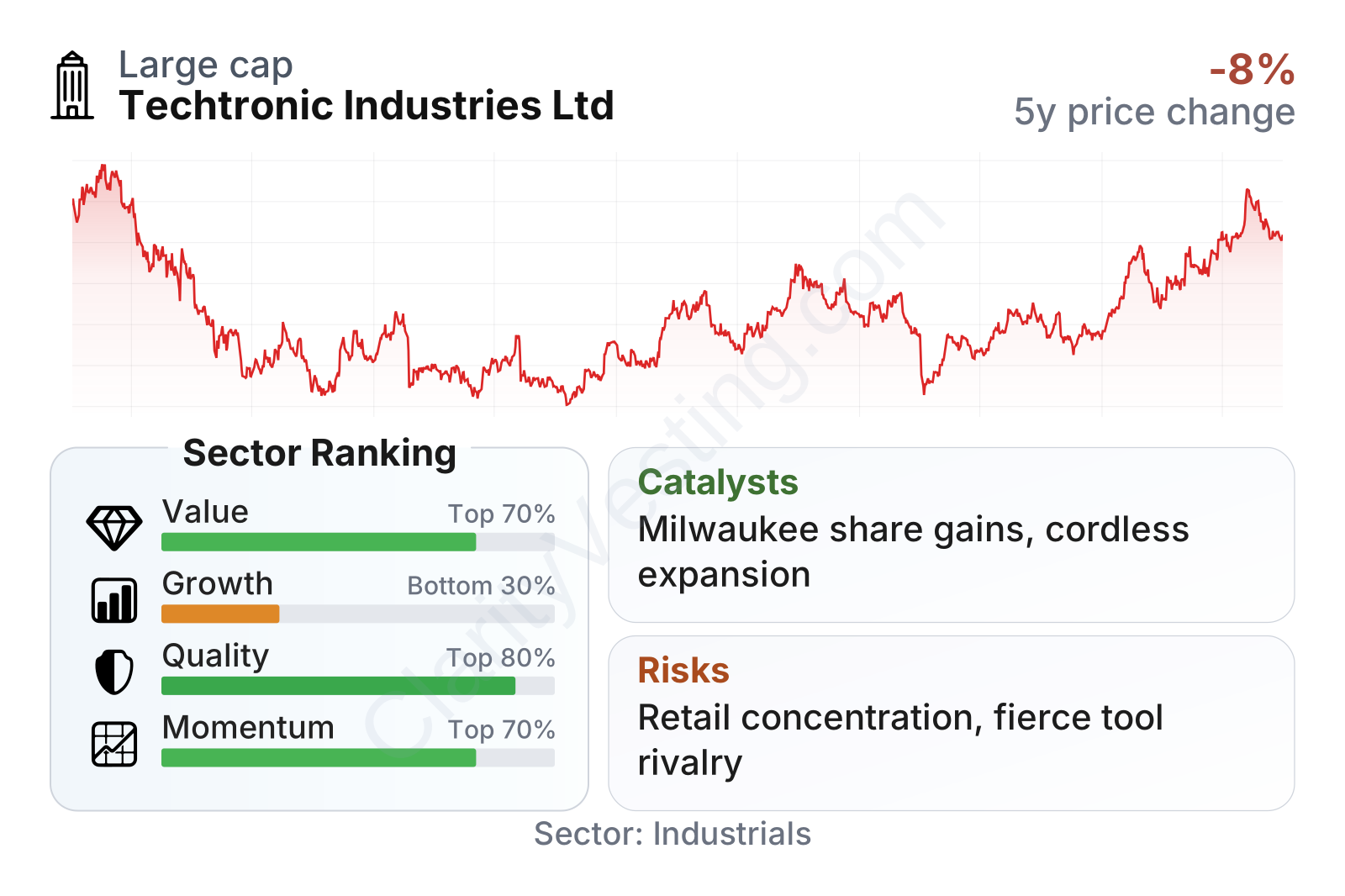
TTI is a large industrial company with a market value around $30 billion, so it is not a small niche name. The table points to a mixed but generally strong profile. Quality stands out: returns on capital and assets are well above sector medians, leverage is low, and free cash flow generation is healthy. Value metrics are more balanced. The earnings multiple is close to the sector median, but the price-to-book ratio is clearly richer, suggesting the market assigns a premium to the business model and brand strength. Growth metrics are the weakest area relative to peers, reflecting a slower recent expansion rate and less impressive earnings progression over the past five years. Price momentum has been favorable, with the shares outperforming much of the sector over medium-term periods.
The stock chart also highlights that TTI has been volatile. After a steep decline in 2022, the shares recovered strongly and have climbed meaningfully into 2026. That rebound indicates improving sentiment, but it also means the market has already recognized part of the company’s operational recovery.
Growth
TTI operates in an attractive part of the industrial market: electrification of tools and outdoor equipment. The shift from gas-powered or corded products toward cordless systems remains a long-duration industry trend. That matters because battery platforms create repeat demand. Once a customer adopts one system, future purchases often stay within the same brand family for convenience, charger compatibility, and performance consistency.
TTI’s strategy fits that trend well. It invests heavily in research and development, expands product categories around battery ecosystems, and uses strong retail and professional distribution to widen adoption. Milwaukee is especially important because professional users tend to be frequent buyers and are often less price-sensitive than casual consumers. Ryobi supports scale on the consumer side, particularly in home improvement channels, which can help the group spread development and sourcing costs across a broad installed base.
Recent revenue growth has not been smooth, and the year-over-year pattern shows noticeable swings rather than a straight line upward. Even so, the broader direction of the business remains expansionary, with 2024 and 2025 annual revenue above prior years. That suggests TTI is still growing, but in a cyclical and product-driven way rather than at a consistently high pace every period.
A meaningful catalyst is continued share gains in professional cordless tools and jobsite solutions, where Milwaukee has built a strong reputation. Another is the broader replacement cycle in outdoor equipment as battery-powered products improve in runtime and power. Product adjacency also matters: storage, accessories, hand tools, and safety gear can deepen customer relationships and lift revenue per user without requiring entry into completely new markets.
Recent company communications have also emphasized product innovation and geographic expansion in categories tied to professional users. That is significant because professionals often create recurring demand, and TTI’s brand positioning is strongest where performance and system compatibility matter most.
Risks
This article is for informational purposes only and does not constitute financial advice. Some content is AI-generated. See Disclaimer