Stock Analysis · Techtronic Industries Company Limited (TTNDF)
Overview
Techtronic Industries Company Limited, often called TTI, is a global manufacturer of power tools, outdoor power equipment, hand tools, floorcare products, and related accessories. Its best-known brands include Milwaukee, Ryobi, AEG, Empire, Homelite, Hoover, Oreck, Vax, and Dirt Devil. The company sells to both professional users and consumers, with a strong presence in North America and a broad retail and distribution network.
Its business is built around cordless tools and equipment, where battery platforms encourage repeat purchases of compatible tools, chargers, and accessories. That creates a mix of one-time hardware sales and recurring accessory and replacement demand. TTI has also invested heavily in product development, especially in professional-grade cordless tools and outdoor equipment.
Based on recent annual reporting, revenue is mainly split across two operating segments:
- Power Equipment: approximately 94% of revenue. This includes power tools, outdoor products, hand tools, accessories, and storage solutions sold under brands such as Milwaukee, Ryobi, and AEG.
- Floorcare & Cleaning: approximately 6% of revenue. This includes vacuum cleaners and cleaning products sold under brands such as Hoover, Oreck, Vax, and Dirt Devil.
Within that structure, Milwaukee is widely viewed as the main growth engine, especially in professional construction, industrial, and infrastructure applications, while Ryobi is a major consumer-facing brand, particularly in home improvement channels.
The long-term pattern in the business model is favorable: revenue has continued to rise, gross profit has expanded faster than cost of revenue, and research and development spending has steadily increased. That suggests TTI is not simply protecting its position; it is reinvesting to broaden product lines and defend brand strength.
Key Figures
| Metric | Value | Sector ⓘ |
|---|---|---|
| Date | Oct 03, 2026 | |
| Context | ||
| Sector | Industrials | |
| Industry | Tools & Accessories | |
| Market Cap ⓘ | $29.44B | |
| Beta ⓘ | 1.73 | |
Value (Cheapness) | ||
| P/E Ratio ⓘ | 22.71 | 22.45 |
| P/B Ratio ⓘ | 3.88 | 1.98 |
| FCF Yield ⓘ | 13.49% | 6.31% |
| Dividend Yield ⓘ | 2.21% | 1.96% |
| EBIT / EV ⓘ | 9.48% | 4.81% |
| PEG ⓘ | N/A | |
Growth (Business expansion) | ||
| Revenue Growth ⓘ | 5.90% | 9.10% |
| RPS Growth (5Y CAGR) ⓘ | 3.84% | 7.75% |
| EPS Growth (5Y CAGR) ⓘ | -17.82% | -13.59% |
| BVPS Growth (5Y CAGR) ⓘ | 10.29% | 6.22% |
| Margin Growth (5Y Trend) ⓘ | 0.33% | 0.72% |
| FCF Growth (5Y CAGR) ⓘ | N/A | 10.98% |
| DPS Growth (5Y CAGR) ⓘ | 9.95% | 9.48% |
Quality (Business durability) | ||
| ROIC (Latest) ⓘ | 32.54% | 10.92% |
| ROA (Latest) ⓘ | 18.80% | 5.41% |
| ROIC (5Y Median) ⓘ | 16.15% | 9.21% |
| ROA (5Y Median) ⓘ | 8.87% | 4.94% |
| Net Debt / EBIT (Latest) ⓘ | -0.11 | 2.07 |
| Net Debt / EBIT (5Y Median) ⓘ | 1.60 | 2.28 |
| Net Debt / EBITDA (Latest) ⓘ | -0.08 | 1.43 |
| Net Debt / Assets ⓘ | -2.29% | 19.27% |
| EBITDA / Interest ⓘ | 21.32 | 9.53 |
| Operating Margin (Latest) ⓘ | 9.15% | 10.50% |
| Operating Margin (5Y Median) ⓘ | 9.24% | 10.27% |
| Debt to Equity (Latest) ⓘ | 21.13% | 65.48% |
| Profit Margin (Latest) ⓘ | 8.32% | 6.62% |
| Free Cash Flow (Latest) ⓘ | $3.97B | |
Momentum (Price trend) | ||
| 3Y Return ⓘ | +69.40% | +58.56% |
| 12M Return (excl. last month) ⓘ | +45.23% | +15.63% |
| 6M Return ⓘ | +17.11% | +4.19% |
| Price vs. 200-Day MA ⓘ | +18.39% | +0.93% |
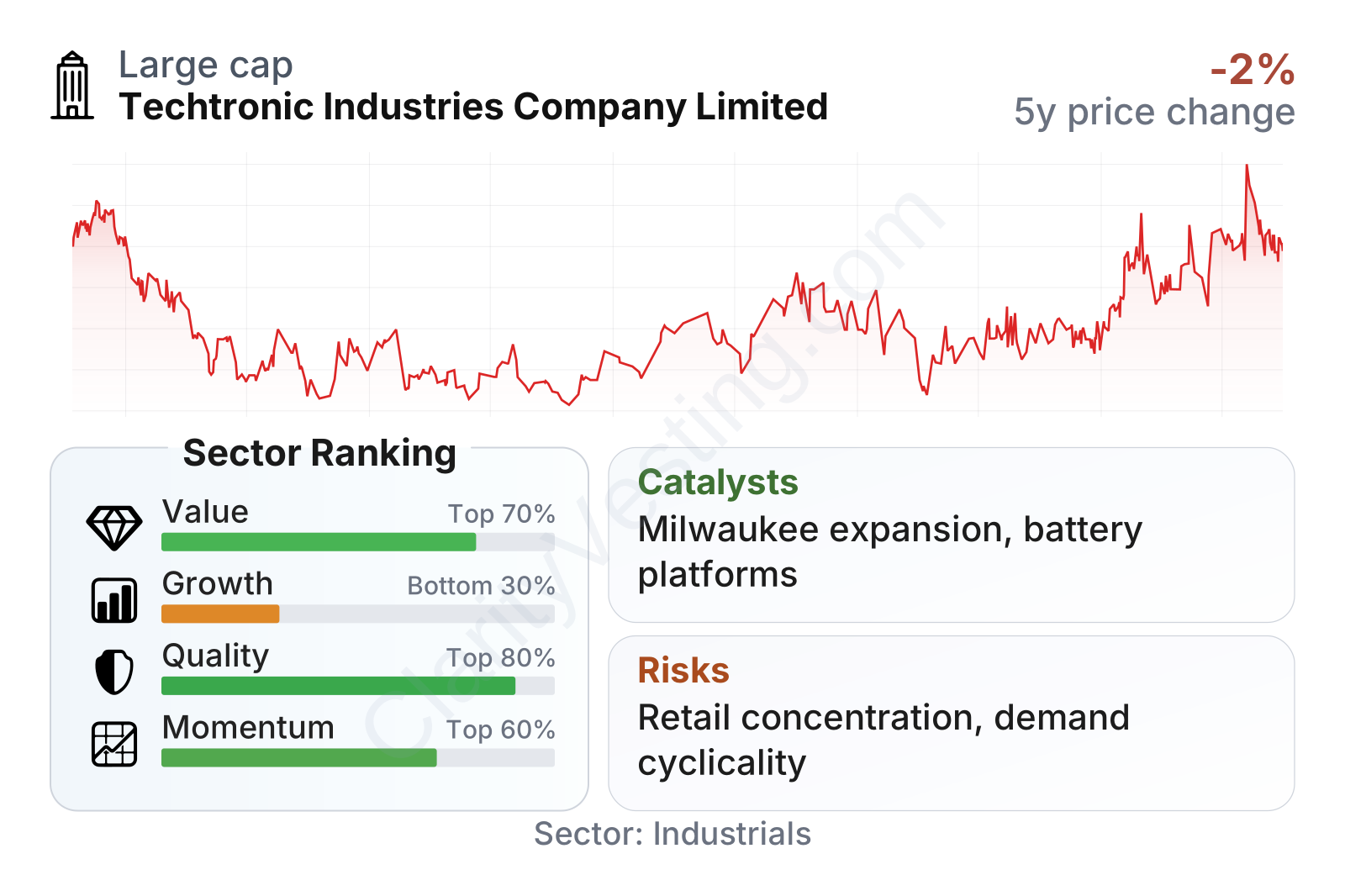
TTI is a large industrial company with a stock that has been more volatile than the broader market, as shown by its elevated beta. The operating profile stands out more positively than the growth profile. Profitability and capital efficiency are strong versus much of the sector, with returns on capital and assets comfortably above median levels, while leverage remains conservative. By contrast, recent and multi-year growth measures look less impressive relative to peers, which means the investment case depends more on business quality and execution than on rapid top-line acceleration alone.
Cash generation also looks solid. Free cash flow yield and EBIT relative to enterprise value compare well with the sector, while dividend yield is modestly above the industry median. The share price has recovered strongly from its 2022 trough and recent momentum has been better than the broader tools and industrial peer group, showing that the market has been rewarding the company’s improving operating trend.
Growth
TTI operates in parts of the market that still have structural growth drivers. Cordless power tools continue taking share from corded alternatives, battery-powered outdoor equipment is benefiting from a shift away from gas-powered products, and professional trades remain increasingly focused on productivity, safety, and platform compatibility. These are attractive themes because they support repeat purchases: once a user adopts a battery ecosystem, additional tools often stay within that same platform.
The company’s strategy is coherent for that backdrop. It continues to push new product launches, deepen brand loyalty through battery systems, and expand in professional channels where switching costs can be meaningful. Milwaukee is especially important here because professional users tend to value reliability, tool breadth, and performance more than just headline price. Ryobi plays a different but complementary role by targeting DIY and prosumer customers through large retail chains.
Recent growth has been positive, but not especially fast compared with the sector median. That does not necessarily weaken the long-term case, because TTI’s appeal has historically come from pairing steady expansion with strong returns and disciplined balance sheet management. The more encouraging point is that revenue, gross profit, and net income all moved higher again in the latest annual trend, showing that the business regained traction after a softer period.
A notable catalyst is ongoing electrification in outdoor power equipment, where regulation, noise restrictions, and ease of use are pushing battery-powered products into more residential and commercial applications. Another is infrastructure and commercial construction activity, which can support professional tool demand. TTI’s rising research and development spending also matters: it increases the chance of winning share through innovation rather than relying only on end-market growth.
Recent company communications have also highlighted continued product pipeline expansion and operational focus on core brands. For a business like TTI, that is significant because broadening tool categories inside existing battery platforms can raise revenue per customer without needing a proportional increase in customer acquisition costs.
Risks
This article is for informational purposes only and does not constitute financial advice. Some content is AI-generated. See Disclaimer