Stock Analysis · Toro Co (TTC)
Overview
The Toro Company is an equipment manufacturer focused on outdoor environments. Its products are used to mow grass, maintain golf courses and sports fields, manage snow and ice, support landscaping work, and improve irrigation efficiency. The company sells to professional users such as contractors, golf courses, municipalities, and rental fleets, while also serving homeowners through residential yard-care products.
Toro’s business is organized mainly into two operating segments. Based on the latest annual structure and recent company reporting, revenue is concentrated as follows:
- Professional segment: about 75% to 80% of revenue. This includes professional landscape equipment, golf and grounds equipment, irrigation systems, construction and specialty equipment, underground utility products, and parts related to those categories. This is the company’s largest earnings driver.
- Residential segment: about 20% to 25% of revenue. This includes walk power mowers, zero-turn mowers, snow blowers, yard tools, and related parts and accessories sold to homeowners.
Within those segments, the company also benefits from recurring replacement parts, service-related demand, and equipment refresh cycles, especially in the professional market where uptime matters. That gives Toro a revenue mix that is not purely dependent on one-time equipment sales.
The broader financial picture shows a business that has kept annual revenue around the mid-$4 billion range in recent years, even while profitability has moved up and down with demand conditions, product mix, and costs. Gross profit has held relatively steady, but operating income and net income have been more cyclical, which suggests Toro has pricing power and brand strength, yet still feels pressure when volumes or expenses shift.
Over the last several years, revenue has remained fairly stable after a strong expansion period, while earnings have been more volatile. That combination points to a business with resilient end markets but some sensitivity to operating costs and demand timing.
Key Figures
| Metric | Value | Sector ⓘ |
|---|---|---|
| Date | Oct 24, 2026 | |
| Context | ||
| Sector | Industrials | |
| Industry | Tools & Accessories | |
| Market Cap ⓘ | $9.72B | |
| Beta ⓘ | 0.67 | |
Value (Cheapness) | ||
| P/E Ratio ⓘ | 27.45 | 22.29 |
| P/B Ratio ⓘ | 7.39 | 1.98 |
| FCF Yield ⓘ | 7.32% | 6.26% |
| Dividend Yield ⓘ | 1.54% | 1.92% |
| EBIT / EV ⓘ | 5.16% | 4.83% |
| PEG ⓘ | 1.46 | |
Growth (Business expansion) | ||
| Revenue Growth ⓘ | 8.40% | 9.30% |
| RPS Growth (5Y CAGR) ⓘ | 5.48% | 7.76% |
| EPS Growth (5Y CAGR) ⓘ | -3.60% | -13.17% |
| BVPS Growth (5Y CAGR) ⓘ | 8.23% | 6.13% |
| Margin Growth (5Y Trend) ⓘ | -4.26% | 0.74% |
| FCF Growth (5Y CAGR) ⓘ | 6.39% | 10.79% |
| DPS Growth (5Y CAGR) ⓘ | 9.93% | 9.41% |
Quality (Business durability) | ||
| ROIC (Latest) ⓘ | 17.07% | 10.75% |
| ROA (Latest) ⓘ | 10.42% | 5.41% |
| ROIC (5Y Median) ⓘ | 18.72% | 9.37% |
| ROA (5Y Median) ⓘ | 11.59% | 4.95% |
| Net Debt / EBIT (Latest) ⓘ | 1.74 | 2.04 |
| Net Debt / EBIT (5Y Median) ⓘ | 1.50 | 2.27 |
| Net Debt / EBITDA (Latest) ⓘ | 1.36 | 1.39 |
| Net Debt / Assets ⓘ | 25.53% | 19.27% |
| EBITDA / Interest ⓘ | 11.85 | 9.58 |
| Operating Margin (Latest) ⓘ | 10.90% | 10.49% |
| Operating Margin (5Y Median) ⓘ | 12.54% | 10.30% |
| Debt to Equity (Latest) ⓘ | 80.67% | 64.82% |
| Profit Margin (Latest) ⓘ | 7.64% | 6.67% |
| Free Cash Flow (Latest) ⓘ | $711.50M | |
Momentum (Price trend) | ||
| 3Y Return ⓘ | +32.61% | +67.77% |
| 12M Return (excl. last month) ⓘ | +21.61% | +12.05% |
| 6M Return ⓘ | +10.27% | 0.00% |
| Price vs. 200-Day MA ⓘ | +9.82% | +0.67% |
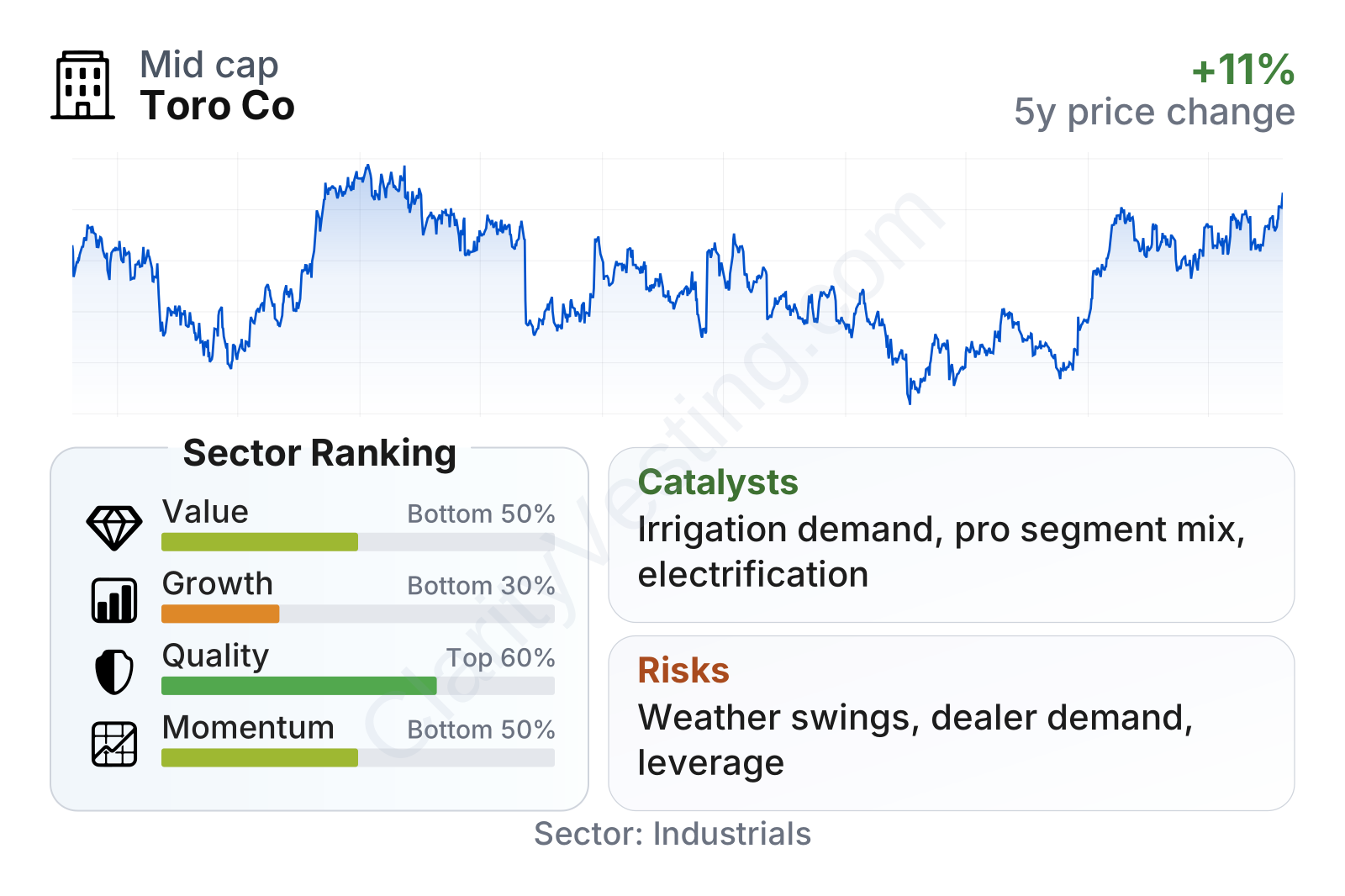
Toro is a large mid-cap industrial company with a market value near $9 billion and a below-market beta, which suggests the shares have historically moved less sharply than the broader market. On quality, the company stands out: returns on invested capital and assets are well above sector medians, and cash generation is solid. Growth is less impressive relative to the sector, with revenue and free-cash-flow expansion trailing many industrial peers over a multi-year period. Valuation looks mixed: the earnings multiple is only modestly above the sector median, but the price-to-book ratio is much higher, reflecting the market’s willingness to pay up for a business with established brands and durable profitability.
Growth
Toro operates in parts of the market that have long-term support rather than rapid disruption. Professional landscaping, golf course maintenance, municipal grounds care, irrigation, and snow management are all tied to ongoing property upkeep. These are not explosive categories, but they are durable ones. Water management is particularly relevant because irrigation efficiency has become more important in drought-prone regions and for commercial users trying to reduce operating costs.
The company’s strategy also makes practical sense for future growth. Toro has built a portfolio across professional turf care, underground construction, and irrigation, which gives it multiple ways to grow without depending only on consumer lawn equipment. Professional customers usually value reliability, dealer support, and replacement parts availability, which can strengthen repeat business. This is an area where established manufacturers tend to have an advantage over newer entrants.
Recent revenue trends show a business that went through a strong post-pandemic expansion, then a slower period, and is now returning to modest positive growth. The latest year-over-year pace is in the high-single-digit range, which is a clear improvement from the contraction seen earlier, even if it still does not place Toro among the faster-growing industrial names.
Cash generation has improved sharply from the low point seen a couple of years ago. Free cash flow has rebounded to a much stronger level, which matters because it gives the company flexibility to fund product development, acquisitions, debt management, and dividends without relying heavily on outside financing.
One meaningful catalyst is the continuing shift toward more automated and electrified outdoor equipment. Toro has been expanding battery-powered offerings and smart connected solutions in professional applications. Another catalyst is infrastructure and underground utility work through its specialty equipment businesses, which can benefit from investment in telecom, water, and utility installation. A further opening comes from irrigation modernization, where customers are looking for efficiency gains rather than discretionary upgrades alone.
Recent company updates have also highlighted ongoing product launches and portfolio investments aimed at the professional market, which remains the most attractive part of the business because it tends to have better margins and more recurring parts demand than the residential side.
Risks
This article is for informational purposes only and does not constitute financial advice. Some content is AI-generated. See Disclaimer


