Stock Analysis · Titan America SA (TTAM)
Overview
Titan America SA is a building materials company focused mainly on cement, aggregates, ready-mix concrete, and related products used in residential, commercial, industrial, and infrastructure construction. It operates primarily in the United States, with a footprint centered on fast-growing and high-construction-demand regions such as Florida and the Mid-Atlantic. In simple terms, the company sells core materials that go into roads, bridges, homes, warehouses, and other large construction projects.
The business model is fairly straightforward: Titan America produces basic construction inputs and supplies them to customers that need reliable local delivery. That matters because heavy building materials are expensive to transport over long distances, which gives regional producers with quarries, plants, terminals, and distribution networks an important operating advantage.
Based on the company’s filings and segment descriptions, revenue is mainly generated from the following activities:
- Cement and clinker: approximately 35% to 45% of revenue. This includes bulk and bagged cement used as the key binding ingredient in concrete.
- Ready-mix concrete: approximately 25% to 35% of revenue. This is concrete produced to customer specifications and delivered directly to construction sites.
- Aggregates: approximately 10% to 20% of revenue. These are crushed stone, sand, and gravel used in concrete, asphalt, and general construction.
- Fly ash, blocks, and other building materials and services: approximately 10% to 20% of revenue. This category may include concrete blocks, supplementary cementitious materials, and logistics or related solutions depending on the market served.
Titan America’s revenue mix is attractive for a materials producer because it spans both upstream products such as cement and downstream products such as ready-mix concrete. That vertical integration can help support margins, improve plant utilization, and deepen relationships with contractors and infrastructure customers.
The long-term operating picture has improved meaningfully. Revenue has risen steadily since 2021, while operating income and net income have grown faster than sales. That usually points to a favorable mix of pricing, efficiency, and plant utilization rather than growth coming only from higher volumes.
Key Figures
| Metric | Value | Sector ⓘ |
|---|---|---|
| Date | Oct 17, 2026 | |
| Context | ||
| Sector | Basic Materials | |
| Industry | Building Materials | |
| Market Cap ⓘ | $2.42B | |
| Beta ⓘ | N/A | |
Value (Cheapness) | ||
| P/E Ratio ⓘ | 13.79 | 16.90 |
| P/B Ratio ⓘ | 2.22 | 1.65 |
| FCF Yield ⓘ | 6.26% | 5.76% |
| Dividend Yield ⓘ | N/A | 2.13% |
| EBIT / EV ⓘ | 8.70% | 6.30% |
| PEG ⓘ | N/A | |
Growth (Business expansion) | ||
| Revenue Growth ⓘ | 9.60% | 11.10% |
| RPS Growth (5Y CAGR) ⓘ | 9.76% | 4.49% |
| EPS Growth (5Y CAGR) ⓘ | 50.73% | -13.47% |
| BVPS Growth (5Y CAGR) ⓘ | 20.57% | 5.51% |
| Margin Growth (5Y Trend) ⓘ | 7.77% | -1.54% |
| FCF Growth (5Y CAGR) ⓘ | 14.87% | 0.37% |
| DPS Growth (5Y CAGR) ⓘ | N/A | 6.08% |
Quality (Business durability) | ||
| ROIC (Latest) ⓘ | 28.45% | 9.26% |
| ROA (Latest) ⓘ | 8.83% | 4.91% |
| ROIC (5Y Median) ⓘ | N/A | 7.70% |
| ROA (5Y Median) ⓘ | 10.72% | 3.86% |
| Net Debt / EBIT (Latest) ⓘ | 2.06 | 1.40 |
| Net Debt / EBIT (5Y Median) ⓘ | 1.77 | 1.70 |
| Net Debt / EBITDA (Latest) ⓘ | 1.42 | 0.95 |
| Net Debt / Assets ⓘ | 24.84% | 13.69% |
| EBITDA / Interest ⓘ | 20.25 | 12.34 |
| Operating Margin (Latest) ⓘ | 15.24% | 13.20% |
| Operating Margin (5Y Median) ⓘ | 14.02% | 11.80% |
| Debt to Equity (Latest) ⓘ | 52.74% | 40.56% |
| Profit Margin (Latest) ⓘ | 10.35% | 6.43% |
| Free Cash Flow (Latest) ⓘ | $151.18M | |
Momentum (Price trend) | ||
| 3Y Return ⓘ | N/A | +68.89% |
| 12M Return (excl. last month) ⓘ | -8.59% | +30.21% |
| 6M Return ⓘ | -19.89% | -4.16% |
| Price vs. 200-Day MA ⓘ | -19.04% | -1.27% |
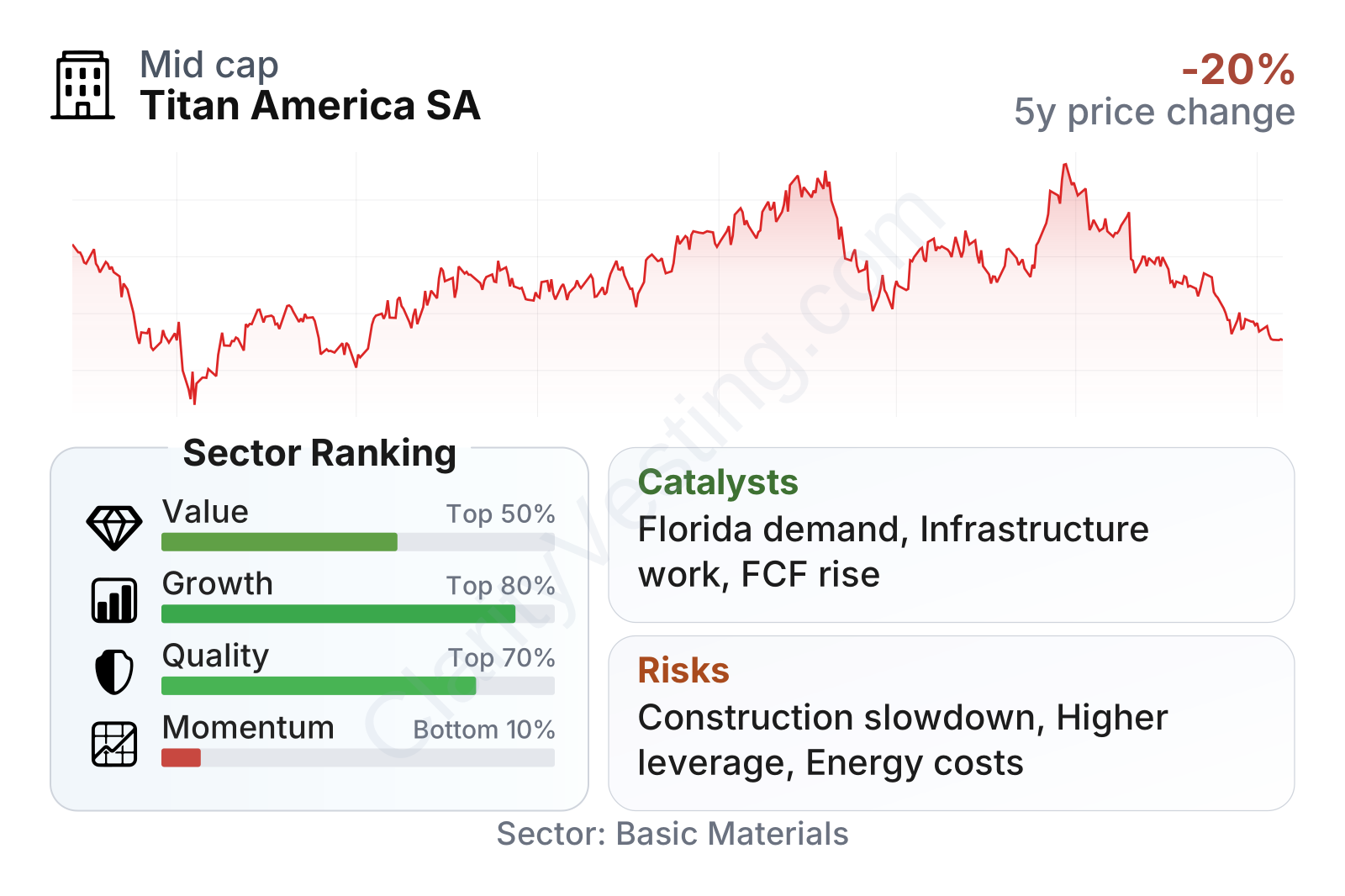
Titan America sits in a solid middle-to-upper range on valuation and quality, while its growth profile stands out more clearly. Profitability measures are better than many peers, with returns on capital and margins comfortably above sector medians. Growth over the last five years has also been strong, especially in earnings, book value, and free cash flow. The weaker area is market momentum, as the stock has recently trailed much of the sector despite the underlying business remaining profitable.
The company is mid-sized rather than a giant industry heavyweight. It currently combines a moderate earnings multiple with above-median operating performance, but leverage is somewhat higher than the sector median, which is an important balancing factor when reviewing the overall profile.
Growth
Building materials is not a high-growth technology sector, but it can still offer durable long-term expansion when it is tied to population growth, infrastructure renewal, industrial investment, and housing demand. Titan America is positioned in parts of the U.S. where these trends remain supportive, especially in Florida, one of the country’s more active construction markets. Public infrastructure programs, manufacturing reshoring, logistics projects, and data center construction can all support demand for cement and concrete over a multi-year period.
The company’s strategy makes practical sense for this type of industry. Heavy materials are local by nature, so scale within a region often matters more than global reach. Titan America’s network of plants, terminals, quarries, and ready-mix operations gives it a platform to serve projects across multiple stages of construction. Its integrated model also helps it capture value from raw materials through delivered concrete.
Recent revenue growth has been positive, although not perfectly linear. The latest pattern suggests growth accelerated into mid-2026 after a softer earlier comparison. For a cyclical materials producer, that kind of rebound can indicate resilient end-market demand and ongoing pricing support rather than a business that is rolling over.
Cash generation has also moved in the right direction. Free cash flow has increased from roughly $120 million to the mid-$150 million range on a trailing basis. That matters because cash flow is what funds debt reduction, plant upgrades, bolt-on expansion, and potential shareholder returns over time. Stronger free cash flow is especially valuable in a capital-intensive business like cement and concrete.
A notable catalyst is the company’s exposure to U.S. infrastructure and non-residential construction spending. Cement demand tends to benefit from roads, bridges, ports, and large industrial projects that run for several years. Another catalyst is operating leverage: once plant utilization improves, earnings can rise faster than revenue, which has already been visible in the company’s multi-year margin expansion.
Recent company communications have also highlighted continued investment in capacity, operational efficiency, and lower-carbon product development. Those initiatives matter because large customers and public authorities are increasingly focused on emissions intensity in construction materials. In this industry, environmental compliance is not only a cost issue; it can also become a factor in winning future projects.
Risks
This article is for informational purposes only and does not constitute financial advice. Some content is AI-generated. See Disclaimer


