Stock Analysis · Trane Technologies plc (TT)
Overview
Trane Technologies plc is a large industrial company focused on climate solutions. Its best-known brands are Trane and Thermo King. In simple terms, the company helps customers cool, heat, ventilate, and control air in buildings, and it also provides temperature-controlled transport equipment used to move food, medicine, and other sensitive goods. Its customers include commercial building owners, industrial facilities, contractors, institutions, and transportation fleets.
The business is organized mainly into two segments, with revenue heavily concentrated in heating, ventilation, air conditioning, and related services. Based on recent annual reporting, the mix is approximately:
- Americas segment: about 84% of revenue. This includes commercial HVAC equipment, building controls, services, and parts, mainly in North America and Latin America. A recurring portion comes from aftermarket activities such as maintenance, repairs, upgrades, and replacement parts.
- EMEA segment: about 16% of revenue. This includes HVAC systems and services in Europe, the Middle East, Africa, and parts of Asia, along with transport refrigeration through Thermo King in several international markets.
Looking through the income structure over the last several years, the business has not only expanded revenue but also improved profitability. Revenue moved from about $14 billion in 2021 to more than $21 billion in 2025, while operating income and net income grew faster than sales. That points to pricing power, a richer service mix, and stronger execution rather than growth driven only by volume.
The financial profile also shows a healthy conversion of sales into profit and cash, with gross profit and operating income rising faster than operating expenses over time. Interest expense has remained relatively contained even as the company has grown, which supports the view that expansion has not come at the cost of balance-sheet strain.
Key Figures
| Metric | Value | Sector ⓘ |
|---|---|---|
| Date | Oct 24, 2026 | |
| Context | ||
| Sector | Industrials | |
| Industry | Building Products & Equipment | |
| Market Cap ⓘ | $101.52B | |
| Beta ⓘ | 1.16 | |
Value (Cheapness) | ||
| P/E Ratio ⓘ | 34.38 | 22.29 |
| P/B Ratio ⓘ | 12.16 | 1.98 |
| FCF Yield ⓘ | 3.54% | 6.26% |
| Dividend Yield ⓘ | 0.86% | 1.92% |
| EBIT / EV ⓘ | 3.97% | 4.83% |
| PEG ⓘ | 1.55 | |
Growth (Business expansion) | ||
| Revenue Growth ⓘ | 10.60% | 9.30% |
| RPS Growth (5Y CAGR) ⓘ | 13.07% | 7.76% |
| EPS Growth (5Y CAGR) ⓘ | -1.59% | -13.17% |
| BVPS Growth (5Y CAGR) ⓘ | 10.33% | 6.13% |
| Margin Growth (5Y Trend) ⓘ | 3.83% | 0.74% |
| FCF Growth (5Y CAGR) ⓘ | 19.79% | 10.79% |
| DPS Growth (5Y CAGR) ⓘ | 12.77% | 9.41% |
Quality (Business durability) | ||
| ROIC (Latest) ⓘ | 24.36% | 10.75% |
| ROA (Latest) ⓘ | 13.02% | 5.41% |
| ROIC (5Y Median) ⓘ | 24.61% | 9.37% |
| ROA (5Y Median) ⓘ | 10.80% | 4.95% |
| Net Debt / EBIT (Latest) ⓘ | 0.83 | 2.04 |
| Net Debt / EBIT (5Y Median) ⓘ | 1.32 | 2.27 |
| Net Debt / EBITDA (Latest) ⓘ | 0.76 | 1.39 |
| Net Debt / Assets ⓘ | 13.79% | 19.27% |
| EBITDA / Interest ⓘ | 19.75 | 9.58 |
| Operating Margin (Latest) ⓘ | 17.79% | 10.49% |
| Operating Margin (5Y Median) ⓘ | 15.85% | 10.30% |
| Debt to Equity (Latest) ⓘ | 53.40% | 64.82% |
| Profit Margin (Latest) ⓘ | 13.28% | 6.67% |
| Free Cash Flow (Latest) ⓘ | $3.59B | |
Momentum (Price trend) | ||
| 3Y Return ⓘ | +159.41% | +67.77% |
| 12M Return (excl. last month) ⓘ | +7.58% | +12.05% |
| 6M Return ⓘ | -1.15% | 0.00% |
| Price vs. 200-Day MA ⓘ | +4.49% | +0.67% |
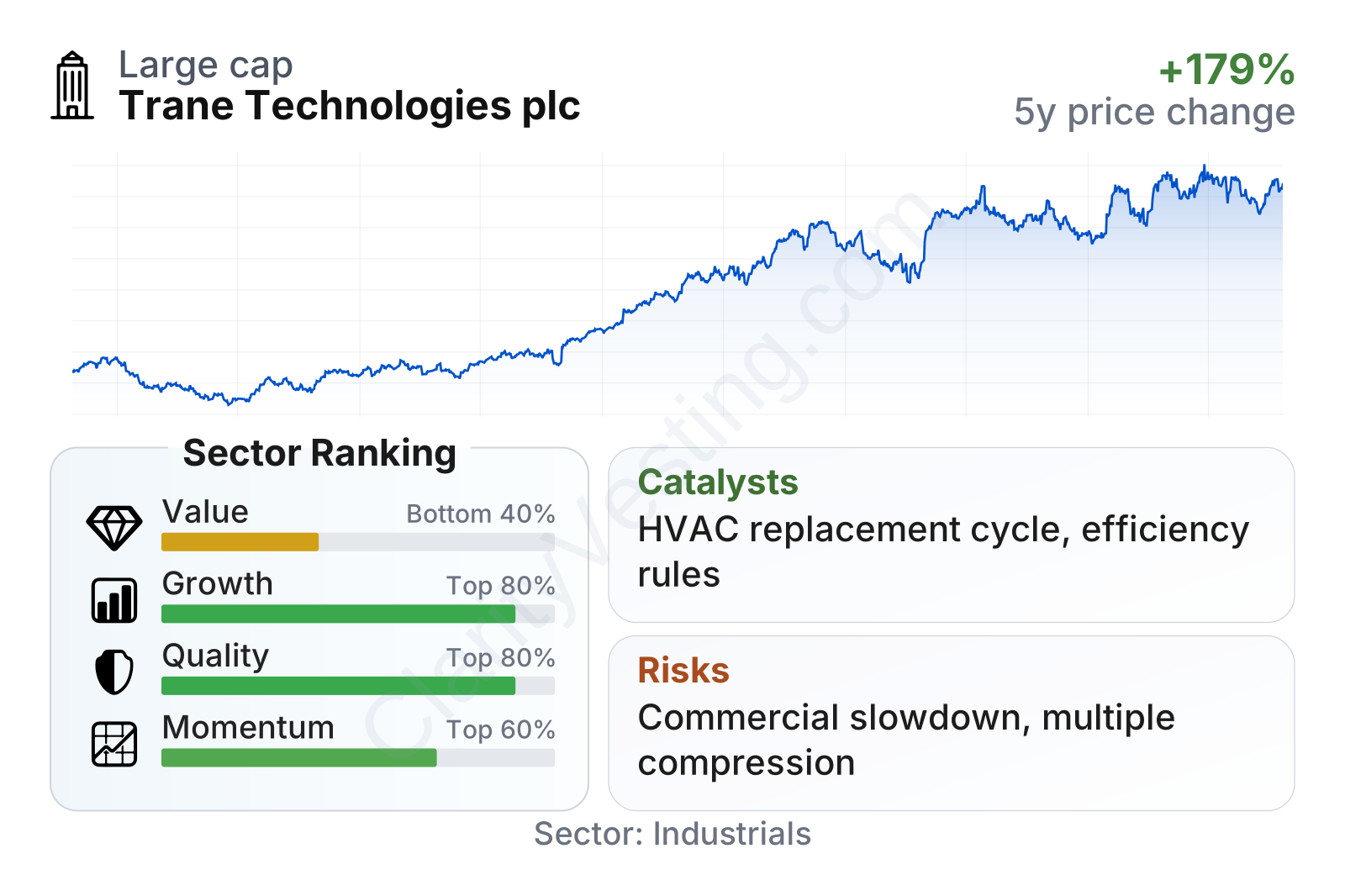
Trane Technologies stands out on quality and growth relative to much of the industrial sector, while looking weaker on traditional value measures. Returns on capital and assets are well above sector norms, margins are clearly stronger than average, and leverage is moderate. The trade-off is valuation: earnings, book value, and cash flow multiples are all elevated versus the sector median, so the market is already recognizing the company’s stronger fundamentals.
The stock’s long-term performance has been very strong, although the path has not been smooth. After the 2022 pullback, the shares recovered sharply and reached new highs over the following years, reflecting both earnings growth and a higher market multiple.
Growth
Trane Technologies operates in parts of the industrial economy that appear structurally favorable for long-term expansion. Building owners are under growing pressure to improve energy efficiency, lower operating costs, modernize aging HVAC systems, and meet stricter environmental standards. At the same time, transport refrigeration benefits from demand for cold-chain logistics tied to food distribution, pharmaceuticals, and tighter temperature-control requirements.
The company’s strategy also fits these trends well. It is not just selling equipment once; it combines equipment, controls, connected systems, and a service network that keeps customers engaged over long periods. That matters because service and parts typically add resilience, support margins, and create repeat business even when new equipment orders slow.
Revenue growth has remained consistently positive in recent years, often landing in the high-single-digit to low-teens range. There was some moderation during parts of 2025, but growth reaccelerated in the most recent period, suggesting demand has remained solid rather than fading into stagnation. That pattern is notable for a mature industrial business.
Cash generation has also strengthened meaningfully. Free cash flow has climbed from below $1 billion a few years ago to more than $3 billion on a trailing basis. That is important because it gives the company flexibility to invest in innovation, expand production, pursue acquisitions, repurchase shares, and return capital through dividends without heavily relying on debt.
Several catalysts could continue to support growth. Replacement demand in commercial HVAC is substantial because many installed systems are old and inefficient. Regulation around refrigerants and emissions can also push customers toward system upgrades. In addition, data centers, healthcare facilities, education buildings, and industrial sites all need increasingly sophisticated climate control, which plays to Trane’s product lineup and service capabilities.
Recent company communications have continued to emphasize healthy demand, backlog support in key categories, and investment in higher-efficiency and lower-emission solutions. For a business tied to large installed infrastructure, that combination of replacement demand and regulation-driven modernization creates a meaningful runway.
Risks
This article is for informational purposes only and does not constitute financial advice. Some content is AI-generated. See Disclaimer