Stock Analysis · Toyo Suisan Kaisha Ltd (TSUKY)
Overview
Toyo Suisan Kaisha is a Japanese packaged food company best known for instant noodles and other convenient meal products sold under brands such as Maruchan. Its business is built around everyday, relatively affordable food items, which places it in the defensive part of the consumer sector. The group sells products in Japan and internationally, with North America playing an important role through its instant noodle operations and prepared food business.
Based on the company’s latest annual disclosures for the fiscal year ended March 31, 2026, revenue is spread across several operating segments. The mix is diversified, but instant noodles remain the central earnings engine.
- Overseas instant noodles: approximately 39% of revenue. This is the company’s largest activity and mainly reflects instant noodle sales outside Japan, especially in North America.
- Seafood products: approximately 22% of revenue. This includes processed seafood and related food items sold in Japan.
- Foods: approximately 19% of revenue. This segment includes packaged food products for the domestic market beyond seafood and noodles.
- Instant noodles in Japan: approximately 14% of revenue. This covers cup noodles, bag noodles, and related domestic products.
- Frozen and refrigerated foods: approximately 5% of revenue. This includes chilled and frozen prepared foods.
- Other businesses: approximately 1% of revenue. This is a small residual category.
The company’s financial profile has improved noticeably in recent years. Revenue has moved steadily higher, but the more striking change is profitability: operating income and net income have grown faster than sales, showing that pricing, mix, and cost control have all contributed. Interest expense is very small, which fits a balance sheet with minimal leverage.
The visual above highlights a favorable trend: sales have risen consistently since fiscal 2022, while operating profit has expanded even faster. That matters because it suggests recent growth has not come only from volume, but also from stronger margins.
Key Figures
| Metric | Value | Sector ⓘ |
|---|---|---|
| Date | Nov 21, 2026 | |
| Context | ||
| Sector | Consumer Defensive | |
| Industry | Packaged Foods | |
| Market Cap ⓘ | $6.45B | |
| Beta ⓘ | 0.25 | |
Value (Cheapness) | ||
| P/E Ratio ⓘ | 14.24 | 18.64 |
| P/B Ratio ⓘ | N/A | 2.51 |
| FCF Yield ⓘ | 4.00% | 7.02% |
| Dividend Yield ⓘ | 1.27% | 2.67% |
| EBIT / EV ⓘ | 12.10% | 7.77% |
| PEG ⓘ | 2.79 | |
Growth (Business expansion) | ||
| Revenue Growth ⓘ | 5.20% | 3.80% |
| RPS Growth (5Y CAGR) ⓘ | 13.05% | 6.10% |
| EPS Growth (5Y CAGR) ⓘ | -19.64% | -10.36% |
| BVPS Growth (5Y CAGR) ⓘ | 11.06% | 3.04% |
| Margin Growth (5Y Trend) ⓘ | 7.19% | -0.21% |
| FCF Growth (5Y CAGR) ⓘ | 22.61% | 5.25% |
| DPS Growth (5Y CAGR) ⓘ | 24.19% | 5.88% |
Quality (Business durability) | ||
| ROIC (Latest) ⓘ | 13.45% | 11.80% |
| ROA (Latest) ⓘ | 11.79% | 6.20% |
| ROIC (5Y Median) ⓘ | 12.92% | 10.51% |
| ROA (5Y Median) ⓘ | 10.42% | 5.41% |
| Net Debt / EBIT (Latest) ⓘ | -2.61 | 1.88 |
| Net Debt / EBIT (5Y Median) ⓘ | -2.98 | 2.32 |
| Net Debt / EBITDA (Latest) ⓘ | -2.17 | 1.29 |
| Net Debt / Assets ⓘ | -38.86% | 20.02% |
| EBITDA / Interest ⓘ | 605.19 | 9.62 |
| Operating Margin (Latest) ⓘ | 16.97% | 9.06% |
| Operating Margin (5Y Median) ⓘ | 15.01% | 9.57% |
| Debt to Equity (Latest) ⓘ | 0.60% | 67.45% |
| Profit Margin (Latest) ⓘ | 13.35% | 5.43% |
| Free Cash Flow (Latest) ⓘ | $258.20M | |
Momentum (Price trend) | ||
| 3Y Return ⓘ | +34.66% | +17.50% |
| 12M Return (excl. last month) ⓘ | -0.49% | +3.34% |
| 6M Return ⓘ | -1.43% | +2.78% |
| Price vs. 200-Day MA ⓘ | +2.18% | +3.79% |
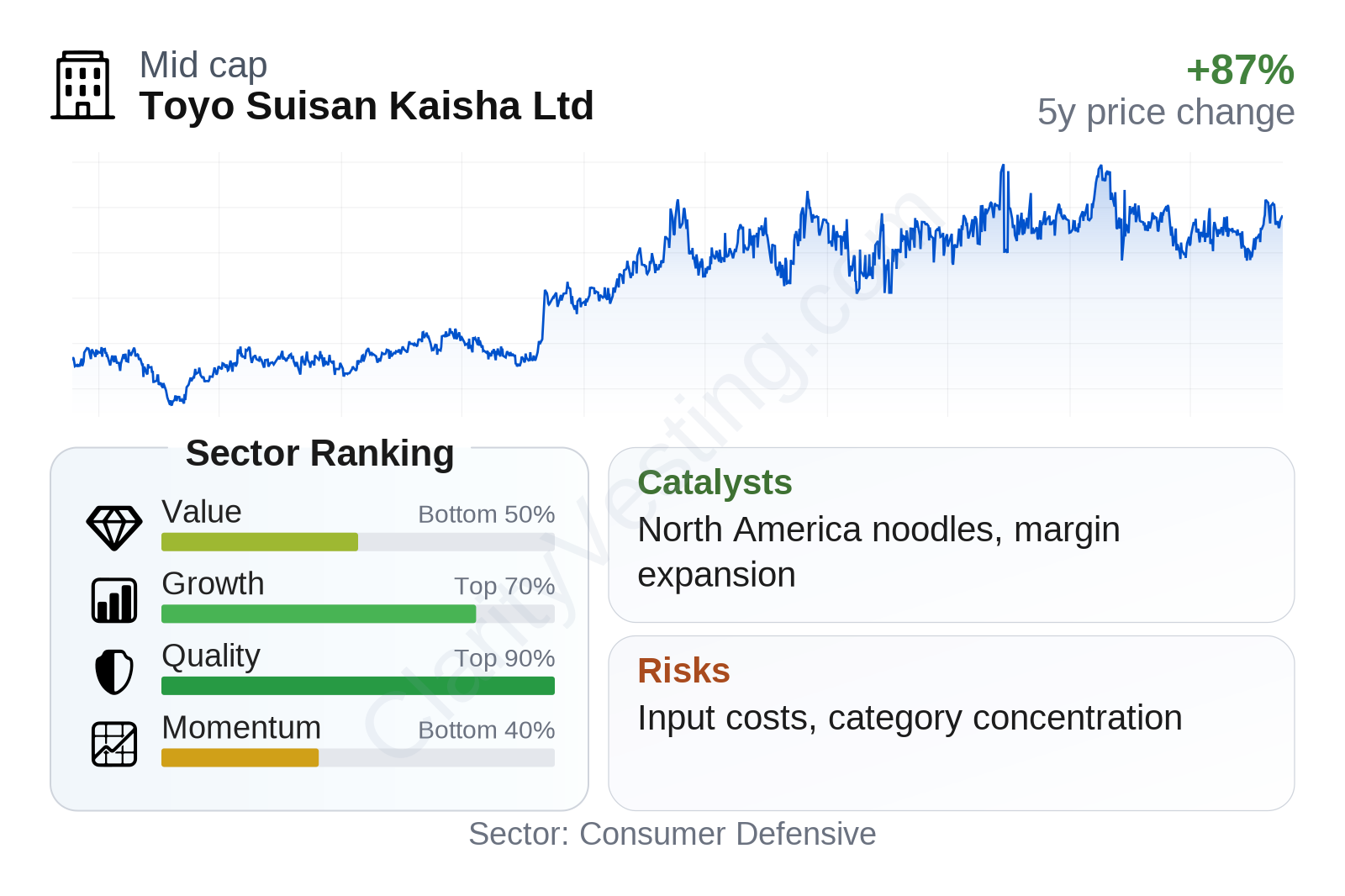
Toyo Suisan stands out more for business quality than for classic cheapness. Profitability measures are well above the sector median, and leverage is exceptionally low. Growth indicators are also solid, especially over a five-year view for revenue per share, free cash flow, and book value per share. On valuation, the earnings multiple is below the sector median, but the overall value profile is mixed because free cash flow yield and dividend yield are not especially high. Price momentum has been softer recently even though the longer-term share performance remains positive.
The stock has roughly doubled from late 2022 lows to recent levels, although gains have been less linear over the past year. That pattern often reflects a company that has already been recognized for improving fundamentals, while the market is now waiting for the next step in growth.
Growth
The company operates in a sector that is usually mature rather than fast-moving, but packaged foods still offers dependable expansion when a company has strong brands, pricing power, and room to grow internationally. Instant noodles are a practical category with broad appeal: they are low-cost, easy to distribute, and resilient across economic cycles. That makes the addressable market stable, and it can still expand through product innovation, premium offerings, and wider distribution.
Toyo Suisan’s strategy appears coherent for that environment. The company has a strong base in Japan, but one of its biggest advantages is its established overseas noodle business, particularly in North America. This matters because overseas markets can support both volume growth and brand extension. In addition, the company is not relying on one single category: seafood, frozen foods, and other packaged products provide diversification.
Sales growth has not been perfectly smooth quarter to quarter, but the broader direction remains positive. The latest annual growth pace is above the sector median, and the five-year revenue-per-share trend is notably stronger than the sector norm. That suggests expansion has been durable even when quarterly comparisons become uneven.
Cash generation is another encouraging point. Free cash flow has grown strongly over the longer term, which gives the company room to fund capacity, product development, dividends, and balance-sheet flexibility without depending much on debt. Even without a long series in the chart, the broader record indicates that cash conversion has improved alongside margins.
A major catalyst is the company’s ability to keep building its overseas instant noodle franchise. If consumer demand in North America remains firm and the company continues to add manufacturing, logistics, or shelf presence, that could support another phase of earnings growth. A second catalyst is product mix: moving consumers toward higher-value products can lift profit faster than revenue. Recent company disclosures also point to continued capital investment aimed at supporting production and long-term expansion, which is important for a food manufacturer serving high-volume categories.
Risks
This article is for informational purposes only and does not constitute financial advice. Some content is AI-generated. See Disclaimer