Stock Analysis · Treasury Wine Estates Ltd PK (TSRYY)
Overview
Treasury Wine Estates is a global wine company that makes, markets, and sells premium and luxury wine. Its portfolio includes well-known labels such as Penfolds, 19 Crimes, Wolf Blass, Lindeman’s, Beringer, Stags’ Leap, and Daou. The business is organized around brand-led winemaking and distribution rather than broad beverage diversification, which means its results are closely tied to consumer demand for wine, pricing power in premium categories, and its ability to manage grape supply, inventories, and routes to market across different countries.
The company generates revenue from a mix of geographic markets and brand tiers. Based on recent annual disclosures and segment reporting, the largest contributors are approximately:
- Americas: about 43% of revenue. This includes U.S., Canada, and Latin America operations, with a meaningful presence in premium and luxury brands, especially through labels such as Beringer, Stags’ Leap, Frank Family, and Daou.
- Treasury Premium Brands: about 30% of revenue. This segment includes premium commercial wine sold mainly in Australia, New Zealand, Asia, Europe, the Middle East, and Africa.
- Penfolds: about 27% of revenue. This is the group’s flagship luxury portfolio, sold globally and positioned as one of the company’s most strategically important earnings drivers.
Another useful way to look at the business is by product positioning rather than geography. Treasury Wine Estates is increasingly focused on premium and luxury wine, where bottle prices and brand strength matter more than pure volume. That strategy is intended to support margins and reduce exposure to lower-priced categories that have been under pressure in several markets.
The business mix has been volatile over the last few years, but one encouraging operating pattern is that gross profit has generally held up better than reported earnings. That suggests the core brands still retain pricing power, even when headline profit is affected by one-off items, taxes, write-downs, or restructuring effects.
Revenue rose into fiscal 2025 before pulling back in fiscal 2026, while operating profit remained positive. The bigger swing has been below the operating line, where interest costs and unusual items had a much larger effect on final net income than on the underlying trading business.
Key Figures
| Metric | Value | Sector ⓘ |
|---|---|---|
| Date | Oct 17, 2026 | |
| Context | ||
| Sector | Consumer Defensive | |
| Industry | Beverages - Wineries & Distilleries | |
| Market Cap ⓘ | $3.15B | |
| Beta ⓘ | 0.35 | |
Value (Cheapness) | ||
| P/E Ratio ⓘ | N/A | 17.88 |
| P/B Ratio ⓘ | 0.95 | 1.29 |
| FCF Yield ⓘ | 15.18% | 12.39% |
| Dividend Yield ⓘ | N/A | 2.85% |
| EBIT / EV ⓘ | N/A | 6.43% |
| PEG ⓘ | N/A | |
Growth (Business expansion) | ||
| Revenue Growth ⓘ | -7.30% | 4.10% |
| RPS Growth (5Y CAGR) ⓘ | -2.07% | 6.18% |
| EPS Growth (5Y CAGR) ⓘ | 11.65% | -13.59% |
| BVPS Growth (5Y CAGR) ⓘ | -5.58% | 3.20% |
| Margin Growth (5Y Trend) ⓘ | -2.84% | -0.15% |
| FCF Growth (5Y CAGR) ⓘ | -35.48% | 4.10% |
| DPS Growth (5Y CAGR) ⓘ | -8.14% | 6.79% |
Quality (Business durability) | ||
| ROIC (Latest) ⓘ | N/A | 12.34% |
| ROA (Latest) ⓘ | -8.57% | 6.30% |
| ROIC (5Y Median) ⓘ | 7.15% | 10.49% |
| ROA (5Y Median) ⓘ | 3.70% | 5.44% |
| Net Debt / EBIT (Latest) ⓘ | 1.43 | 1.96 |
| Net Debt / EBIT (5Y Median) ⓘ | 2.72 | 2.35 |
| Net Debt / EBITDA (Latest) ⓘ | 1.13 | 1.38 |
| Net Debt / Assets ⓘ | 27.61% | 21.51% |
| EBITDA / Interest ⓘ | 4.03 | 9.46 |
| Operating Margin (Latest) ⓘ | 22.06% | 8.87% |
| Operating Margin (5Y Median) ⓘ | 19.58% | 9.53% |
| Debt to Equity (Latest) ⓘ | 59.90% | 72.35% |
| Profit Margin (Latest) ⓘ | -41.04% | 5.40% |
| Free Cash Flow (Latest) ⓘ | $478.85M | |
Momentum (Price trend) | ||
| 3Y Return ⓘ | -41.44% | +20.92% |
| 12M Return (excl. last month) ⓘ | -27.36% | +2.13% |
| 6M Return ⓘ | +41.67% | +1.26% |
| Price vs. 200-Day MA ⓘ | +17.51% | +1.39% |
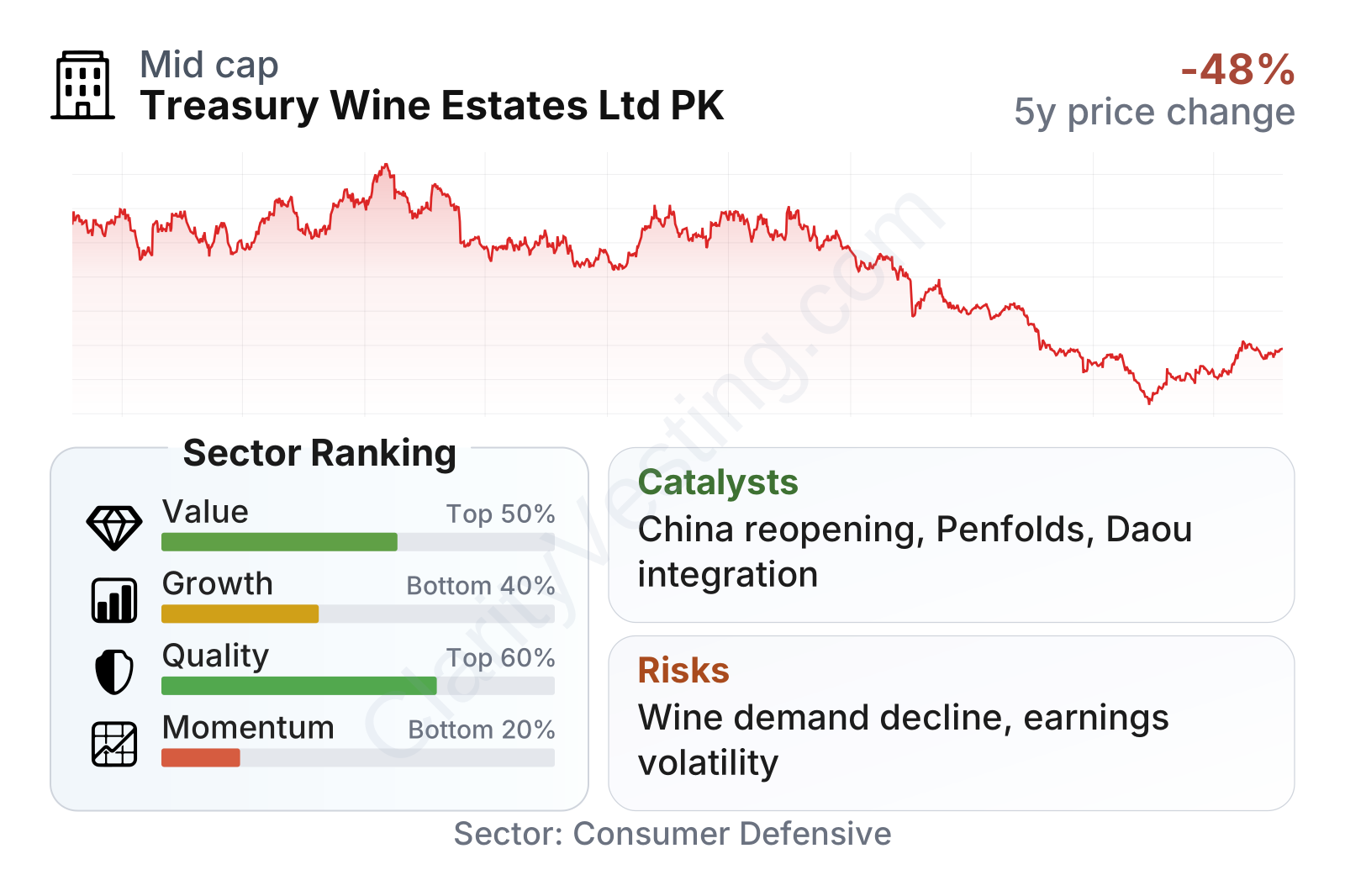
Treasury Wine Estates is a mid-sized consumer defensive company with relatively low share-price volatility, as shown by its beta well below 1. On value, the stock screens better than much of the sector: price-to-book is below the sector median and free cash flow yield is above it. Quality is more mixed. Operating margins are notably stronger than the sector median, and leverage is not excessive relative to peers, but recent return metrics have been distorted by losses tied to non-operating items. Growth is the weakest area in the table, reflecting declining revenue trends over recent periods and pressure on free cash flow growth. Momentum has also been weak over longer periods, although the more recent rebound has been stronger than the sector.
Growth
Wine is not a fast-growing beverage category overall, especially in developed markets where consumer tastes are shifting and health-related moderation trends are becoming more visible. That means Treasury Wine Estates does not operate in a naturally expanding sector in the same way as some spirits or non-alcoholic brands. However, the premium and luxury end of wine has historically been more resilient than mass-market wine, and that is the part of the market where the company has been deliberately concentrating its portfolio.
Its strategy is logical for long-term growth: build stronger global luxury brands, push deeper into higher-priced segments, and use acquisitions to expand distribution and credibility in the U.S. luxury market. The Daou acquisition is central to that plan. It adds a recognized luxury brand in U.S. wine, strengthens the company in one of the world’s most important premium wine markets, and broadens its earnings base beyond the older Australian-centered portfolio.
Penfolds is another important growth lever. Management has spent several years repositioning it as a global luxury brand rather than a label tied mainly to one export channel. If that brand continues expanding in markets such as Southeast Asia, travel retail, and selected developed markets, it could support better mix and stronger profitability even without large volume growth.
Recent developments also matter. The easing of Chinese tariffs on Australian wine changed the opportunity set for the industry. Treasury Wine Estates has one of the strongest premium Australian portfolios, so improved access to China creates a potential reopening catalyst, particularly for Penfolds and other higher-end labels. That does not guarantee a rapid return to previous sales levels, but it reopens a market that had been heavily constrained for years.
Cash generation is a notable strength in the current profile. Recent free cash flow has remained solid even though growth metrics over a five-year period look weak. That gap suggests the business may be in a transition phase where portfolio upgrades, inventory management, and margin discipline are more important than top-line expansion alone.
Risks
This article is for informational purposes only and does not constitute financial advice. Some content is AI-generated. See Disclaimer


