Stock Analysis · Treasury Wine Estates Ltd (TSRYF)
Overview
Treasury Wine Estates Ltd is a global wine company that owns, produces, markets, and distributes premium and luxury wine brands. Its portfolio includes well-known labels such as Penfolds, 19 Crimes, Wolf Blass, Lindeman’s, Beringer, Stags’ Leap, and Matua. The group operates across Australia, Asia, the Americas, Europe, the Middle East, and Africa, with a strategy increasingly centered on higher-priced wines rather than large-volume, lower-margin products.
The business makes money mainly by selling bottled wine through retail stores, restaurants, bars, hospitality channels, and distributors. Based on the company’s recent annual disclosures, revenue is primarily organized by geography and brand portfolio, with premiumization playing a major role in profit generation.
- Americas: approximately 35% to 40% of group sales in recent years. This includes U.S.-focused brands such as Beringer, Sterling Vineyards, Beaulieu Vineyard, and other commercial to premium wines.
- Penfolds: approximately 20% to 25% of sales, but a larger share of earnings than revenue because of its luxury positioning. This segment includes the flagship Penfolds brand sold across Asia, Australia, Europe, and the U.S.
- Treasury Premium Brands: approximately 20% to 25% of sales. This includes labels such as 19 Crimes, Wolf Blass, Squealing Pig, and Wynns.
- Asia: approximately 10% to 15% of sales, depending on the year and channel conditions. This business is especially important for premium imported wine demand.
- EMEA: approximately 5% to 10% of sales, covering Europe, the Middle East, and Africa distribution.
One notable business pattern is that revenue has stayed relatively resilient over the last several years, but profit has been much more volatile. Gross profit expanded from 2022 through 2025, showing pricing power and product mix improvement, yet net income swung sharply negative in fiscal 2026. That gap suggests the core business remained profitable at the operating level, while one-off or non-cash items had a major effect on reported earnings.
Key Figures
| Metric | Value | Sector ⓘ |
|---|---|---|
| Date | Oct 03, 2026 | |
| Context | ||
| Sector | Consumer Defensive | |
| Industry | Beverages - Wineries & Distilleries | |
| Market Cap ⓘ | $3.06B | |
| Beta ⓘ | 0.35 | |
Value (Cheapness) | ||
| P/E Ratio ⓘ | N/A | 18.16 |
| P/B Ratio ⓘ | 0.92 | 1.27 |
| FCF Yield ⓘ | 15.57% | 12.39% |
| Dividend Yield ⓘ | N/A | 2.83% |
| EBIT / EV ⓘ | N/A | 6.45% |
| PEG ⓘ | N/A | |
Growth (Business expansion) | ||
| Revenue Growth ⓘ | -7.30% | 3.80% |
| RPS Growth (5Y CAGR) ⓘ | -1.02% | 6.20% |
| EPS Growth (5Y CAGR) ⓘ | 11.65% | -14.64% |
| BVPS Growth (5Y CAGR) ⓘ | -5.61% | 3.26% |
| Margin Growth (5Y Trend) ⓘ | -3.28% | -0.25% |
| FCF Growth (5Y CAGR) ⓘ | N/A | 4.65% |
| DPS Growth (5Y CAGR) ⓘ | -7.66% | 6.86% |
Quality (Business durability) | ||
| ROIC (Latest) ⓘ | N/A | 12.58% |
| ROA (Latest) ⓘ | -8.64% | 6.35% |
| ROIC (5Y Median) ⓘ | 7.24% | 10.36% |
| ROA (5Y Median) ⓘ | 3.70% | 5.44% |
| Net Debt / EBIT (Latest) ⓘ | 1.43 | 1.91 |
| Net Debt / EBIT (5Y Median) ⓘ | 2.62 | 2.32 |
| Net Debt / EBITDA (Latest) ⓘ | 1.13 | 1.36 |
| Net Debt / Assets ⓘ | 27.61% | 21.25% |
| EBITDA / Interest ⓘ | 4.03 | 9.61 |
| Operating Margin (Latest) ⓘ | 22.08% | 8.96% |
| Operating Margin (5Y Median) ⓘ | 20.02% | 9.53% |
| Debt to Equity (Latest) ⓘ | 59.90% | 71.66% |
| Profit Margin (Latest) ⓘ | -41.04% | 5.40% |
| Free Cash Flow (Latest) ⓘ | $476.23M | |
Momentum (Price trend) | ||
| 3Y Return ⓘ | -41.97% | +15.25% |
| 12M Return (excl. last month) ⓘ | -17.18% | +2.63% |
| 6M Return ⓘ | +75.81% | +2.43% |
| Price vs. 200-Day MA ⓘ | +13.58% | +0.43% |
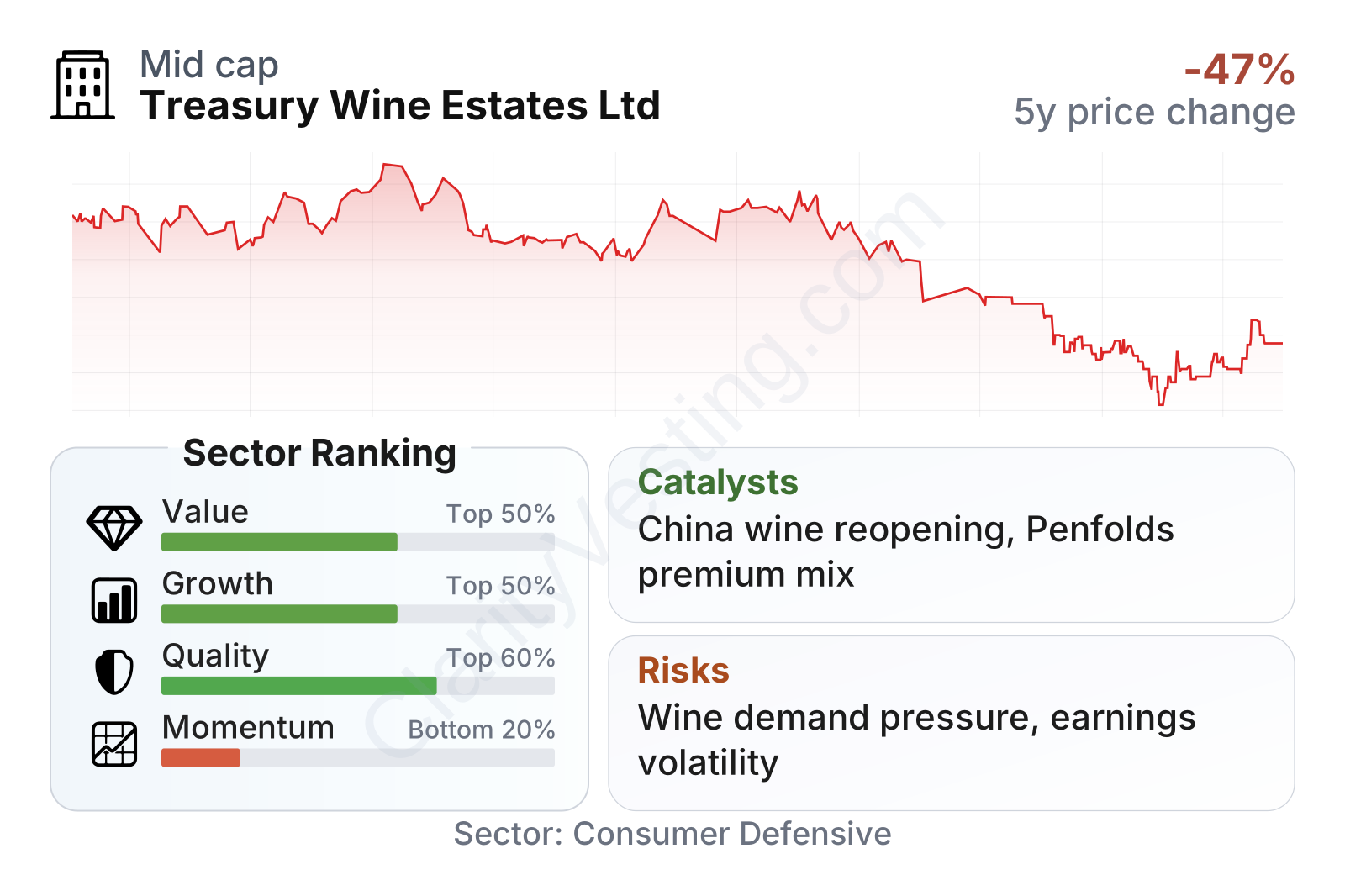
Treasury Wine Estates sits in the mid-sized range within consumer staples. The table points to a mixed profile: value metrics look relatively strong, quality is respectable in some areas, growth is uneven, and market momentum remains weak over the longer period despite a sharp rebound in recent months.
Profitability from operations is better than the sector median, with operating margin around the low 20% range versus a much lower sector norm. Free cash flow generation also stands out positively. However, the latest return on assets is negative because fiscal 2026 included a very large reported loss, which distorts bottom-line quality measures. Growth indicators are less convincing: recent revenue declined year over year, five-year revenue per share trends are slightly negative, and dividend growth has moved backward. In short, the business still converts sales into cash relatively well, but the recent earnings profile is not clean.
Growth
The wine industry is not a fast-growing sector in volume terms, especially in mature markets such as Australia, Europe, and the U.S. Growth tends to come more from premiumization than from selling more bottles. Treasury Wine Estates has built its strategy around exactly that idea: focusing on luxury and premium brands, raising average selling prices, and strengthening distribution in markets where brand heritage matters.
That strategy is logical for long-term growth because premium wine can produce better margins, stronger customer loyalty, and more pricing resilience than mass-market wine. Penfolds is the clearest example. It is one of the few wine brands from Australia with true global luxury recognition, which gives Treasury Wine Estates a distinctive asset that is difficult to replicate.
A major growth catalyst is the reopening of trade flows into China for Australian wine after the removal of punitive tariffs. That matters especially for Penfolds and other premium labels, since Chinese demand historically supported higher-value exports. The company has also expanded Penfolds sourcing beyond Australia into France, the U.S., and China, which can reduce dependence on one country of origin while broadening the brand’s reach.
Another positive point is portfolio reshaping. Management has spent years moving away from lower-end commercial wine and emphasizing premium labels, direct brand investment, and higher-margin channels. If that execution continues, Treasury Wine Estates could generate growth more through mix improvement than through simple volume gains.
Recent annual reporting also suggests management remains focused on simplifying the portfolio and supporting long-term brand equity. For a wine producer, that matters because vineyard assets, inventory aging, and luxury positioning often require patience rather than short-term volume chasing.
Risks
This article is for informational purposes only and does not constitute financial advice. Some content is AI-generated. See Disclaimer


