Stock Analysis · Taysha Gene Therapies Inc (TSHA)
Overview
Taysha Gene Therapies is a clinical-stage biotechnology company focused on gene therapy for severe neurological diseases, especially rare disorders affecting the central nervous system. Its approach is to use adeno-associated virus, or AAV, gene therapy to deliver functioning genetic material into patients’ cells. In simple terms, the company is trying to treat diseases at their root cause rather than only managing symptoms.
The company is still in the development stage, so its business is not yet built on recurring product sales. Revenue has mainly come from collaboration and licensing arrangements rather than from approved commercial medicines. That is a very important point for long-term analysis: Taysha is currently valued more on the potential of its pipeline than on an established operating business.
Based on recent annual reporting, Taysha’s revenue sources are concentrated and relatively small in absolute size.
- Collaboration and license revenue: approximately 100% of recent revenue. This includes upfront payments, milestone-related recognition, and other amounts tied to strategic partnerships.
- Product revenue: 0%. Taysha does not currently market an approved therapy, so it has no meaningful recurring sales from patients or hospitals.
- Other revenue: if present, it appears limited and not a core driver of the business.
The broad financial pattern is typical for an early-stage biotech company: modest revenue, heavy research spending, and persistent losses while clinical programs advance. Research and development remains the largest use of cash, clearly above general and administrative costs, which shows management is still directing most resources toward the pipeline rather than commercialization.
The financial flow also shows that nearly all of the company’s economics still run through operating expenses rather than product sales. Revenue has appeared intermittently through partnerships, but not at a level that changes the overall picture: Taysha remains a pipeline-driven biotech with research spending as its central engine.
Key Figures
| Metric | Value | Sector ⓘ |
|---|---|---|
| Date | Oct 03, 2026 | |
| Context | ||
| Sector | Healthcare | |
| Industry | Biotechnology | |
| Market Cap ⓘ | $1.59B | |
| Beta ⓘ | 1.17 | |
Value (Cheapness) | ||
| P/E Ratio ⓘ | N/A | 24.06 |
| P/B Ratio ⓘ | 4.52 | 3.08 |
| FCF Yield ⓘ | -8.54% | 3.07% |
| Dividend Yield ⓘ | N/A | 2.05% |
| EBIT / EV ⓘ | -12.49% | 0.63% |
| PEG ⓘ | N/A | |
Growth (Business expansion) | ||
| Revenue Growth ⓘ | 171.30% | 7.50% |
| RPS Growth (5Y CAGR) ⓘ | N/A | 8.70% |
| EPS Growth (5Y CAGR) ⓘ | -52.07% | -18.20% |
| BVPS Growth (5Y CAGR) ⓘ | -25.69% | 3.95% |
| Margin Growth (5Y Trend) ⓘ | N/A | -0.58% |
| FCF Growth (5Y CAGR) ⓘ | -9.29% | 0.88% |
| DPS Growth (5Y CAGR) ⓘ | N/A | 6.80% |
Quality (Business durability) | ||
| ROIC (Latest) ⓘ | -37.03% | 3.29% |
| ROA (Latest) ⓘ | -38.03% | 3.02% |
| ROIC (5Y Median) ⓘ | -70.34% | 4.75% |
| ROA (5Y Median) ⓘ | -73.82% | 1.93% |
| Net Debt / EBIT (Latest) ⓘ | N/A | 1.33 |
| Net Debt / EBIT (5Y Median) ⓘ | N/A | 1.83 |
| Net Debt / EBITDA (Latest) ⓘ | N/A | 0.99 |
| Net Debt / Assets ⓘ | -85.00% | 5.33% |
| EBITDA / Interest ⓘ | N/A | 9.63 |
| Operating Margin (Latest) ⓘ | -2735.68% | 9.25% |
| Operating Margin (5Y Median) ⓘ | -1092.51% | 7.80% |
| Debt to Equity (Latest) ⓘ | 14.34% | 28.99% |
| Profit Margin (Latest) ⓘ | N/A | 3.60% |
| Free Cash Flow (Latest) ⓘ | -$135.57M | |
Momentum (Price trend) | ||
| 3Y Return ⓘ | +64.30% | +37.48% |
| 12M Return (excl. last month) ⓘ | +95.21% | +20.85% |
| 6M Return ⓘ | +9.98% | +9.73% |
| Price vs. 200-Day MA ⓘ | -13.20% | +4.69% |
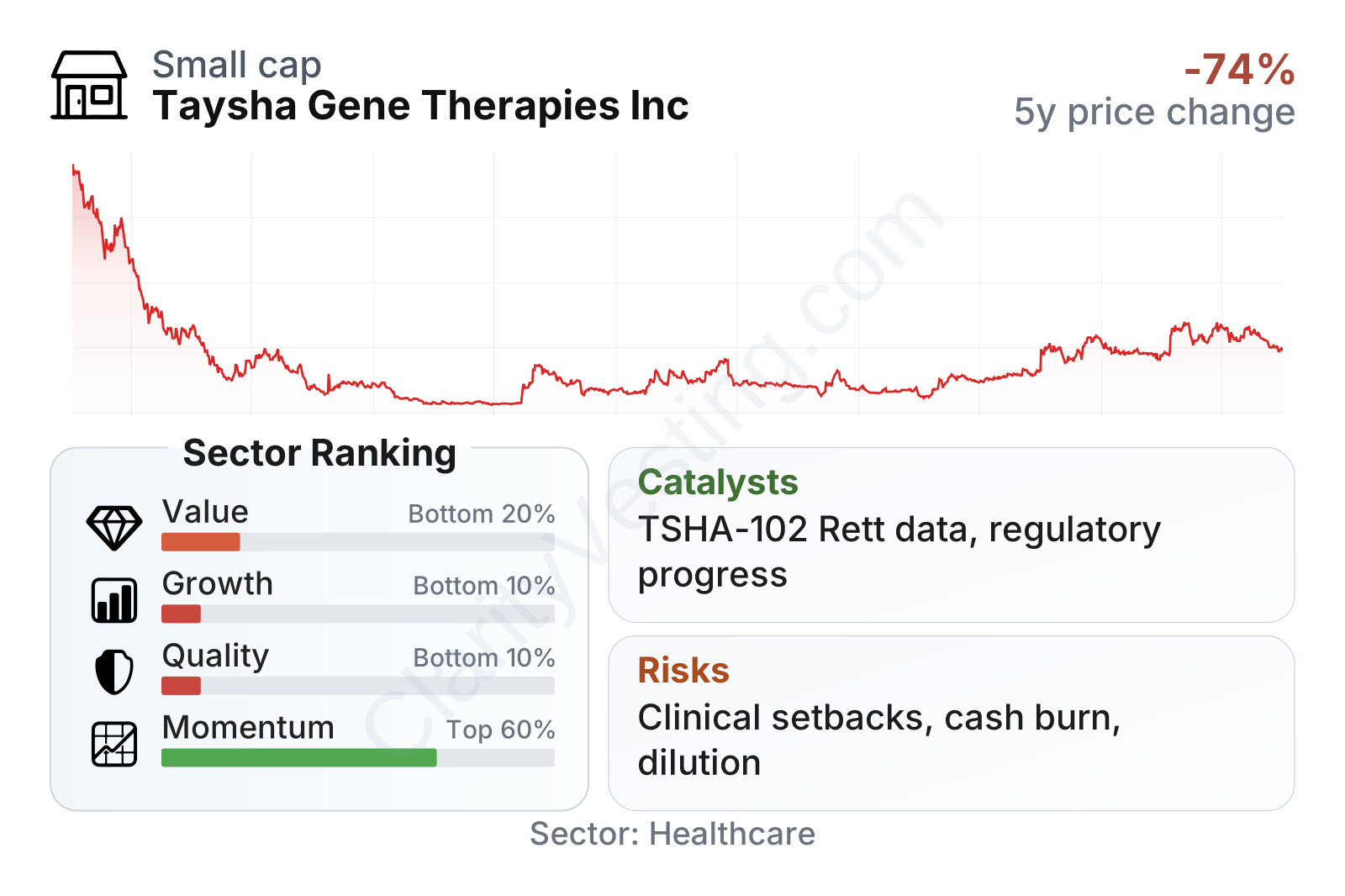
Taysha is a small-cap biotech company with above-average share-price volatility, which is normal for a business driven by clinical milestones. The factor table points to a mixed picture: market momentum has been relatively strong over the last year and over the longer three-year window, but value, quality, and most operating fundamentals rank near the bottom of the healthcare sector. That combination usually means the market is reacting to pipeline expectations rather than to current profitability or balance-sheet efficiency.
The stock’s historical path reinforces that point. Shares fell sharply after the 2021 period, spent time at very depressed levels, and later recovered significantly. That pattern is common in development-stage biotech names where major moves often follow financing updates, regulatory progress, or changes in clinical expectations.
Growth
Taysha operates in a sector with real long-term growth potential. Gene therapy addresses diseases that often have limited treatment options, and rare neurological conditions are an area where even one successful therapy can create substantial medical and commercial value. The broader field has attracted large pharmaceutical partners, regulatory attention, and continued investment because these therapies may offer durable effects after a single administration.
Taysha’s strategy is logical for that setting. Rather than spreading itself across many unrelated programs, the company has increasingly centered attention on a smaller number of higher-priority neurological assets. For a company of this size, that focus matters because it can reduce operational complexity and concentrate capital on the programs most likely to create value.
A major part of the long-term thesis is TSHA-102, the company’s Rett syndrome gene therapy candidate. Rett syndrome is a rare and serious neurodevelopmental disorder with high unmet need, and progress in that program has become the company’s most visible catalyst. Positive clinical signals, regulatory alignment, or broader development expansion in Rett syndrome could materially reshape how the market views Taysha.
Recent company updates have also highlighted continued execution around dosing, manufacturing preparation, and regulatory interactions for lead programs. For a pre-revenue biotech, these are not small operational details: they are the steps that determine whether a therapy can move from early promise toward registrational development and, eventually, commercial relevance.
The recent revenue growth spike looks dramatic, but it should be interpreted carefully. In Taysha’s case, changes in reported revenue mostly reflect partnership accounting rather than rising customer demand. That means strong year-over-year revenue growth does not yet signal a self-sustaining commercial business.
Cash generation remains negative, and recent free cash flow has moved deeper into the red again after some earlier improvement. This is a crucial growth constraint. Taysha may have meaningful clinical upside, but that upside still has to be financed. In biotech, growth is often determined not only by science, but also by how long the cash runway can support trials, manufacturing work, and regulatory activity.
Risks
This article is for informational purposes only and does not constitute financial advice. Some content is AI-generated. See Disclaimer