Stock Analysis · Tessenderlo Group NV (TSDOF)
Overview
Tessenderlo Group NV is a Belgian industrial company active in agriculture, bio-residuals, machinery, and industrial solutions. The group has evolved from a traditional chemicals business into a more diversified portfolio centered on products and services that are tied to food production, water management, construction, and industrial efficiency. In practice, that means it sells crop nutrition products, processes animal by-products, makes and distributes equipment, and supplies pipe systems and other industrial materials.
The business mix is spread across several operating segments rather than one single product line, which gives the company some diversification. Based on the group’s segment reporting in recent annual disclosures, the main revenue sources are approximately the following:
- Agro and crop nutrition: about 30% to 35% of revenue. This includes liquid crop fertilizers and related agricultural products, notably through Tessenderlo Kerley.
- Bio-valorization: about 20% to 25%. This activity processes animal by-products into proteins, fats, gelatin, and other ingredients through brands such as Akiolis and PB Leiner.
- Industrial solutions and materials: about 20% to 25%. This includes pipe systems, water management products, and industrial processing solutions.
- Machinery and equipment distribution: about 15% to 20%. This includes distribution and service of agricultural, construction, and industrial equipment.
- Other activities: the remaining 5% to 10%, including smaller industrial and service businesses.
This combination makes Tessenderlo less dependent on any one end market than a pure-play fertilizer or pure-play chemicals company. At the same time, it also means the group can be harder to analyze because each division follows its own cycle and margin pattern.
The operating profile over the last several years shows a company with fairly resilient revenue, but with profitability that has become much thinner. Sales moved from a little above $2.0 billion in 2021 to around $2.8 billion in 2025, yet operating income and net income fell sharply after the stronger 2022 period. That suggests costs, pricing pressure, and weaker conditions in some divisions have been more important than top-line growth alone.
Key Figures
| Metric | Value | Sector ⓘ |
|---|---|---|
| Date | Oct 17, 2026 | |
| Context | ||
| Sector | Basic Materials | |
| Industry | Agricultural Inputs | |
| Market Cap ⓘ | $1.58B | |
| Beta ⓘ | 0.66 | |
Value (Cheapness) | ||
| P/E Ratio ⓘ | N/A | 16.90 |
| P/B Ratio ⓘ | 0.93 | 1.65 |
| FCF Yield ⓘ | 12.12% | 5.76% |
| Dividend Yield ⓘ | 2.80% | 2.13% |
| EBIT / EV ⓘ | N/A | 6.30% |
| PEG ⓘ | N/A | |
Growth (Business expansion) | ||
| Revenue Growth ⓘ | 0.40% | 11.10% |
| RPS Growth (5Y CAGR) ⓘ | -1.28% | 4.49% |
| EPS Growth (5Y CAGR) ⓘ | 2.74% | -13.47% |
| BVPS Growth (5Y CAGR) ⓘ | 1.48% | 5.51% |
| Margin Growth (5Y Trend) ⓘ | -10.86% | -1.54% |
| FCF Growth (5Y CAGR) ⓘ | -16.40% | 0.37% |
| DPS Growth (5Y CAGR) ⓘ | N/A | 6.08% |
Quality (Business durability) | ||
| ROIC (Latest) ⓘ | 5.20% | 9.26% |
| ROA (Latest) ⓘ | -1.16% | 4.91% |
| ROIC (5Y Median) ⓘ | N/A | 7.70% |
| ROA (5Y Median) ⓘ | 4.20% | 3.86% |
| Net Debt / EBIT (Latest) ⓘ | 0.71 | 1.40 |
| Net Debt / EBIT (5Y Median) ⓘ | 0.35 | 1.70 |
| Net Debt / EBITDA (Latest) ⓘ | 0.13 | 0.95 |
| Net Debt / Assets ⓘ | 2.89% | 13.69% |
| EBITDA / Interest ⓘ | 7.14 | 12.34 |
| Operating Margin (Latest) ⓘ | 2.00% | 13.20% |
| Operating Margin (5Y Median) ⓘ | 4.32% | 11.80% |
| Debt to Equity (Latest) ⓘ | 12.48% | 40.56% |
| Profit Margin (Latest) ⓘ | -0.20% | 6.43% |
| Free Cash Flow (Latest) ⓘ | $191.61M | |
Momentum (Price trend) | ||
| 3Y Return ⓘ | -7.83% | +68.89% |
| 12M Return (excl. last month) ⓘ | +12.49% | +30.21% |
| 6M Return ⓘ | -9.25% | -4.16% |
| Price vs. 200-Day MA ⓘ | N/A | -1.27% |
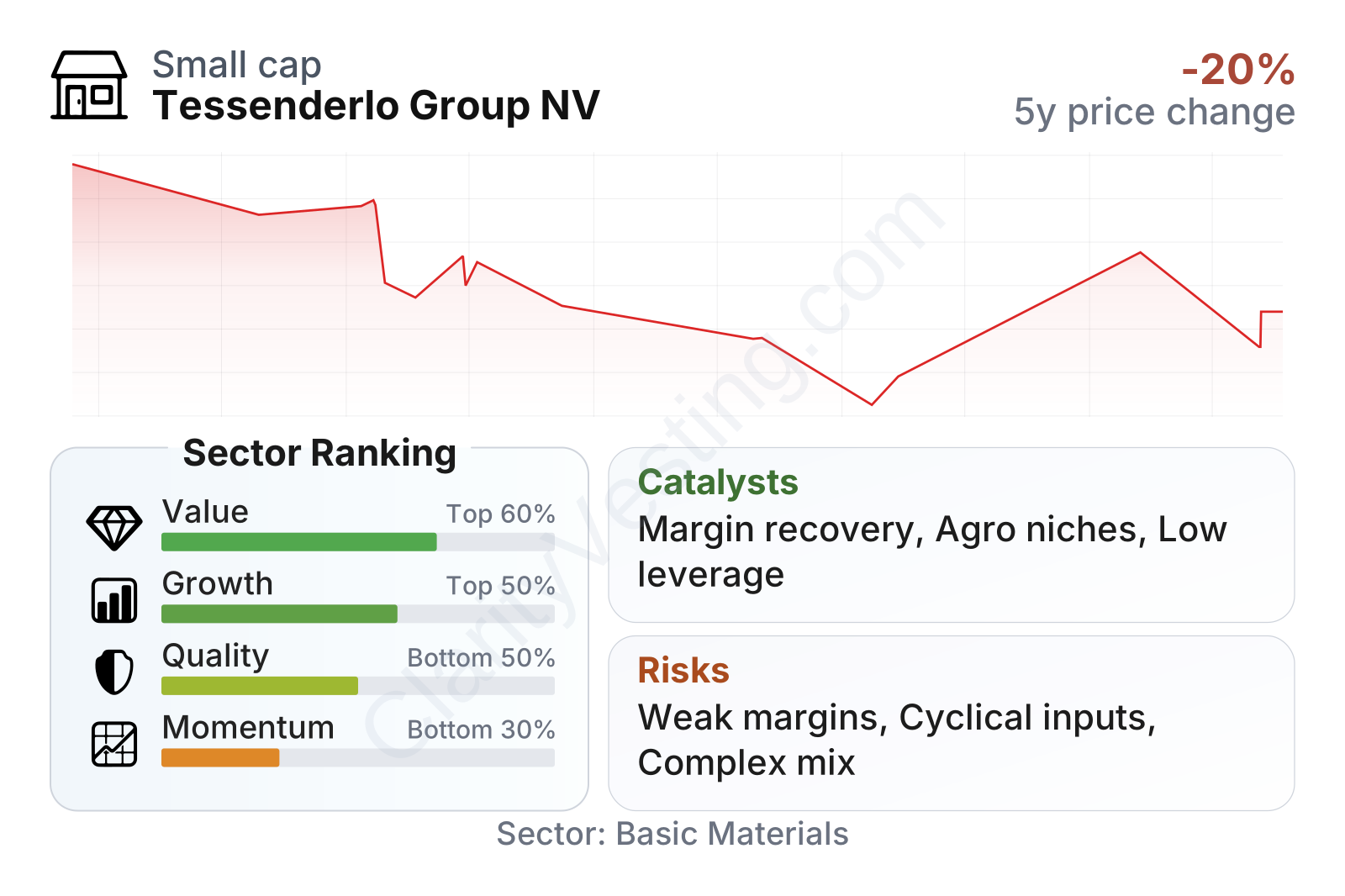
Tessenderlo currently looks inexpensive on several balance-sheet and cash-flow measures relative to many companies in its sector. The price-to-book ratio is below 1.0, free cash flow yield is notably above the sector median, and the dividend yield is modestly above the peer midpoint. The company is also not heavily leveraged: debt-to-equity is around 12%, net debt is low relative to assets, and net debt to EBITDA remains conservative.
The weaker side is business quality and recent operating efficiency. Return on invested capital is around 5%, below the sector median, and the latest operating margin is close to 2%, far below many peers in basic materials. Profit margin is slightly negative on a trailing basis, which fits with the recent deterioration in earnings. Growth metrics are mixed as well: short-term revenue growth is close to flat, five-year revenue per share has declined slightly, and free cash flow has been volatile despite a strong latest level. In short, the balance sheet gives the company room to maneuver, but the current earnings base is not strong.
Growth
Tessenderlo operates in several markets that have durable long-term demand drivers. Agriculture benefits from the need to improve crop yields and nutrient efficiency. Bio-valorization is linked to circular economy trends, where waste streams are converted into useful products. Water infrastructure and pipe systems also have structural support from replacement demand, drainage needs, and environmental regulation. These are not fast-moving technology markets, but they can offer steady multi-year demand if execution is sound.
The group’s strategy also makes industrial sense. Its portfolio is built around practical, often essential products rather than discretionary consumer spending. Agricultural inputs, gelatin ingredients, animal by-product processing, and water-management systems all serve recurring needs. This can help stabilize activity over long periods, especially when one division is weaker and another is more resilient.
A key catalyst is any recovery in margins after the very weak recent earnings period. Revenue has held up better than profits, which means even moderate improvement in pricing, input costs, or utilization rates could have a meaningful effect on earnings. Another potential support comes from the company’s low leverage, which gives it flexibility to continue investing, maintain operations through softer markets, or pursue targeted portfolio actions.
There is also a portfolio angle worth watching. Tessenderlo has a history of reshaping its activities, and its link with Picanol and the broader industrial ecosystem around its controlling shareholder has often led the market to look for simplification, better capital allocation, or operational improvement. For a diversified group trading at a modest valuation, clearer structure and better profitability could matter more than headline revenue growth.
Risks
This article is for informational purposes only and does not constitute financial advice. Some content is AI-generated. See Disclaimer


