Stock Analysis · Tenaris SA (TS)
Overview
Tenaris is a global manufacturer and supplier of steel pipe products and related services used mainly by the oil and gas industry. Its core role is to provide the tubular goods that energy companies need to drill wells, complete them, and operate them safely over time. The company is especially known for seamless pipes used in demanding environments, where reliability and technical performance matter a great deal. Beyond manufacturing, Tenaris also offers services such as pipe handling, inventory management, coating, and technical support at customer sites.
The business is closely tied to upstream oil and gas activity, especially spending by national oil companies, international oil majors, and shale producers. That means Tenaris is not simply selling steel; it is selling a combination of engineering, quality control, logistics, and long-term customer relationships in a specialized part of the energy supply chain.
Based on company reporting, Tenaris’s revenue mix is primarily driven by tubular products and then by associated services and other industrial applications. A simple way to think about the business is:
- Oil Country Tubular Goods (OCTG) and line pipe for oil and gas: approximately 80% to 90% of revenue. This includes seamless and welded steel pipes used in drilling, casing, tubing, and transport infrastructure.
- Rig direct, coatings, accessories, and field services: approximately 10% to 15% of revenue. This includes pipe preparation, logistics, technical assistance, and related products sold with the main tubular offering.
- Other industrial pipes and applications: a small single-digit share. This includes uses outside oil and gas, such as mechanical and industrial projects.
Geographically, Tenaris is diversified across North America, South America, the Middle East, and other international markets, which helps reduce dependence on any single country, although oil and gas spending cycles still dominate results.
Over the last several years, the company moved from a powerful upcycle in 2022 and 2023 to a more normalized phase in 2024 and 2025. Revenue and profit pulled back from peak levels, but the business remained strongly profitable, which says a lot about its cost structure, product mix, and disciplined balance sheet.
The long-term pattern is clear: sales rose sharply through the energy upcycle, margins expanded meaningfully, and even after the peak passed, Tenaris kept a solid earnings base. Cost of revenue remains the largest outflow, as expected for a steel-intensive manufacturer, but operating discipline has allowed the company to convert a healthy share of revenue into operating income and net income.
Key Figures
| Metric | Value | Sector ⓘ |
|---|---|---|
| Date | Oct 17, 2026 | |
| Context | ||
| Sector | Energy | |
| Industry | Oil & Gas Equipment & Services | |
| Market Cap ⓘ | $29.55B | |
| Beta ⓘ | 0.48 | |
Value (Cheapness) | ||
| P/E Ratio ⓘ | 15.61 | 15.44 |
| P/B Ratio ⓘ | 1.76 | 1.73 |
| FCF Yield ⓘ | 5.87% | 8.20% |
| Dividend Yield ⓘ | 3.04% | 3.59% |
| EBIT / EV ⓘ | 9.66% | 7.46% |
| PEG ⓘ | 3.15 | |
Growth (Business expansion) | ||
| Revenue Growth ⓘ | -3.90% | 26.90% |
| RPS Growth (5Y CAGR) ⓘ | 20.18% | 6.90% |
| EPS Growth (5Y CAGR) ⓘ | -18.56% | -15.73% |
| BVPS Growth (5Y CAGR) ⓘ | 11.65% | 6.07% |
| Margin Growth (5Y Trend) ⓘ | 1.62% | 0.58% |
| FCF Growth (5Y CAGR) ⓘ | N/A | 1.86% |
| DPS Growth (5Y CAGR) ⓘ | 33.83% | 16.79% |
Quality (Business durability) | ||
| ROIC (Latest) ⓘ | 11.65% | 11.40% |
| ROA (Latest) ⓘ | 9.38% | 6.06% |
| ROIC (5Y Median) ⓘ | 12.09% | 10.30% |
| ROA (5Y Median) ⓘ | 9.81% | 5.42% |
| Net Debt / EBIT (Latest) ⓘ | -0.04 | 1.64 |
| Net Debt / EBIT (5Y Median) ⓘ | -0.05 | 1.83 |
| Net Debt / EBITDA (Latest) ⓘ | -0.04 | 1.08 |
| Net Debt / Assets ⓘ | -0.54% | 17.29% |
| EBITDA / Interest ⓘ | 64.13 | 9.64 |
| Operating Margin (Latest) ⓘ | 20.92% | 16.27% |
| Operating Margin (5Y Median) ⓘ | 21.04% | 20.39% |
| Debt to Equity (Latest) ⓘ | 2.63% | 54.76% |
| Profit Margin (Latest) ⓘ | 15.88% | 8.82% |
| Free Cash Flow (Latest) ⓘ | $1.73B | |
Momentum (Price trend) | ||
| 3Y Return ⓘ | +96.89% | +67.38% |
| 12M Return (excl. last month) ⓘ | +59.26% | +49.19% |
| 6M Return ⓘ | +0.67% | +7.07% |
| Price vs. 200-Day MA ⓘ | +6.68% | +9.56% |
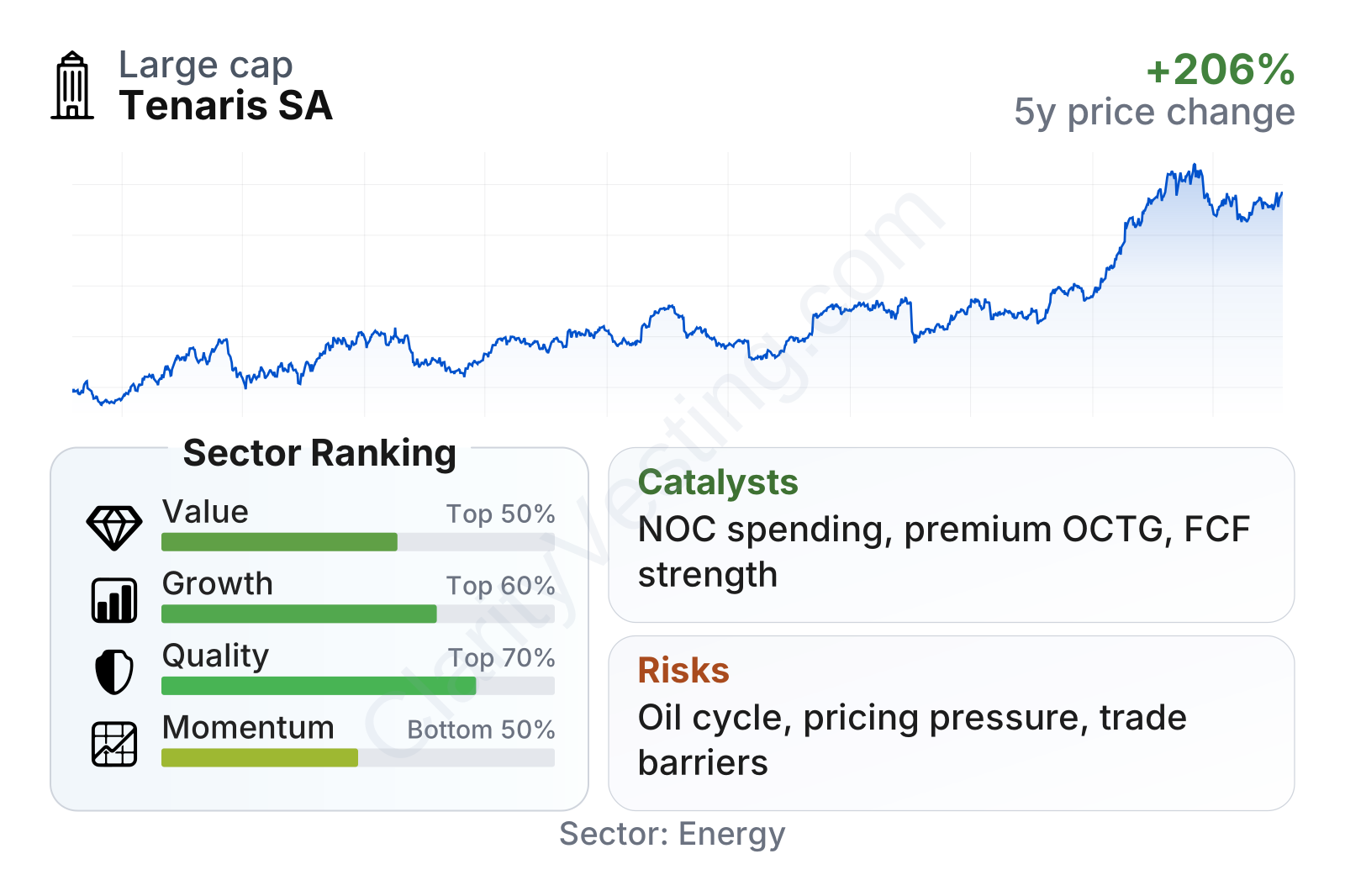
Tenaris is a large energy equipment company with a stock that has been less volatile than many names in the sector, as reflected by its beta of roughly 0.48. On valuation, it sits close to the sector on earnings and book value multiples, while its EBIT-to-enterprise-value measure is somewhat stronger than the sector median. Quality is one of the more notable traits here: leverage is extremely low, profitability is comfortably above sector norms, and returns on assets and invested capital are solid. Growth looks mixed in the short term because recent revenue has softened, but the longer-term record for revenue per share and book value growth remains favorable. Price momentum has cooled recently after a strong multiyear run.
Growth
Tenaris operates in a sector that is mature rather than structurally high-growth, but that does not mean growth is absent. Demand can still rise meaningfully when global drilling activity, offshore development, liquefied natural gas infrastructure, or Middle East capacity expansion accelerate. In other words, this is a cyclical growth business rather than a steady secular growth business.
The company’s strategy for future expansion is logical. It focuses on high-specification steel tubes, local manufacturing footprints near key markets, premium connections, and service integration with customers. That approach is important because oil and gas operators often care more about reliability, lead times, and total well cost than about the cheapest pipe price alone. This tends to favor established suppliers with technical credibility and broad logistics capabilities.
Recent sales trends show the cycle has cooled from the exceptional growth rates seen in 2022 and early 2023. Revenue then turned negative on a year-over-year basis for much of 2024 and part of 2025, before showing signs of stabilization. The latest reading points to a modest decline again, which suggests the recovery is not yet fully established. For long-term analysis, the important point is that the business has already shown it can scale strongly when customer spending improves.
Cash generation remains one of the more encouraging features. Free cash flow surged during the upcycle and, while lower than the peak, it has stayed positive at a healthy level. That matters because it gives Tenaris flexibility to maintain capital spending, pursue selective expansion, support shareholder distributions, and absorb weaker market periods without stressing the balance sheet.
A meaningful catalyst is continued spending by national oil companies, especially in regions where drilling programs are long-cycle and less sensitive to short-term commodity price swings. Another potential driver is offshore and international development, where premium tubular products are especially important. If energy security concerns continue to support investment in oil and natural gas supply, Tenaris is positioned to participate because its products are tied directly to well construction and production infrastructure.
Recent company communications have also highlighted industrial investments and operating upgrades in key markets, including North America and the Middle East. These projects matter because local presence can improve delivery speed, deepen customer relationships, and strengthen Tenaris’s position in large tenders.
Risks
This article is for informational purposes only and does not constitute financial advice. Some content is AI-generated. See Disclaimer


