Stock Analysis · Trevi Therapeutics Inc (TRVI)
Overview
Trevi Therapeutics is a clinical-stage biotechnology company. In simple terms, it is developing drug candidates but does not yet have an approved product on the market. Its lead program is oral nalbuphine extended-release, called Haduvio, which the company is studying for chronic cough conditions with high unmet need, especially refractory chronic cough and chronic cough in patients with idiopathic pulmonary fibrosis. Trevi’s approach is to target the body’s opioid receptors in a way that may reduce cough while trying to manage the side-effect profile through its formulation and dosing strategy.
Because Trevi is still in the development stage, its business model is not built on recurring commercial sales today. The economic value of the company currently depends mainly on clinical progress, regulatory milestones, and the possibility of eventually launching a product or partnering with a larger pharmaceutical company.
Its revenue mix is therefore unusually simple at this stage:
- Product revenue: 0% — Trevi has not reported meaningful commercial product sales.
- Collaboration or licensing revenue: approximately 0% — there is no major recurring partnered revenue stream visible in recent annual results.
- Other revenue: approximately 0% — reported revenue has been negligible relative to operating expenses.
That means the company is essentially funded by shareholder capital and cash on the balance sheet while it advances clinical trials. The expense base is concentrated in research and development, which has been the largest spending category, followed by general and administrative costs. Over the last several years, research and development has generally represented around 66% to 77% of operating expenses, showing that most spending is going into clinical advancement rather than commercial infrastructure.
The financial profile is typical of an earlier-stage biotech: no meaningful revenue, a heavy research budget, and persistent losses while the lead program moves through trials. The notable change is that spending rose sharply in 2024 and remained elevated in 2025, reflecting a more active development phase rather than a mature operating business.
Key Figures
| Metric | Value | Sector ⓘ |
|---|---|---|
| Date | Oct 17, 2026 | |
| Context | ||
| Sector | Healthcare | |
| Industry | Biotechnology | |
| Market Cap ⓘ | $1.72B | |
| Beta ⓘ | 0.98 | |
Value (Cheapness) | ||
| P/E Ratio ⓘ | N/A | 24.79 |
| P/B Ratio ⓘ | 5.90 | 3.08 |
| FCF Yield ⓘ | -2.29% | 3.15% |
| Dividend Yield ⓘ | N/A | 1.94% |
| EBIT / EV ⓘ | -2.94% | 0.57% |
| PEG ⓘ | N/A | |
Growth (Business expansion) | ||
| Revenue Growth ⓘ | N/A | 7.45% |
| RPS Growth (5Y CAGR) ⓘ | N/A | 8.61% |
| EPS Growth (5Y CAGR) ⓘ | -24.02% | -17.81% |
| BVPS Growth (5Y CAGR) ⓘ | 14.01% | 3.72% |
| Margin Growth (5Y Trend) ⓘ | N/A | -0.62% |
| FCF Growth (5Y CAGR) ⓘ | N/A | 1.04% |
| DPS Growth (5Y CAGR) ⓘ | N/A | 6.77% |
Quality (Business durability) | ||
| ROIC (Latest) ⓘ | -18.42% | 3.24% |
| ROA (Latest) ⓘ | -19.29% | 3.01% |
| ROIC (5Y Median) ⓘ | -31.49% | 4.60% |
| ROA (5Y Median) ⓘ | -36.10% | 1.89% |
| Net Debt / EBIT (Latest) ⓘ | N/A | 1.34 |
| Net Debt / EBIT (5Y Median) ⓘ | N/A | 1.84 |
| Net Debt / EBITDA (Latest) ⓘ | N/A | 1.00 |
| Net Debt / Assets ⓘ | -16.25% | 5.45% |
| EBITDA / Interest ⓘ | N/A | 9.64 |
| Operating Margin (Latest) ⓘ | N/A | 9.27% |
| Operating Margin (5Y Median) ⓘ | N/A | 7.38% |
| Debt to Equity (Latest) ⓘ | 0.19% | 28.58% |
| Profit Margin (Latest) ⓘ | N/A | 3.59% |
| Free Cash Flow (Latest) ⓘ | -$39.39M | |
Momentum (Price trend) | ||
| 3Y Return ⓘ | +544.15% | +42.80% |
| 12M Return (excl. last month) ⓘ | +86.48% | +18.50% |
| 6M Return ⓘ | -15.14% | +7.57% |
| Price vs. 200-Day MA ⓘ | -15.15% | +5.12% |
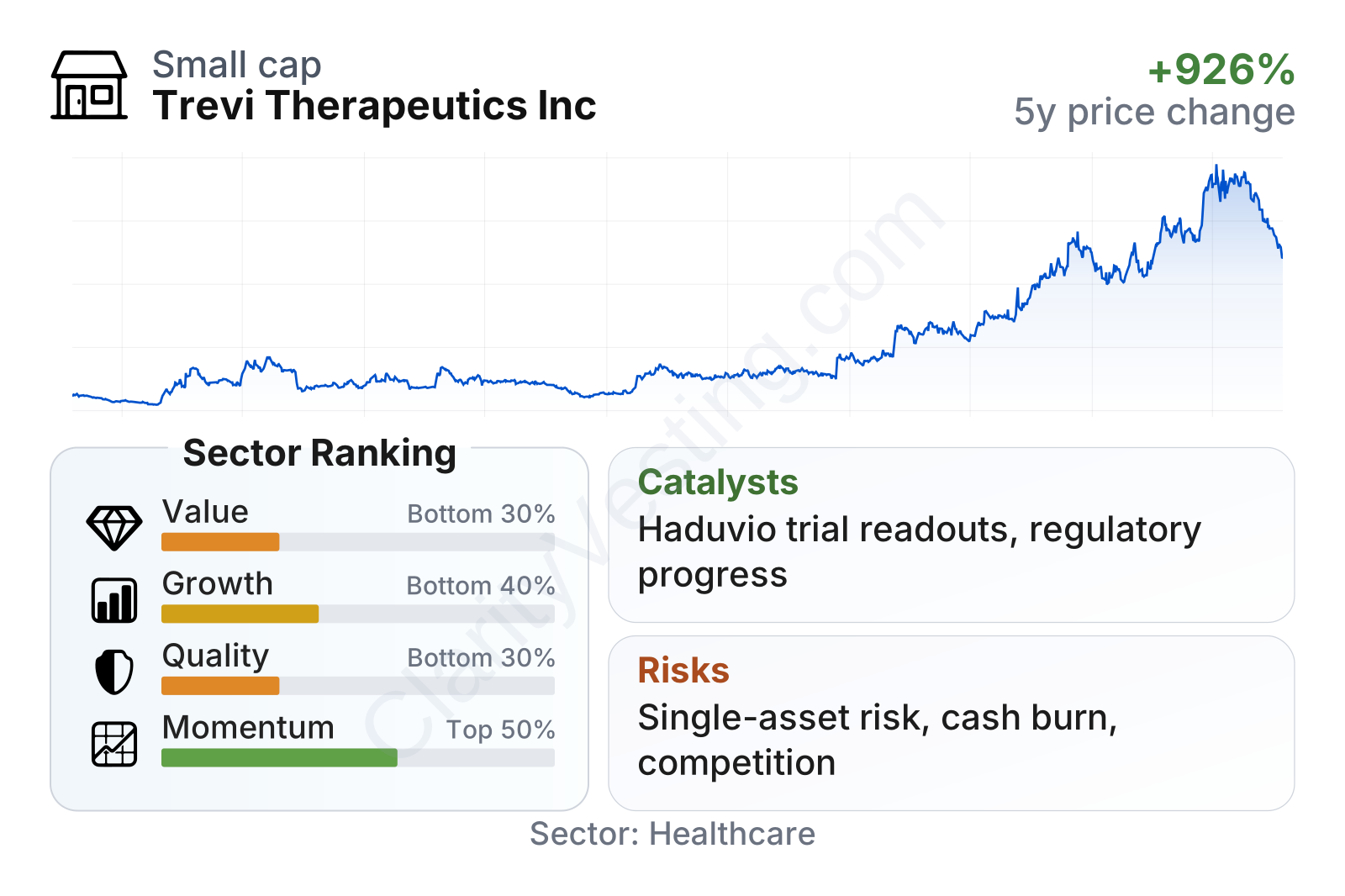
Trevi is now a mid-sized public biotech by market value, with share-price momentum that has been far stronger than most healthcare peers over the last one, three, and twelve-month comparison periods. That strength suggests the market has been reassessing the company upward, likely because of clinical progress and future expectations rather than current earnings power.
At the same time, the broader fundamentals remain those of a pre-revenue drug developer. On valuation, the company screens weaker than much of the sector because traditional measures such as price-to-book and free-cash-flow yield look demanding relative to peers. On quality and growth factors, the rankings also sit in the lower part of the sector, which is not surprising for a company without approved products or operating profits.
The main balance-sheet positive is financial leverage. Debt is minimal, and the company’s net cash position stands out as a strength. In other words, Trevi does not look financially stressed in a debt sense, even though it is still consuming cash.
Growth
Trevi operates in a part of healthcare that can offer meaningful long-term upside if a drug reaches approval: treating chronic conditions with limited effective options. Chronic cough, particularly refractory chronic cough and cough associated with idiopathic pulmonary fibrosis, is an area with substantial unmet need. Patients can live with persistent symptoms for years, and effective treatments remain limited, which creates room for new therapies if trial results are convincing.
The company’s strategy is coherent for a small biotech. Rather than building a broad pipeline across many unrelated diseases, Trevi has concentrated on a lead asset and on indications where symptom relief could be clinically important and commercially relevant. That focus can be a strength because it reduces strategic sprawl, although it also raises dependence on one program.
A major catalyst is the continuing clinical development of Haduvio. For a company like Trevi, trial readouts matter far more than current income statement trends. Positive efficacy and safety data, regulatory alignment, or signs that the drug could address more than one cough-related setting could materially improve its positioning. Management has emphasized advancing late-stage development planning, which is the key bridge between a research-stage company and a future commercial organization or licensing candidate.
Recent company updates have also pointed to expanding interest around chronic cough treatment, a market that has become more visible as larger companies pursue the same area. That does not guarantee success for Trevi, but it does help validate the medical and commercial importance of the field.
Cash flow remains negative, which is normal for a clinical-stage biotech, but the recent pattern shows some improvement from the worst level reached during the heavier spending phase. Even so, the company is still burning tens of millions of dollars annually, so growth in the business sense depends on converting clinical progress into a registrational path, partnership, or eventual product launch rather than on near-term revenue expansion.
Risks
This article is for informational purposes only and does not constitute financial advice. Some content is AI-generated. See Disclaimer


