Stock Analysis · Trupanion Inc (TRUP)
Overview
Trupanion is a pet medical insurance company focused mainly on cats and dogs. Its core product helps cover veterinary costs when a pet gets sick or injured, and the company is best known for a model that pays veterinarians directly at checkout in many cases. That direct-pay approach is designed to reduce friction for pet owners and clinics while supporting retention over time.
The business is concentrated in subscription-style recurring revenue. Based on recent annual reporting, the largest revenue sources are approximately the following:
- Subscription business: about 98% of total revenue. This includes monthly premiums from enrolled pets in North America and is the central engine of the company.
- Other business: about 2% of total revenue. This includes items such as fees and other non-subscription activities, which are much smaller than the core insurance-related stream.
Within the subscription model, revenue is supported by three operating building blocks: attracting new pets, keeping existing members enrolled, and adjusting pricing to reflect veterinary cost trends. Trupanion also works through veterinary relationships and field representatives, which is different from many insurance companies that rely more heavily on broad comparison shopping or large multi-line insurance platforms.
Over the last several years, revenue has continued to rise, while profitability has taken longer to arrive. More recently, the income profile has started to improve, suggesting that scale and pricing discipline are beginning to matter more than in the earlier growth phase.
The progression is notable: revenue has climbed steadily from under $700 million in 2021 to roughly $1.4 billion in 2025, while operating results moved from losses to a modest profit. That shift matters because it shows Trupanion is no longer only chasing growth; it is also showing signs of a more sustainable earnings model.
Key Figures
| Metric | Value | Sector ⓘ |
|---|---|---|
| Date | Oct 17, 2026 | |
| Context | ||
| Sector | Financial Services | |
| Industry | Insurance - Property & Casualty | |
| Market Cap ⓘ | $1.17B | |
| Beta ⓘ | 1.44 | |
Value (Cheapness) | ||
| P/E Ratio ⓘ | 50.43 | 12.26 |
| P/B Ratio ⓘ | 2.98 | 1.23 |
| FCF Yield ⓘ | 7.05% | 10.40% |
| Dividend Yield ⓘ | N/A | 3.02% |
| EBIT / EV ⓘ | 5.18% | 8.14% |
| PEG ⓘ | N/A | |
Growth (Business expansion) | ||
| Revenue Growth ⓘ | 11.10% | 9.35% |
| RPS Growth (5Y CAGR) ⓘ | 17.37% | 12.19% |
| EPS Growth (5Y CAGR) ⓘ | N/A | -9.53% |
| BVPS Growth (5Y CAGR) ⓘ | 1.59% | 4.99% |
| Margin Growth (5Y Trend) ⓘ | N/A | -3.86% |
| FCF Growth (5Y CAGR) ⓘ | N/A | 4.81% |
| DPS Growth (5Y CAGR) ⓘ | -7.65% | 8.79% |
Quality (Business durability) | ||
| ROIC (Latest) ⓘ | 6.52% | 9.49% |
| ROE (Latest) ⓘ | 5.97% | 13.90% |
| ROA (Latest) ⓘ | 2.56% | 1.55% |
| ROIC (5Y Median) ⓘ | -6.37% | 7.86% |
| ROE (5Y Median) ⓘ | -10.57% | 12.17% |
| ROA (5Y Median) ⓘ | -6.15% | 1.30% |
| Net Debt / EBIT (Latest) ⓘ | -1.15 | 0.96 |
| Net Debt / EBIT (5Y Median) ⓘ | N/A | 0.73 |
| Net Debt / EBITDA (Latest) ⓘ | -0.81 | 0.92 |
| Operating Margin (Latest) ⓘ | 2.42% | 22.30% |
| Operating Margin (5Y Median) ⓘ | -2.97% | 24.63% |
| Debt to Equity (Latest) ⓘ | 26.10% | 58.56% |
| Profit Margin (Latest) ⓘ | 1.53% | 26.57% |
| Free Cash Flow (Latest) ⓘ | $82.18M | |
Momentum (Price trend) | ||
| 3Y Return ⓘ | +4.19% | +88.33% |
| 12M Return (excl. last month) ⓘ | -41.16% | +19.38% |
| 6M Return ⓘ | +2.43% | +4.75% |
| Price vs. 200-Day MA ⓘ | +3.23% | +3.50% |
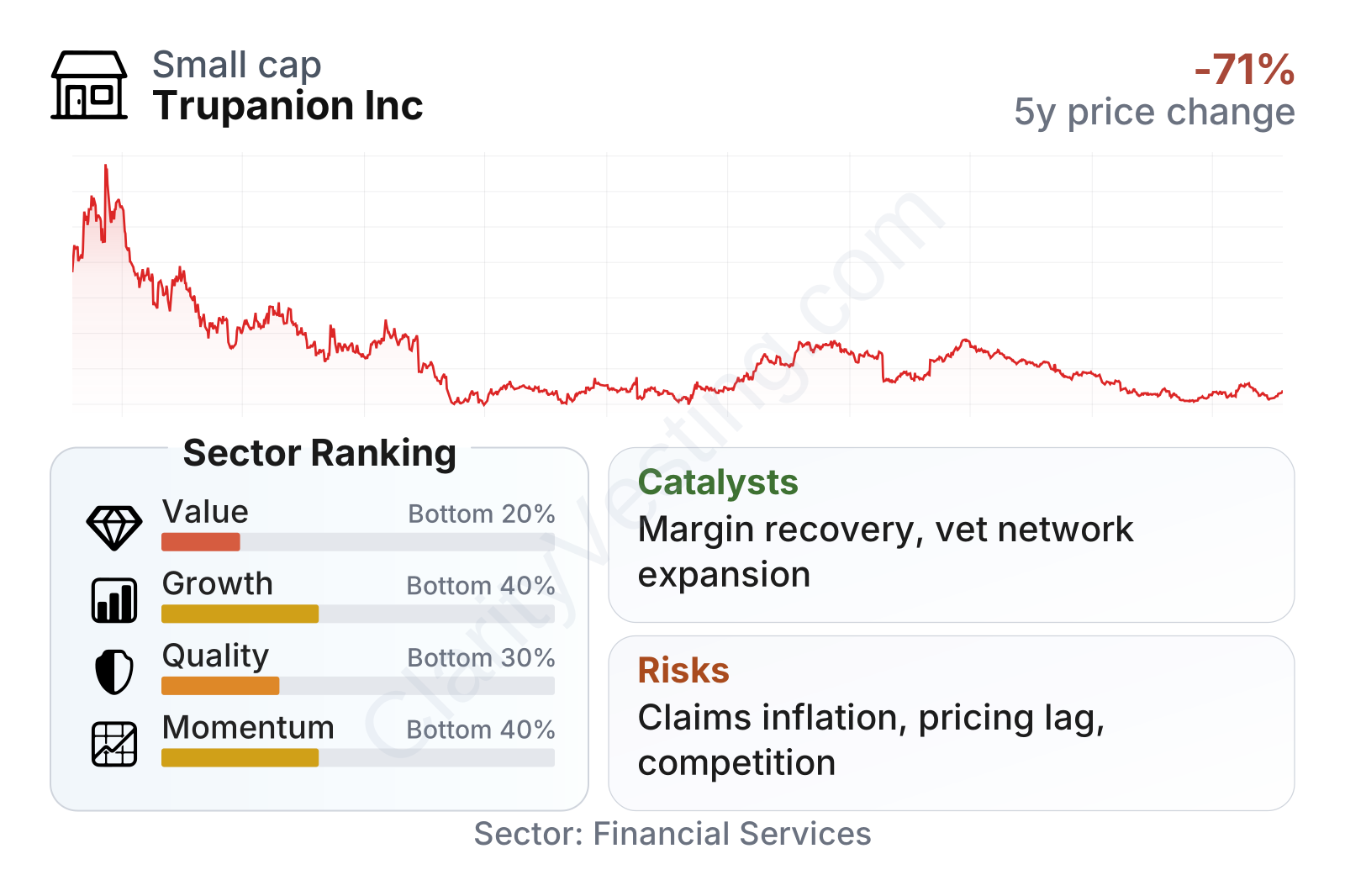
Trupanion is a small-cap company with a stock that has been volatile, as reflected in its above-market beta and weak recent price momentum. The factor snapshot is mixed. Revenue growth has been slightly ahead of the sector median, and free cash flow is positive, but profitability and returns on capital still rank below many peers in insurance. The valuation profile also screens as expensive versus the sector on earnings and book value multiples, even after the stock’s large decline from earlier highs.
The share price history shows how sharply market expectations have changed. After peaking above $120 in early 2022, the stock fell heavily and has remained far below those levels through mid-2026. That usually signals that the market now requires more proof of durable profitability rather than rewarding premium growth alone.
Growth
Pet insurance remains a growing niche inside a much larger pet care market. In the United States and Canada, penetration is still relatively low compared with some more mature international markets, which leaves room for expansion if consumer awareness keeps rising. Veterinary bills have also increased over time, making insurance easier to justify for many households. That backdrop supports the logic behind Trupanion’s long-term strategy.
The company’s strategy is fairly coherent for future growth. It is centered on building a large base of recurring subscription revenue, using data and pricing to manage claims, and deepening relationships with veterinarians. Direct payment technology can help differentiate the service experience because pet owners often care most about simplicity at the point of care, not just the monthly premium. If that network keeps expanding, it can strengthen customer acquisition and retention at the same time.
Earnings per share show a meaningful turnaround. Trupanion moved from losses in 2021 through 2023 to positive earnings in 2024 and stronger profits in 2025. Even though the latest trailing figure is below the 2025 peak, the broader pattern still points to a business that has crossed an important threshold from persistent losses toward recurring profitability.
Book value per share has been more stable than the stock price, with gradual improvement after a dip in 2022 and 2023. That is not a hyper-growth pattern, but it does suggest the company has started to rebuild shareholder value as losses narrowed and earnings improved.
A significant catalyst is execution on pricing and margins. Trupanion’s recent financial direction indicates better alignment between premium pricing and veterinary cost inflation. If that balance holds, revenue growth does not need to be extreme for earnings to continue improving. Another possible tailwind is continued expansion of clinic relationships and software-enabled payment capabilities, which could make the product more visible at the point where pet owners make healthcare decisions.
Recent company communications have also emphasized operating discipline and adjusted profitability progress rather than growth at any cost. That change in tone is important because it suggests management is responding to the market’s demand for stronger financial quality, not just larger scale.
Risks
This article is for informational purposes only and does not constitute financial advice. Some content is AI-generated. See Disclaimer


