Stock Analysis · Tootsie Roll Industries Inc (TROLB)
Overview
Tootsie Roll Industries is a long-established U.S. confectionery company best known for chocolate and candy brands sold in supermarkets, convenience stores, dollar stores, club stores, pharmacies, and seasonal channels. Its portfolio includes Tootsie Roll, Tootsie Pop, Dot’s, Junior Mints, Charleston Chew, Sugar Daddy, Sugar Babies, Andes, Charms, Blow-Pop, Dubble Bubble, Cella’s, and Ring Pop. The business is straightforward: it manufactures branded candy, distributes it widely, and relies on repeat purchases supported by brand familiarity, holiday demand, and broad retail shelf presence.
The company reports revenue mainly through product categories rather than many separate operating segments. Based on its latest annual filing, revenue is heavily concentrated in chocolate and candy sold primarily in the United States, with a smaller international contribution.
- Chocolate products: about 47% of revenue. This category includes Tootsie Roll, Junior Mints, Andes, Charleston Chew, Sugar Daddy, Sugar Babies, Cella’s, and related items.
- Candy products: about 47% of revenue. This includes Tootsie Pops, Charms, Blow-Pop, Dubble Bubble, Dot’s, Ring Pop, and other fruit- and gum-based products.
- Other: about 6% of revenue. This mainly reflects less central product lines and miscellaneous sales activity.
Geographically, the company remains primarily a domestic business. The United States typically represents close to 90% of sales, with international markets contributing roughly 10%.
What stands out financially is how much of each sales dollar is retained compared with many packaged food peers. Revenue has fluctuated over the last few years, but margins and net income have generally held up well, helped by disciplined operations and a business model that requires very little borrowing.
Over the last five years, sales moved from roughly $570 million to more than $730 million, while operating income and net income also improved overall. The pattern is not one of rapid expansion, but rather of a steady branded consumer business that has preserved profitability even through uneven revenue periods.
Key Figures
| Metric | Value | Sector ⓘ |
|---|---|---|
| Date | Oct 17, 2026 | |
| Context | ||
| Sector | Consumer Defensive | |
| Industry | Confectioners | |
| Market Cap ⓘ | $2.93B | |
| Beta ⓘ | 0.41 | |
Value (Cheapness) | ||
| P/E Ratio ⓘ | 30.95 | 17.88 |
| P/B Ratio ⓘ | 3.07 | 1.29 |
| FCF Yield ⓘ | 2.73% | 12.39% |
| Dividend Yield ⓘ | 0.89% | 2.85% |
| EBIT / EV ⓘ | 4.75% | 6.43% |
| PEG ⓘ | N/A | |
Growth (Business expansion) | ||
| Revenue Growth ⓘ | -0.60% | 4.10% |
| RPS Growth (5Y CAGR) ⓘ | 6.72% | 6.18% |
| EPS Growth (5Y CAGR) ⓘ | -21.93% | -13.59% |
| BVPS Growth (5Y CAGR) ⓘ | 5.46% | 3.20% |
| Margin Growth (5Y Trend) ⓘ | 3.77% | -0.15% |
| FCF Growth (5Y CAGR) ⓘ | 15.64% | 4.10% |
| DPS Growth (5Y CAGR) ⓘ | 2.21% | 6.79% |
Quality (Business durability) | ||
| ROIC (Latest) ⓘ | 10.09% | 12.34% |
| ROA (Latest) ⓘ | 7.64% | 6.30% |
| ROIC (5Y Median) ⓘ | 10.19% | 10.49% |
| ROA (5Y Median) ⓘ | 7.78% | 5.44% |
| Net Debt / EBIT (Latest) ⓘ | -0.35 | 1.96 |
| Net Debt / EBIT (5Y Median) ⓘ | -0.83 | 2.35 |
| Net Debt / EBITDA (Latest) ⓘ | -0.31 | 1.38 |
| Net Debt / Assets ⓘ | -3.62% | 21.51% |
| EBITDA / Interest ⓘ | N/A | 9.46 |
| Operating Margin (Latest) ⓘ | 17.73% | 8.87% |
| Operating Margin (5Y Median) ⓘ | 15.63% | 9.53% |
| Debt to Equity (Latest) ⓘ | 1.70% | 72.35% |
| Profit Margin (Latest) ⓘ | 12.99% | 5.40% |
| Free Cash Flow (Latest) ⓘ | $80.16M | |
Momentum (Price trend) | ||
| 3Y Return ⓘ | +42.14% | +20.92% |
| 12M Return (excl. last month) ⓘ | -18.92% | +2.13% |
| 6M Return ⓘ | +15.51% | +1.26% |
| Price vs. 200-Day MA ⓘ | +30.62% | +1.39% |
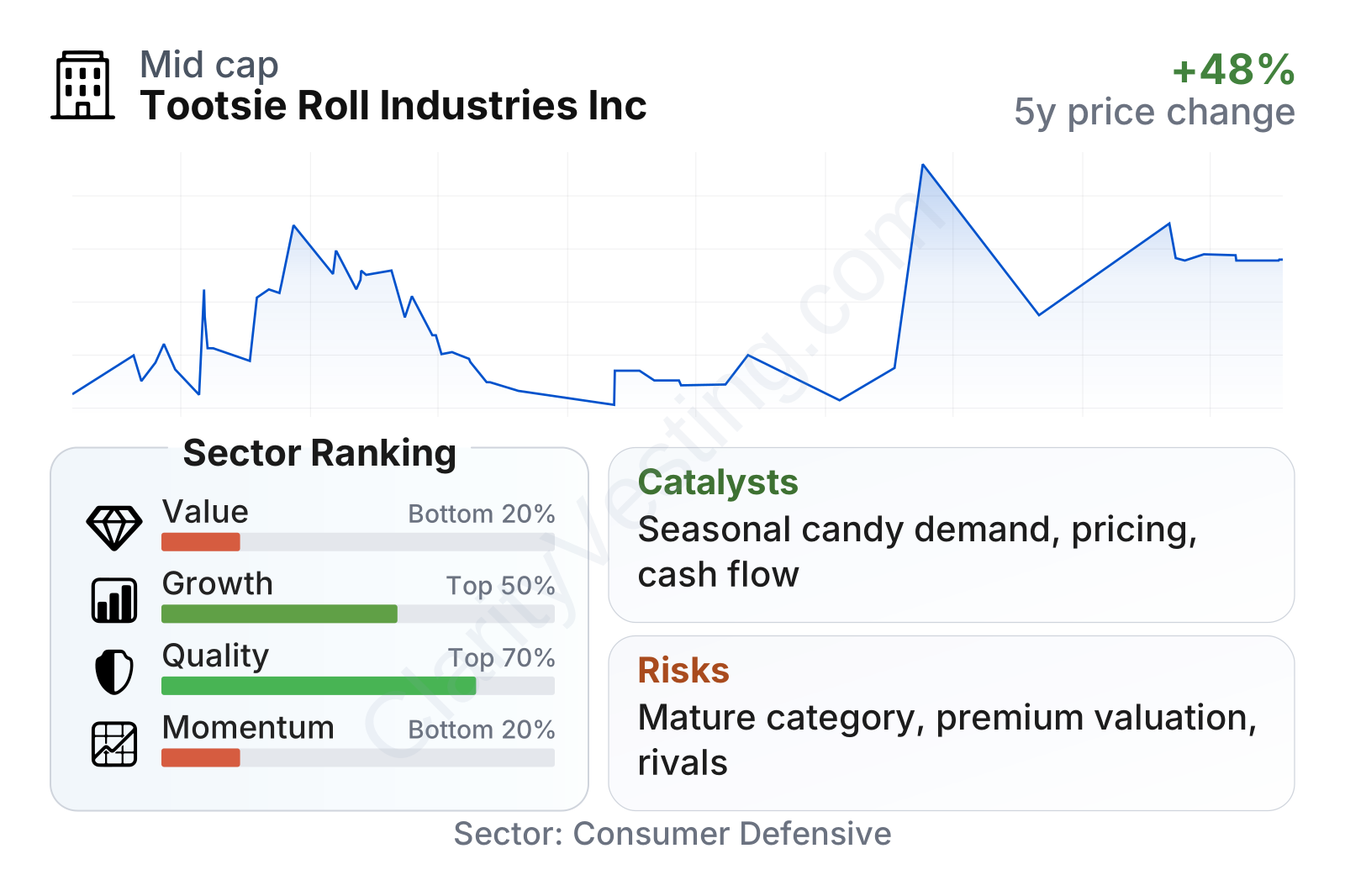
Tootsie Roll is a mid-sized consumer defensive company with unusually low share-price volatility, as shown by its low beta. Profitability and balance-sheet quality look stronger than much of the sector: operating margin is well above the industry median, profit margin is also materially higher, and net debt is effectively negative because cash exceeds borrowings. Growth measures are more mixed. Longer-term revenue per share and free cash flow trends have been solid, but recent revenue growth has been slightly negative and earnings growth over five years has been weak. Valuation is the main constraint: the stock trades at meaningfully higher earnings and book multiples than the sector, while dividend yield and free-cash-flow yield are lower than typical peers.
Growth
The confectionery market is a mature part of the consumer staples sector, not a high-growth industry. That matters because Tootsie Roll is unlikely to produce the kind of expansion seen in newer categories such as energy drinks or premium health-focused snacks. Still, candy has attractive characteristics for long-term business resilience: low ticket prices, frequent repeat purchases, strong seasonality around holidays, and relatively stable demand even during weaker economic periods.
Tootsie Roll’s strategy is sensible for this type of market. The company focuses on established brands, broad retail distribution, manufacturing control, and conservative financial management rather than large acquisitions or aggressive leverage. That approach does not usually create sudden jumps in sales, but it can support durable cash generation and protect margins over time.
Recent sales momentum has been soft. After very strong post-inflation and post-reopening gains in 2022 and 2023, year-over-year revenue turned negative in 2024 and remained slightly below prior-year levels more recently. That suggests the business is currently in a slower phase, likely reflecting a tougher comparison base, normal fluctuations in shipment timing, and the mature nature of the category. Even so, the longer view is more stable than the recent quarters imply, with five-year revenue per share growth still modestly ahead of the sector median.
Cash generation is one of the more constructive signals. Free cash flow has been volatile from year to year, but the broader direction over five years has been favorable, and current levels remain healthy for a company of this size. That gives Tootsie Roll flexibility to keep investing in production, advertising, seasonal inventory, and regular dividends without depending on external financing.
As for catalysts, Tootsie Roll does not have an obvious transformative trigger such as a major new market, a large merger, or a fast-growing digital platform. The more realistic opportunities are incremental: price realization, improved product mix, seasonal strength, wider distribution, and continued margin discipline. In a market that values consistency, a company with high margins, strong cash generation, and almost no leverage can still create gradual long-term business progress even without dramatic top-line acceleration.
Risks
This article is for informational purposes only and does not constitute financial advice. Some content is AI-generated. See Disclaimer


