Stock Analysis · Terreno Realty Corporation (TRNO)
Overview
Terreno Realty Corporation is an industrial real estate investment trust, or REIT. In simple terms, it owns warehouses and other logistics properties, then earns rent from tenants that use those buildings to store, sort, and move goods. The company focuses on six large coastal U.S. markets: Los Angeles, Northern New Jersey/New York City, Miami, the San Francisco Bay Area, Seattle, and Washington, D.C. These markets tend to have dense populations, limited land for new industrial construction, and strong demand from distribution, transportation, and e-commerce users.
Its business model is relatively straightforward: acquire industrial properties in supply-constrained locations, lease them to tenants, raise rent over time, and selectively redevelop or reposition assets to improve returns. Terreno also benefits from tenant diversification, with no single tenant dominating rent, which helps reduce dependence on one customer.
The main sources of revenue are concentrated in rental income from industrial properties. Based on company filings, revenue is overwhelmingly recurring and property-based.
- Rental and occupancy revenue: approximately 95% to 98% — base rent from warehouse, distribution, flex, and transshipment properties leased to tenants.
- Tenant reimbursements and other property income: approximately 2% to 5% — recoveries for operating costs, parking or ancillary income, and other lease-related items.
- Gains from property sales: variable and not part of core recurring revenue — these can materially affect net income in some periods, but they are episodic rather than a stable operating source.
Over the last several years, total revenue and gross profit have moved upward steadily, while operating costs have risen more slowly than revenue. That pattern is consistent with a landlord benefiting from rent growth, acquisitions, and generally efficient property operations.
Key Figures
| Metric | Value | Sector ⓘ |
|---|---|---|
| Date | Oct 03, 2026 | |
| Context | ||
| Sector | Real Estate | |
| Industry | REIT - Industrial | |
| Market Cap ⓘ | $7.03B | |
| Beta ⓘ | 1.04 | |
Value (Cheapness) | ||
| P/E Ratio ⓘ | 17.35 | 17.35 |
| P/B Ratio ⓘ | 1.54 | 0.86 |
| FCF Yield ⓘ | 2.64% | 7.47% |
| Dividend Yield ⓘ | 3.17% | 4.75% |
| EBIT / EV ⓘ | 5.24% | 3.81% |
| PEG ⓘ | 7.15 | |
Growth (Business expansion) | ||
| Revenue Growth ⓘ | 11.10% | 5.30% |
| RPS Growth (5Y CAGR) ⓘ | 10.28% | 5.96% |
| EPS Growth (5Y CAGR) ⓘ | -16.48% | -11.41% |
| BVPS Growth (5Y CAGR) ⓘ | 8.55% | 0.41% |
| Margin Growth (5Y Trend) ⓘ | 44.04% | 0.53% |
| FCF Growth (5Y CAGR) ⓘ | 26.69% | 5.40% |
| DPS Growth (5Y CAGR) ⓘ | 13.51% | 5.02% |
Quality (Business durability) | ||
| ROIC (Latest) ⓘ | 6.38% | 5.77% |
| ROE (Latest) ⓘ | 9.22% | 7.64% |
| ROA (Latest) ⓘ | 7.04% | 2.85% |
| ROIC (5Y Median) ⓘ | 3.92% | 4.20% |
| ROE (5Y Median) ⓘ | 5.89% | 6.03% |
| ROA (5Y Median) ⓘ | 4.29% | 2.45% |
| Net Debt / EBIT (Latest) ⓘ | 2.37 | 7.57 |
| Net Debt / EBIT (5Y Median) ⓘ | 3.44 | 8.41 |
| Net Debt / EBITDA (Latest) ⓘ | 1.83 | 5.12 |
| Net Debt / Assets ⓘ | 17.59% | 37.84% |
| EBITDA / Interest ⓘ | 15.59 | 4.11 |
| Operating Margin (Latest) ⓘ | 84.28% | 35.40% |
| Operating Margin (5Y Median) ⓘ | 54.47% | 36.59% |
| Debt to Equity (Latest) ⓘ | 23.83% | 89.06% |
| Profit Margin (Latest) ⓘ | 77.27% | 19.99% |
| Free Cash Flow (Latest) ⓘ | $185.47M | |
Momentum (Price trend) | ||
| 3Y Return ⓘ | +26.32% | +30.60% |
| 12M Return (excl. last month) ⓘ | +19.00% | +7.55% |
| 6M Return ⓘ | +5.31% | +0.69% |
| Price vs. 200-Day MA ⓘ | -0.35% | -2.30% |
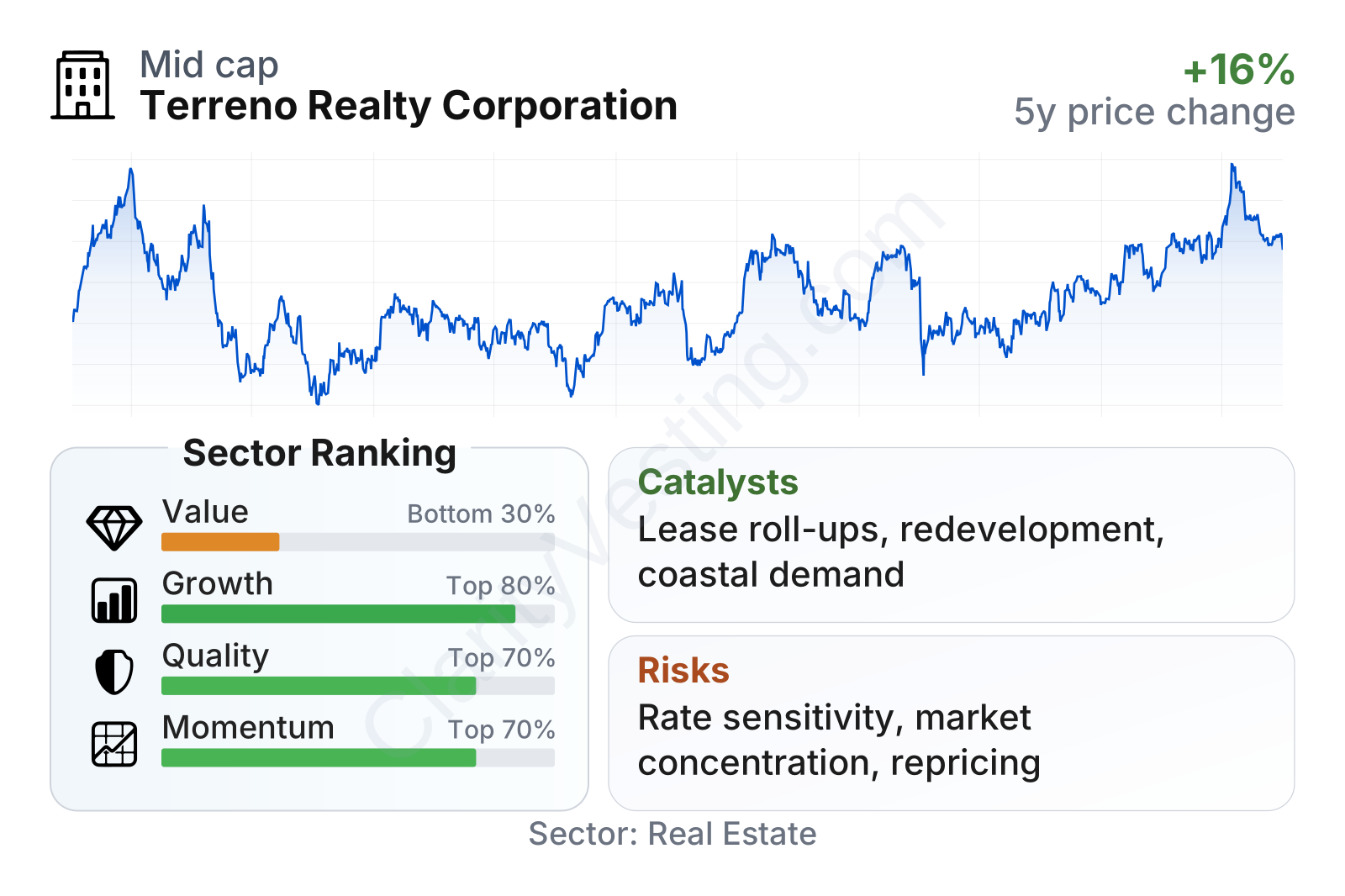
Terreno is a mid-sized public industrial REIT with a market value in the low single-digit billions of dollars and a share price that has recovered well from its 2025 lows. The overall profile is mixed in a useful way: growth, quality, and recent market momentum rank above much of the real estate sector, while value measures look less attractive. In plain English, the business appears operationally strong, but the stock is not obviously cheap relative to peers.
The table also highlights an important distinction for REITs: earnings per share can be noisy because property sales, depreciation rules, and valuation effects can distort bottom-line profit. That is why balance-sheet strength, rent growth, cash generation, and property-level profitability often matter more than a single headline earnings figure.
Growth
Terreno operates in one of the more durable areas of commercial real estate. Industrial properties linked to logistics, local delivery, and supply-chain infrastructure have enjoyed better long-term demand than many office or traditional retail categories. The company’s market focus strengthens that positioning because coastal gateway cities tend to have scarce developable land, dense transportation networks, and large consumer populations. Those features can support occupancy and pricing power over long periods.
Its strategy also makes sense for future expansion. Terreno does not need a nationwide footprint to grow; instead, it concentrates capital where barriers to entry are high. That allows management to pursue acquisitions, redevelopment projects, and lease rollovers in places where replacement costs and land scarcity can support higher rents.
Revenue per share has trended upward consistently over the last five years, rising at a pace above the sector median. That is a constructive sign because it suggests growth has not relied only on issuing more shares. Book value per share has also compounded faster than the sector median, which supports the view that the company has been adding asset value rather than just getting larger.
The dividend has also increased steadily, with five-year growth well ahead of the typical real estate peer. Even though the current yield is below the sector median, the pattern points to a REIT that has prioritized dividend growth from a comparatively strong operating base rather than simply offering a high starting yield.
A meaningful catalyst is lease repricing. In industrial real estate, older leases can reset at higher market rents when they expire, especially in constrained markets. If Terreno continues to capture rent spreads on renewals and new leases, internal growth can remain solid even without a dramatic jump in property acquisitions. Another catalyst is redevelopment: upgrading or reconfiguring existing sites can generate higher returns than buying fully priced assets in the open market.
Recent company updates have also pointed to continued acquisition and development activity, which matters because industrial landlords with disciplined pipelines can create value through both current income and future rent increases. Combined with above-sector revenue growth and strong operating margin expansion, that gives Terreno a credible growth runway as long as demand in logistics markets remains healthy.
Risks
This article is for informational purposes only and does not constitute financial advice. Some content is AI-generated. See Disclaimer