Stock Analysis · Torm PLC (TRMD)
Overview
TORM PLC is a product tanker shipping company. In simple terms, it owns and operates vessels that transport refined oil products such as gasoline, diesel, jet fuel, naphtha, and other clean petroleum products between refineries, storage hubs, and end markets around the world. The company is headquartered in the United Kingdom and runs a large fleet focused mainly on product tankers rather than crude oil tankers.
Its business is driven primarily by freight rates: when customers need ships to move refined fuels across longer distances or in tighter shipping markets, TORM can earn much more per vessel. That makes the company highly exposed to global trade flows, refinery locations, oil demand, and vessel supply.
Based on company reporting, revenue is overwhelmingly tied to vessel operations. A simple way to think about the mix is:
- Time charter equivalent earnings from shipping operations: about 95% to 100% — income generated by transporting refined petroleum products on TORM’s tanker fleet. This is the core business.
- Ancillary and other operating income: usually less than 5% — items such as technical management-related activity, miscellaneous voyage-related items, or accounting adjustments outside core freight earnings.
Within shipping operations, TORM’s exposure is spread across several product tanker classes, with the largest contribution typically coming from LR2, LR1, and MR vessels. These ships serve different trade routes and cargo sizes, helping the company participate in both regional and long-haul fuel transportation.
The broader financial picture shows why the company has attracted attention: revenue and profitability expanded sharply after 2021 as tanker markets strengthened, although results remain cyclical and can swing with freight conditions. Even after a softer 2025 compared with the exceptional prior years, the business remained profitable.
The long-term pattern shows a major step-up from 2021 into 2022 through 2024, when a much larger share of revenue translated into operating profit and net income. 2025 cooled from those peak conditions, but the company still generated meaningful earnings rather than falling back toward break-even.
Key Figures
| Metric | Value | Sector ⓘ |
|---|---|---|
| Date | Oct 17, 2026 | |
| Context | ||
| Sector | Energy | |
| Industry | Oil & Gas Midstream | |
| Market Cap ⓘ | $4.22B | |
| Beta ⓘ | -0.02 | |
Value (Cheapness) | ||
| P/E Ratio ⓘ | 6.77 | 15.44 |
| P/B Ratio ⓘ | 1.64 | 1.73 |
| FCF Yield ⓘ | 4.41% | 8.20% |
| Dividend Yield ⓘ | 10.80% | 3.59% |
| EBIT / EV ⓘ | 16.34% | 7.46% |
| PEG ⓘ | N/A | |
Growth (Business expansion) | ||
| Revenue Growth ⓘ | 110.30% | 26.90% |
| RPS Growth (5Y CAGR) ⓘ | 15.02% | 6.90% |
| EPS Growth (5Y CAGR) ⓘ | -47.18% | -15.73% |
| BVPS Growth (5Y CAGR) ⓘ | 12.99% | 6.07% |
| Margin Growth (5Y Trend) ⓘ | 27.29% | 0.58% |
| FCF Growth (5Y CAGR) ⓘ | N/A | 1.86% |
| DPS Growth (5Y CAGR) ⓘ | -0.76% | 16.79% |
Quality (Business durability) | ||
| ROIC (Latest) ⓘ | N/A | 11.40% |
| ROA (Latest) ⓘ | 17.64% | 6.06% |
| ROIC (5Y Median) ⓘ | 22.64% | 10.30% |
| ROA (5Y Median) ⓘ | 19.32% | 5.42% |
| Net Debt / EBIT (Latest) ⓘ | 1.01 | 1.64 |
| Net Debt / EBIT (5Y Median) ⓘ | 1.40 | 1.83 |
| Net Debt / EBITDA (Latest) ⓘ | 0.76 | 1.08 |
| Net Debt / Assets ⓘ | 18.52% | 17.29% |
| EBITDA / Interest ⓘ | 12.19 | 9.64 |
| Operating Margin (Latest) ⓘ | 39.88% | 16.27% |
| Operating Margin (5Y Median) ⓘ | 41.94% | 20.39% |
| Debt to Equity (Latest) ⓘ | 42.20% | 54.76% |
| Profit Margin (Latest) ⓘ | 35.52% | 8.82% |
| Free Cash Flow (Latest) ⓘ | $186.19M | |
Momentum (Price trend) | ||
| 3Y Return ⓘ | +116.92% | +67.38% |
| 12M Return (excl. last month) ⓘ | +81.52% | +49.19% |
| 6M Return ⓘ | +48.60% | +7.07% |
| Price vs. 200-Day MA ⓘ | +45.49% | +9.56% |
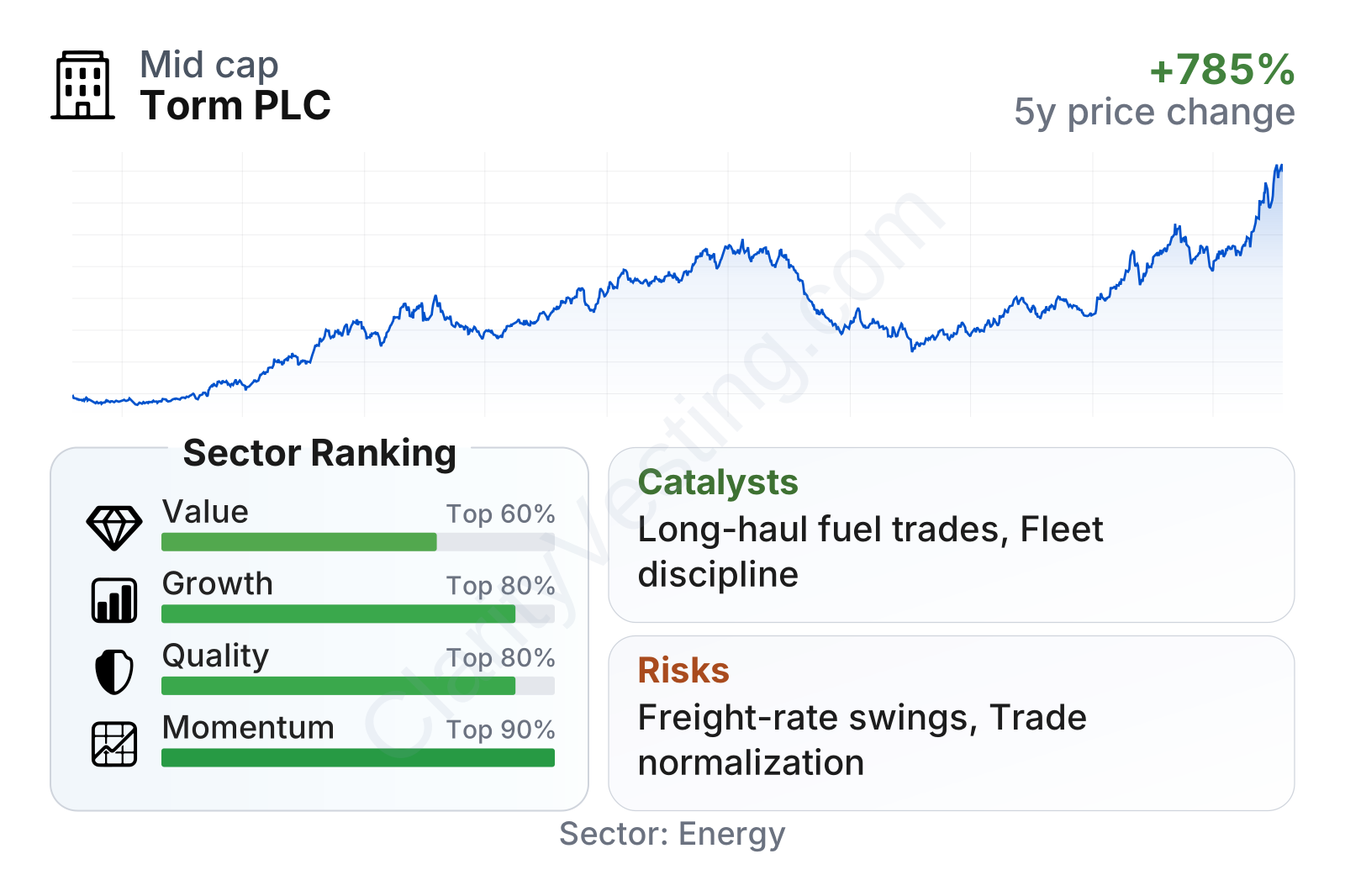
TORM stands out on growth, quality, and momentum relative to much of the energy sector, while value metrics still look undemanding on earnings and enterprise-value-based measures. The stock is no longer priced like a distressed cyclical name, but it still screens cheaper than the sector on P/E, while profitability, balance sheet leverage, and recent price performance remain notably strong.
The share price history also highlights an important point for long-term readers: this has not been a steady compounding stock. It has been a volatile security with sharp upward and downward moves that closely follow tanker market conditions.
Growth
TORM operates in a sector that can grow even when global oil demand grows only modestly. What matters most is not just how much fuel the world consumes, but where fuels are refined and how far they must travel. Over the past few years, refinery reshuffling, changing trade routes, sanctions-related dislocations, and longer average shipping distances have supported demand for product tankers. That backdrop has generally favored efficient operators with scale.
TORM’s strategy is sensible for this market. The company focuses on a specialized fleet, commercial optimization, and active capital allocation. Scale matters in tanker shipping because a larger fleet gives more flexibility in chartering, positioning vessels, and serving customers across multiple regions. TORM is one of the larger publicly listed product tanker operators, which gives it relevance with major charterers even if it is not the only leader in the segment.
Revenue growth has been highly uneven, which is normal in shipping. The business saw explosive gains during the strongest parts of the cycle, then a slowdown and contraction as rates normalized, followed by a sharp rebound in the latest period. That pattern shows both the opportunity and the challenge: TORM can grow very fast when the market turns favorable, but that growth is not linear.
Free cash flow has also been volatile, moving from negative territory to very strong generation and then moderating again. Even so, the company has shown an ability to convert favorable market conditions into real cash rather than only accounting profits. That matters in shipping because cash supports dividends, debt reduction, fleet renewal, and resilience during weaker periods.
A meaningful catalyst is continued inefficiency in refined product trade routes. If refineries remain concentrated in export hubs while demand stays distributed across Europe, Africa, Latin America, and Asia, product tankers may continue to benefit from longer voyages. Environmental regulations can also tighten effective vessel supply by slowing older ships or raising compliance costs, which may support freight rates for modern fleets.
Recent company communications have also emphasized fleet renewal and operational discipline rather than aggressive empire-building. For a cyclical industry, that is generally more constructive than chasing growth at any price. TORM has also remained active in returning capital, which signals confidence in cash generation, though those distributions can fluctuate sharply with the market.
Risks
This article is for informational purposes only and does not constitute financial advice. Some content is AI-generated. See Disclaimer


