Stock Analysis · Trulieve Cannabis Corp (TRLV)
Overview
Trulieve Cannabis Corp is a U.S. cannabis operator focused on cultivating, processing, distributing, and selling marijuana products for medical and adult-use markets where state laws permit. Its model is vertically integrated in many of its core markets, meaning it often controls the product from cultivation through retail sale. That structure can support product consistency, protect margins, and help the company respond faster to pricing changes than businesses that rely more heavily on third parties.
The business is centered on branded cannabis products sold through company-owned dispensaries, with Florida remaining its most important market. Trulieve has also built positions in other states including Pennsylvania, Arizona, and several additional limited-license markets. Revenue is mainly generated from direct retail sales to consumers, with a smaller wholesale contribution from sales to other dispensaries and partners.
Based on company disclosures, Trulieve’s revenue mix is best understood this way:
- Retail cannabis sales: approximately 90% to 95% — flower, pre-rolls, vapes, concentrates, edibles, capsules, tinctures, topicals, and related branded products sold through Trulieve dispensaries.
- Wholesale cannabis sales: approximately 5% to 10% — products sold to other licensed operators or through third-party channels where regulations allow.
- By geography, Florida is the dominant source — recent annual reporting indicates Florida has represented roughly 60% to 65% of revenue, with the rest coming from other U.S. states.
One useful feature of Trulieve’s model is its concentration in markets with tighter licensing structures. That does not remove competition, but it can limit how quickly rivals expand. The tradeoff is that the company is more exposed to state-level regulatory and demand shifts, especially in Florida.
The operating picture has improved from the difficult 2023 period. Revenue has been relatively steady around the low-$1 billion range, gross profit has remained solid, and operating income turned positive again in 2024 and improved further in 2025. Interest expense also moved lower from 2023 levels, which matters for a company still carrying meaningful leverage.
The flow of revenue and costs shows a business that recovered operating profitability after a sharp setback in 2023. Gross profit stayed resilient, while selling and administrative expenses and interest costs became more manageable. The remaining gap between operating profit and net income highlights how taxes, financing costs, and non-operating charges still weigh heavily on final earnings.
Key Figures
| Metric | Value | Sector ⓘ |
|---|---|---|
| Date | Oct 03, 2026 | |
| Context | ||
| Sector | Healthcare | |
| Industry | Drug Manufacturers - Specialty & Generic | |
| Market Cap ⓘ | $2.10B | |
| Beta ⓘ | 1.76 | |
Value (Cheapness) | ||
| P/E Ratio ⓘ | N/A | 24.06 |
| P/B Ratio ⓘ | 2.72 | 3.08 |
| FCF Yield ⓘ | 8.90% | 3.07% |
| Dividend Yield ⓘ | N/A | 2.05% |
| EBIT / EV ⓘ | -10.14% | 0.63% |
| PEG ⓘ | N/A | |
Growth (Business expansion) | ||
| Revenue Growth ⓘ | -10.30% | 7.50% |
| RPS Growth (5Y CAGR) ⓘ | -1.95% | 8.70% |
| EPS Growth (5Y CAGR) ⓘ | N/A | -18.20% |
| BVPS Growth (5Y CAGR) ⓘ | -16.00% | 3.95% |
| Margin Growth (5Y Trend) ⓘ | 8.67% | -0.58% |
| FCF Growth (5Y CAGR) ⓘ | N/A | 0.88% |
| DPS Growth (5Y CAGR) ⓘ | N/A | 6.80% |
Quality (Business durability) | ||
| ROIC (Latest) ⓘ | -42.23% | 3.29% |
| ROA (Latest) ⓘ | -18.86% | 3.02% |
| ROIC (5Y Median) ⓘ | N/A | 4.75% |
| ROA (5Y Median) ⓘ | -5.54% | 1.93% |
| Net Debt / EBIT (Latest) ⓘ | N/A | 1.33 |
| Net Debt / EBIT (5Y Median) ⓘ | 2.30 | 1.83 |
| Net Debt / EBITDA (Latest) ⓘ | N/A | 0.99 |
| Net Debt / Assets ⓘ | 12.12% | 5.33% |
| EBITDA / Interest ⓘ | N/A | 9.63 |
| Operating Margin (Latest) ⓘ | -23.62% | 9.25% |
| Operating Margin (5Y Median) ⓘ | 6.64% | 7.80% |
| Debt to Equity (Latest) ⓘ | 75.22% | 28.99% |
| Profit Margin (Latest) ⓘ | -41.55% | 3.60% |
| Free Cash Flow (Latest) ⓘ | $186.81M | |
Momentum (Price trend) | ||
| 3Y Return ⓘ | N/A | +37.48% |
| 12M Return (excl. last month) ⓘ | N/A | +20.85% |
| 6M Return ⓘ | N/A | +9.73% |
| Price vs. 200-Day MA ⓘ | N/A | +4.69% |
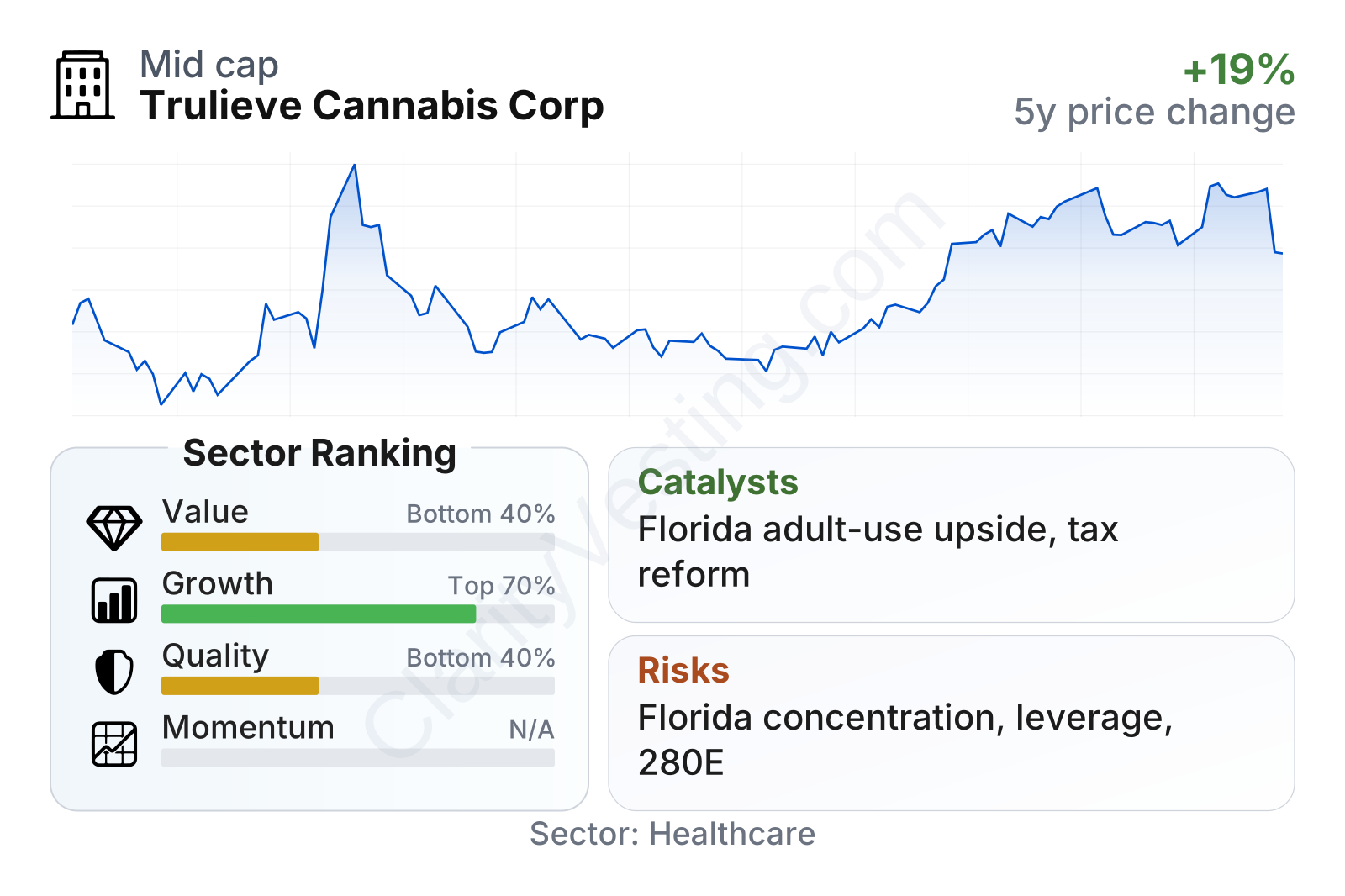
Trulieve sits in the small-to-mid cap range and the stock has shown elevated volatility, with a beta well above 1. The market’s view remains cautious: recent share-price movement has been soft, and the company’s factor profile is mixed rather than broadly strong.
On valuation, the picture is unusual. Traditional earnings-based measures are less helpful because profitability is still inconsistent, but free cash flow stands out positively. Free cash flow yield is well above the sector median, suggesting the market is giving limited credit to the cash the business currently generates. At the same time, book value valuation is close to the sector median rather than deeply discounted.
Quality metrics are weaker. Recent returns on assets and invested capital are negative, operating margin is currently below the broader healthcare median, and balance-sheet leverage is higher than typical sector levels. That said, free cash flow is positive and sizable, which softens some of the concern created by accounting losses.
Growth metrics also require nuance. Recent revenue growth has been negative, and five-year revenue-per-share and book-value trends are weak. However, the longer margin trend has improved versus much of the sector, which suggests management has made progress on cost discipline even without strong top-line expansion.
Growth
Trulieve operates in a sector that still has long-term expansion potential. The U.S. cannabis market remains fragmented and state-driven, with new adult-use conversions and gradual normalization still possible over time. The broad industry opportunity comes from three main forces: rising consumer acceptance, expansion of legal state markets, and a shift from illicit to regulated channels.
Trulieve’s strategy is logical for that backdrop. Rather than pursuing maximum geographic spread at any cost, the company has emphasized depth in selected states, especially Florida, where scale, cultivation capacity, and retail density matter. In a regulated market, that kind of footprint can become a real advantage because adding stores, licenses, and production infrastructure is not always easy for competitors.
A major catalyst remains Florida. Trulieve has long held a leading presence in the state’s medical cannabis market, and any future expansion of adult-use access in Florida would be especially meaningful because the company already has cultivation, distribution, and retail infrastructure in place. That means it would not be starting from zero if the market structure broadens.
Another potential growth driver is federal reform, even if full legalization remains uncertain. Changes in banking access, tax treatment, or exchange-listing rules could materially improve the economics of U.S. cannabis operators. For Trulieve in particular, relief from the current federal tax framework would likely have an outsized effect because tax expense has remained a major drag on net income.
More recently, the company’s own operating trend has become an important internal catalyst. It produced positive operating income in 2024 and improved that result again in 2025 while also generating strong free cash flow. That does not guarantee durable growth, but it does suggest the business is becoming more self-funding and less dependent on outside capital than many cannabis peers.
Risks
This article is for informational purposes only and does not constitute financial advice. Some content is AI-generated. See Disclaimer