Stock Analysis · Thomson Reuters Corporation Common Shares (TRI)
Overview
Thomson Reuters is a professional information and software company. It sells digital tools, research, workflow platforms, and data services that help lawyers, tax professionals, accountants, compliance teams, government agencies, and newsrooms do their work more efficiently. In simple terms, the company makes money by packaging trusted information together with software that fits directly into professional tasks such as legal research, tax filing, regulatory monitoring, and corporate reporting.
The business is attractive because much of its revenue comes from subscriptions and recurring contracts. Customers often build these tools into daily processes, which can make the relationship durable over long periods. Thomson Reuters also owns one of the best-known news brands in business media, but the core of the company is not consumer news; it is enterprise-grade content, analytics, and workflow software for professionals.
Based on recent annual reporting, revenue is mainly split across the following operating segments:
- Legal Professionals: about 40% of revenue. This includes legal research, case law databases, drafting tools, litigation workflow products, and law firm practice solutions.
- Corporates: about 20%. This segment serves in-house legal, tax, trade, and risk functions inside corporations, with software and information products for compliance and decision support.
- Tax & Accounting Professionals: about 19%. This includes tax preparation, tax research, audit, accounting workflow, and firm management solutions.
- Reuters News: about 9%. This includes news content sold to financial professionals, media customers, and digital distribution partners.
- Global Print: about 7%. This is the legacy print publishing business, mainly legal and tax reference materials, and it continues to decline as customers shift to digital products.
- Other / eliminations: about 5%. This covers smaller activities and reporting adjustments.
The broad pattern is clear: Thomson Reuters is now primarily a digital subscription business centered on legal, tax, and corporate workflow rather than a traditional publisher. Over the last several years, revenue has continued to rise while gross profit has remained very strong, showing the economics of a content-and-software model. Operating income has also stayed high, although net income has moved around more because of taxes and other non-operating items.
The visual breakdown highlights a business with high gross profit and relatively controlled financing costs. It also shows that revenue has grown steadily from the low-$6 billion range to the mid-$7 billion range in recent years, while operating profitability has remained solid even as the company continues investing in products and technology.
Key Figures
| Metric | Value | Sector ⓘ |
|---|---|---|
| Date | Oct 17, 2026 | |
| Context | ||
| Sector | Industrials | |
| Industry | Specialty Business Services | |
| Market Cap ⓘ | $45.55B | |
| Beta ⓘ | 0.20 | |
Value (Cheapness) | ||
| P/E Ratio ⓘ | 27.60 | 22.10 |
| P/B Ratio ⓘ | 4.16 | 1.97 |
| FCF Yield ⓘ | 4.86% | 6.38% |
| Dividend Yield ⓘ | 2.43% | 1.94% |
| EBIT / EV ⓘ | 5.13% | 4.79% |
| PEG ⓘ | 1.22 | |
Growth (Business expansion) | ||
| Revenue Growth ⓘ | 9.50% | 9.30% |
| RPS Growth (5Y CAGR) ⓘ | 6.69% | 7.81% |
| EPS Growth (5Y CAGR) ⓘ | -5.09% | -13.06% |
| BVPS Growth (5Y CAGR) ⓘ | -1.34% | 6.14% |
| Margin Growth (5Y Trend) ⓘ | 8.55% | 0.88% |
| FCF Growth (5Y CAGR) ⓘ | 12.40% | 11.01% |
| DPS Growth (5Y CAGR) ⓘ | 10.68% | 9.48% |
Quality (Business durability) | ||
| ROIC (Latest) ⓘ | 12.93% | 10.84% |
| ROA (Latest) ⓘ | 9.26% | 5.41% |
| ROIC (5Y Median) ⓘ | 11.50% | 9.38% |
| ROA (5Y Median) ⓘ | 11.91% | 4.95% |
| Net Debt / EBIT (Latest) ⓘ | 1.12 | 2.08 |
| Net Debt / EBIT (5Y Median) ⓘ | 1.05 | 2.27 |
| Net Debt / EBITDA (Latest) ⓘ | 0.79 | 1.39 |
| Net Debt / Assets ⓘ | 14.41% | 19.28% |
| EBITDA / Interest ⓘ | 19.50 | 9.58 |
| Operating Margin (Latest) ⓘ | 29.74% | 10.50% |
| Operating Margin (5Y Median) ⓘ | 30.72% | 10.29% |
| Debt to Equity (Latest) ⓘ | 28.60% | 65.48% |
| Profit Margin (Latest) ⓘ | 21.22% | 6.67% |
| Free Cash Flow (Latest) ⓘ | $2.22B | |
Momentum (Price trend) | ||
| 3Y Return ⓘ | -10.90% | +61.68% |
| 12M Return (excl. last month) ⓘ | -36.25% | +12.58% |
| 6M Return ⓘ | +23.37% | 0.00% |
| Price vs. 200-Day MA ⓘ | +10.19% | +0.02% |
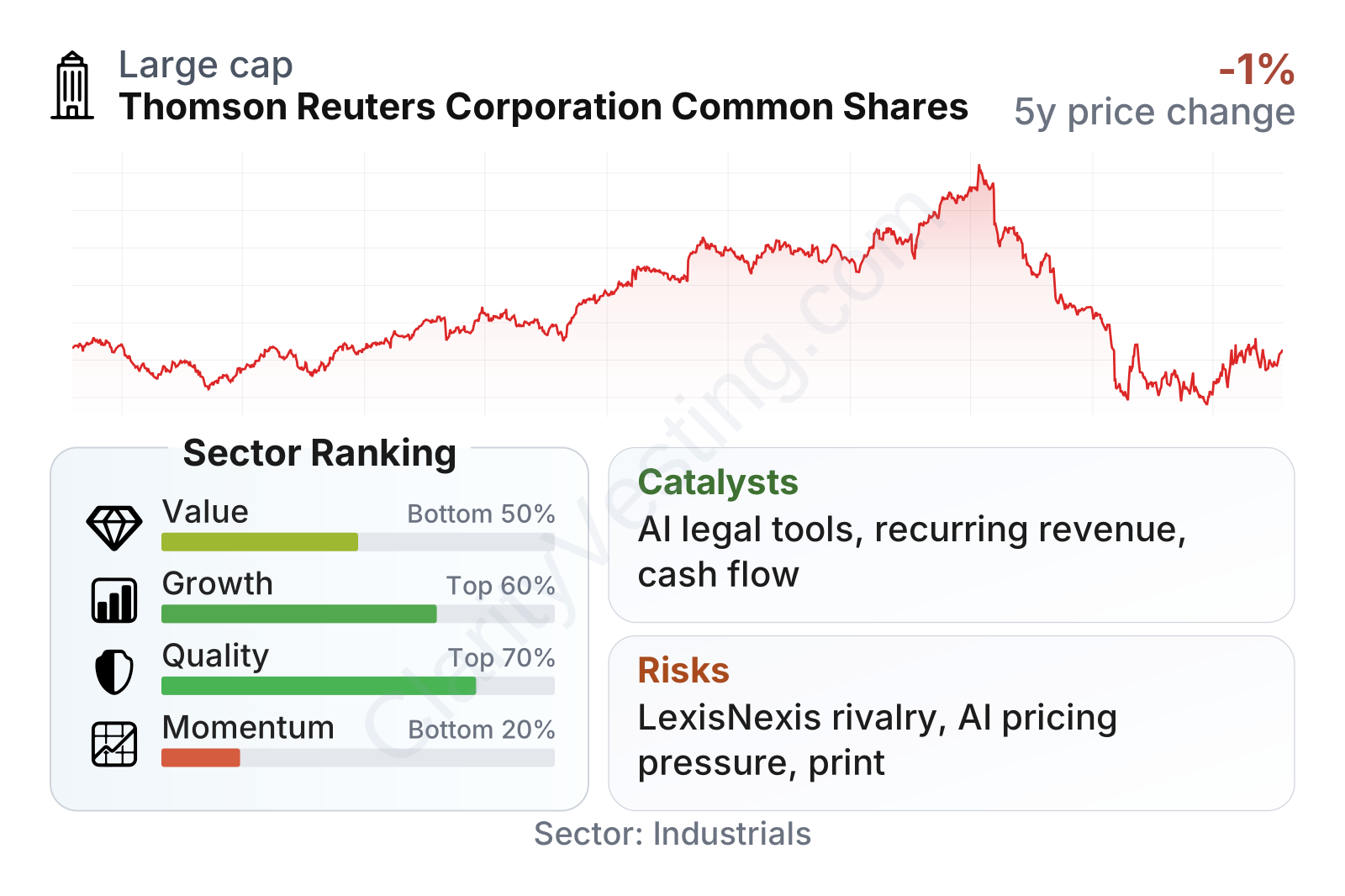
Thomson Reuters stands out more for business quality than for cheapness. Profitability, returns on capital, and balance sheet strength all rank well versus much of its sector. Debt is moderate, interest coverage is strong, and margins are far above typical sector levels. Growth is respectable rather than exceptional, while the valuation profile looks somewhat richer than the sector median. The weakest area is recent share-price momentum over multi-year periods, although shorter-term trading has improved.
In market terms, Thomson Reuters is a large company with unusually low share-price volatility, reflected in a beta close to 0.2. That does not remove risk, but it suggests the stock has historically moved less dramatically than the broader market.
Growth
Thomson Reuters operates in a favorable part of the market: professional work is becoming more digital, more regulated, and more dependent on trusted, searchable, and integrated information. Legal work, tax compliance, cross-border trade, and risk monitoring are all areas where the amount of information keeps growing and the cost of errors can be high. That creates demand for software that saves time and improves accuracy.
The company’s strategy also fits that environment. Management has been pushing the business toward higher-value software, cloud delivery, automation, and artificial intelligence embedded into professional workflows. This is a logical direction because customers are not simply buying raw information anymore; they increasingly want tools that turn information into faster answers, draft documents, identify risks, and connect directly into the systems where work happens.
A major catalyst is generative AI. Thomson Reuters has been rolling AI capabilities into products across legal, tax, and corporate use cases, helped by its content libraries, editorial processes, and domain-specific data. In these markets, trust matters a great deal. Professionals are less interested in novelty than in tools that produce reliable, auditable outputs. That plays to Thomson Reuters’ strengths because it has long-established proprietary content and customer relationships in fields where mistakes can be expensive.
Another important growth driver is the shift from print and one-time research usage toward recurring digital subscriptions. This tends to improve revenue visibility and can support stronger long-term cash generation.
Revenue growth has not been perfectly smooth, but the recent pattern shows a meaningful reacceleration, with year-over-year growth moving from low-single-digit territory in parts of 2025 to around 9% to 10% in the latest periods. That suggests the company is finding traction in newer offerings and that demand in its end markets remains healthy.
Cash generation has also been strong. Free cash flow has generally trended upward from a little above $1 billion a few years ago to just above $2 billion more recently. That matters because it gives Thomson Reuters room to fund product development, pursue acquisitions, return capital to shareholders, and absorb cyclical pressure without stretching the balance sheet.
Recent company updates have reinforced this direction, with continued emphasis on AI-enabled products, productivity tools for professionals, and selective acquisitions that add capabilities in legal technology, compliance, and workflow software. For a company like Thomson Reuters, the most important near-term opportunity is not a single headline event but the steady expansion of embedded software and AI across a large existing customer base.
Risks
This article is for informational purposes only and does not constitute financial advice. Some content is AI-generated. See Disclaimer


