Stock Analysis · Targa Resources Inc (TRGP)
Overview
Targa Resources is a large U.S. midstream energy company. In simple terms, it operates the infrastructure that connects natural gas and natural gas liquids from production areas to processing plants, pipelines, storage sites, export terminals, and end customers. It is especially important in the Permian Basin, one of the most productive oil and gas regions in the United States. The business is less about drilling wells and more about gathering, transporting, processing, fractionating, storing, and exporting hydrocarbons.
Targa organizes its operations into two main segments: Gathering and Processing, and Logistics and Transportation. Gathering and Processing collects raw natural gas from producers and removes impurities while separating valuable liquids. Logistics and Transportation moves and handles natural gas liquids, crude oil, refined products, and related services through pipelines, terminals, storage, fractionation plants, and export assets.
The company’s revenue mix can swing with commodity prices because product sales are recorded at high dollar values, even though many investors watch cash flow and operating margin more closely than reported revenue. Based on the latest annual filing and segment disclosures, the main economic sources of revenue can be summarized as follows:
- Sales of natural gas liquids and related products: approximately 55% to 70% of total revenue in most recent periods. This includes propane, butane, ethane, natural gasoline, and other liquids marketed or sold after processing and fractionation.
- Natural gas sales and services: approximately 20% to 30%. This includes residue gas sales, fuel gas, and services tied to gathering and processing.
- Fees from logistics, transportation, terminaling, storage, and export services: approximately 10% to 20%. This incorporates fractionation fees, pipeline transportation, marine terminal activities, storage, and other service-based midstream earnings.
That accounting view can make Targa look more commodity-exposed than some pipeline companies, but the business model also includes a meaningful amount of fee-based infrastructure income. Over the last several years, profitability has improved more steadily than reported revenue, which suggests that asset utilization, scale, and operating leverage matter more here than top-line growth alone.
The broad pattern over recent years shows operating income and net income rising much faster than overhead, while gross profit has expanded even when total revenue moved around. That is typical of a midstream company whose earnings power depends heavily on volumes, processing spreads, and asset efficiency rather than just headline sales.
Key Figures
| Metric | Value | Sector ⓘ |
|---|---|---|
| Date | Nov 09, 2026 | |
| Context | ||
| Sector | Energy | |
| Industry | Oil & Gas Midstream | |
| Market Cap ⓘ | $56.77B | |
| Beta ⓘ | 0.74 | |
Value (Cheapness) | ||
| P/E Ratio ⓘ | 23.41 | 13.13 |
| P/B Ratio ⓘ | 15.51 | 1.79 |
| FCF Yield ⓘ | 1.64% | 8.37% |
| Dividend Yield ⓘ | 1.75% | 3.46% |
| EBIT / EV ⓘ | 4.43% | 9.05% |
| PEG ⓘ | 1.23 | |
Growth (Business expansion) | ||
| Revenue Growth ⓘ | 34.90% | 26.55% |
| RPS Growth (5Y CAGR) ⓘ | 1.10% | 6.66% |
| EPS Growth (5Y CAGR) ⓘ | 33.75% | -8.29% |
| BVPS Growth (5Y CAGR) ⓘ | N/A | 5.85% |
| Margin Growth (5Y Trend) ⓘ | 14.76% | 0.61% |
| FCF Growth (5Y CAGR) ⓘ | -24.50% | 3.10% |
| DPS Growth (5Y CAGR) ⓘ | 46.77% | 16.54% |
Quality (Business durability) | ||
| ROIC (Latest) ⓘ | 14.59% | 11.73% |
| ROA (Latest) ⓘ | 8.93% | 6.10% |
| ROIC (5Y Median) ⓘ | 14.35% | 10.30% |
| ROA (5Y Median) ⓘ | 5.85% | 5.44% |
| Net Debt / EBIT (Latest) ⓘ | 5.81 | 1.53 |
| Net Debt / EBIT (5Y Median) ⓘ | 5.22 | 1.82 |
| Net Debt / EBITDA (Latest) ⓘ | 3.85 | 0.91 |
| Net Debt / Assets ⓘ | 66.57% | 15.14% |
| EBITDA / Interest ⓘ | 5.61 | 9.78 |
| Operating Margin (Latest) ⓘ | 18.64% | 16.67% |
| Operating Margin (5Y Median) ⓘ | 16.27% | 20.55% |
| Debt to Equity (Latest) ⓘ | 520.07% | 48.84% |
| Profit Margin (Latest) ⓘ | 13.46% | 9.78% |
| Free Cash Flow (Latest) ⓘ | $933.80M | |
Momentum (Price trend) | ||
| 3Y Return ⓘ | +221.88% | +52.75% |
| 12M Return (excl. last month) ⓘ | +74.28% | +40.33% |
| 6M Return ⓘ | +5.73% | -3.65% |
| Price vs. 200-Day MA ⓘ | +1.83% | -0.34% |
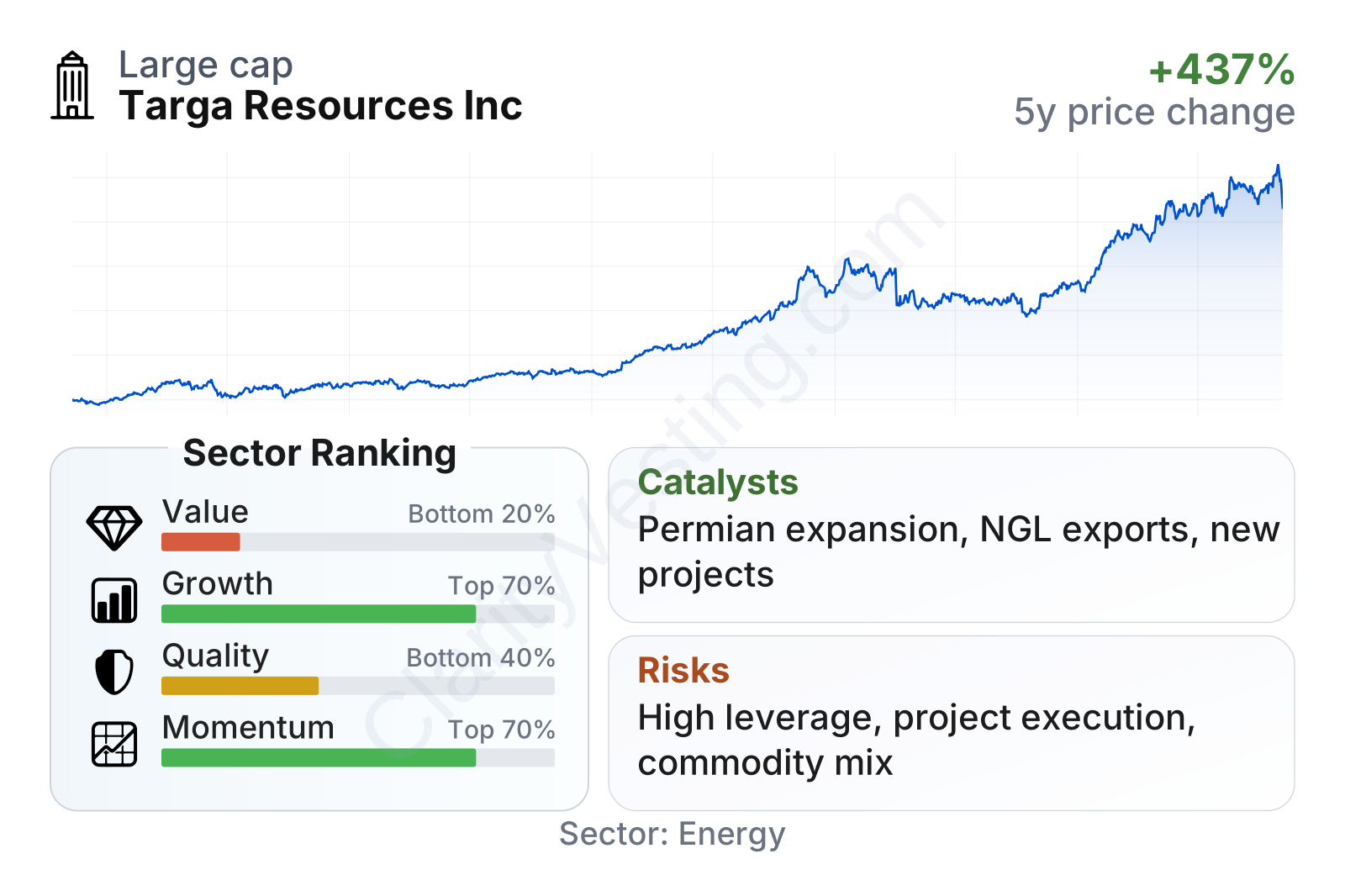
Targa is now a very large midstream operator with a market value in the tens of billions of dollars and a beta below 1, meaning the stock has recently moved somewhat less violently than the broader market. The factor breakdown is mixed: growth and market momentum rank relatively well versus the energy sector, while value metrics rank weakly because the stock trades at much richer multiples than the sector median. Quality is also mixed, with strong returns on capital and assets, but leverage remains much heavier than most peers.
The stock’s long run-up has been supported by major earnings and margin improvement, not just speculation. At the same time, the current profile leaves less room for disappointment because free cash flow yield, dividend yield, and EBIT-to-enterprise-value all sit below typical sector levels.
Growth
Targa operates in a part of the energy sector that still has a clear role in U.S. supply growth. Natural gas liquids infrastructure remains important because the Permian Basin continues to produce associated gas and liquids alongside oil. Even in a mixed commodity environment, growing production volumes can create demand for new gathering systems, processing plants, fractionators, export capacity, and pipelines. That supports the long-term relevance of Targa’s asset base.
The company’s strategy is straightforward and sensible for future expansion: deepen its position in high-volume basins, add processing and fractionation capacity where utilization is high, and connect those barrels to downstream demand centers and export markets. This matters because midstream assets become more valuable when they are linked together. Targa is not just handling one step of the chain; it has built a network from wellhead services to export-oriented logistics.
Revenue growth has been volatile, which is common in this industry because commodity prices can strongly affect reported sales. More important is the recent return to positive year-over-year growth after earlier declines, with late-period acceleration indicating that volume growth and commercial activity have regained momentum.
Free cash flow has been uneven, largely because Targa continues to invest heavily in new projects. That is not automatically negative for a midstream company if the spending is directed toward high-return infrastructure backed by growing throughput. Recent free cash flow remains positive, but not especially high relative to the company’s size, which means future project execution needs to translate into stronger cash generation over time.
One of the strongest catalysts is Targa’s continued buildout in the Permian and its downstream system. New gas processing plants, fractionation projects, pipeline expansions, and export-related infrastructure can add incremental earnings as they enter service. The company has also highlighted strong producer activity in its core areas, which supports throughput growth. Another important tailwind is U.S. demand for natural gas liquids exports, especially LPG, where Gulf Coast infrastructure remains strategically valuable.
Recent company communications have also pointed to large capital projects entering service across 2026 and beyond. For a business like Targa, this can matter more than short-term commodity moves because each project can lock in more volumes across an already integrated system.
Risks
This article is for informational purposes only and does not constitute financial advice. Some content is AI-generated. See Disclaimer