Stock Analysis · Trex Company Inc (TREX)
Overview
Trex Company is a U.S. building-products manufacturer best known for wood-alternative decking. Its main business is producing composite decking and railing made from recycled materials, especially reclaimed wood fibers and recycled plastic film. The company sells primarily into residential outdoor living projects, with products used for decks, rail systems, fascia, trim, and related accessories. Trex also has a smaller commercial presence through structural systems used in certain non-residential applications.
For long-term analysis, Trex is essentially a focused outdoor-living materials company rather than a diversified industrial group. That matters because results are closely tied to repair-and-remodel activity, new housing trends, consumer spending on home upgrades, and how well Trex maintains premium pricing against wood and other composite brands.
The business is highly concentrated in one segment. Based on recent company reporting, revenue is overwhelmingly generated by residential products, while commercial contributions are small.
- Residential decking and railing products: approximately 95%+ of revenue. This includes composite decking boards, railings, fascia, trim, lighting, and accessories sold under the Trex brand through distributors and dealers.
- Commercial products: approximately under 5% of revenue. This mainly relates to structural and engineered systems serving selected commercial applications.
Trex’s financial profile has shown a durable gross profit base, but earnings have moved up and down with demand cycles and cost pressure. Revenue has stayed around the low-billion-dollar range in recent years, while profitability has remained stronger than many peers in building products.
The business mix also shows how dependent Trex is on keeping manufacturing efficient: cost of revenue is the largest expense by far, while selling and administrative costs have increased over time. Even so, the company has continued to convert a meaningful share of sales into operating income and net income, which is an important sign of pricing power and brand strength.
Key Figures
| Metric | Value | Sector ⓘ |
|---|---|---|
| Date | Oct 24, 2026 | |
| Context | ||
| Sector | Industrials | |
| Industry | Building Products & Equipment | |
| Market Cap ⓘ | $4.97B | |
| Beta ⓘ | 1.48 | |
Value (Cheapness) | ||
| P/E Ratio ⓘ | 28.70 | 22.29 |
| P/B Ratio ⓘ | 4.95 | 1.98 |
| FCF Yield ⓘ | 4.12% | 6.26% |
| Dividend Yield ⓘ | N/A | 1.92% |
| EBIT / EV ⓘ | 5.08% | 4.83% |
| PEG ⓘ | 1.00 | |
Growth (Business expansion) | ||
| Revenue Growth ⓘ | 7.80% | 9.30% |
| RPS Growth (5Y CAGR) ⓘ | 1.48% | 7.76% |
| EPS Growth (5Y CAGR) ⓘ | -7.79% | -13.17% |
| BVPS Growth (5Y CAGR) ⓘ | 11.43% | 6.13% |
| Margin Growth (5Y Trend) ⓘ | -4.84% | 0.74% |
| FCF Growth (5Y CAGR) ⓘ | 5.99% | 10.79% |
| DPS Growth (5Y CAGR) ⓘ | N/A | 9.41% |
Quality (Business durability) | ||
| ROIC (Latest) ⓘ | 14.43% | 10.75% |
| ROA (Latest) ⓘ | 11.52% | 5.41% |
| ROIC (5Y Median) ⓘ | 26.76% | 9.37% |
| ROA (5Y Median) ⓘ | 20.06% | 4.95% |
| Net Debt / EBIT (Latest) ⓘ | 1.17 | 2.04 |
| Net Debt / EBIT (5Y Median) ⓘ | 0.80 | 2.27 |
| Net Debt / EBITDA (Latest) ⓘ | 0.90 | 1.39 |
| Net Debt / Assets ⓘ | 17.48% | 19.27% |
| EBITDA / Interest ⓘ | N/A | 9.58 |
| Operating Margin (Latest) ⓘ | 20.17% | 10.49% |
| Operating Margin (5Y Median) ⓘ | 25.23% | 10.30% |
| Debt to Equity (Latest) ⓘ | 28.79% | 64.82% |
| Profit Margin (Latest) ⓘ | 14.68% | 6.67% |
| Free Cash Flow (Latest) ⓘ | $204.68M | |
Momentum (Price trend) | ||
| 3Y Return ⓘ | -11.01% | +67.77% |
| 12M Return (excl. last month) ⓘ | -19.33% | +12.05% |
| 6M Return ⓘ | +15.77% | 0.00% |
| Price vs. 200-Day MA ⓘ | +14.23% | +0.67% |
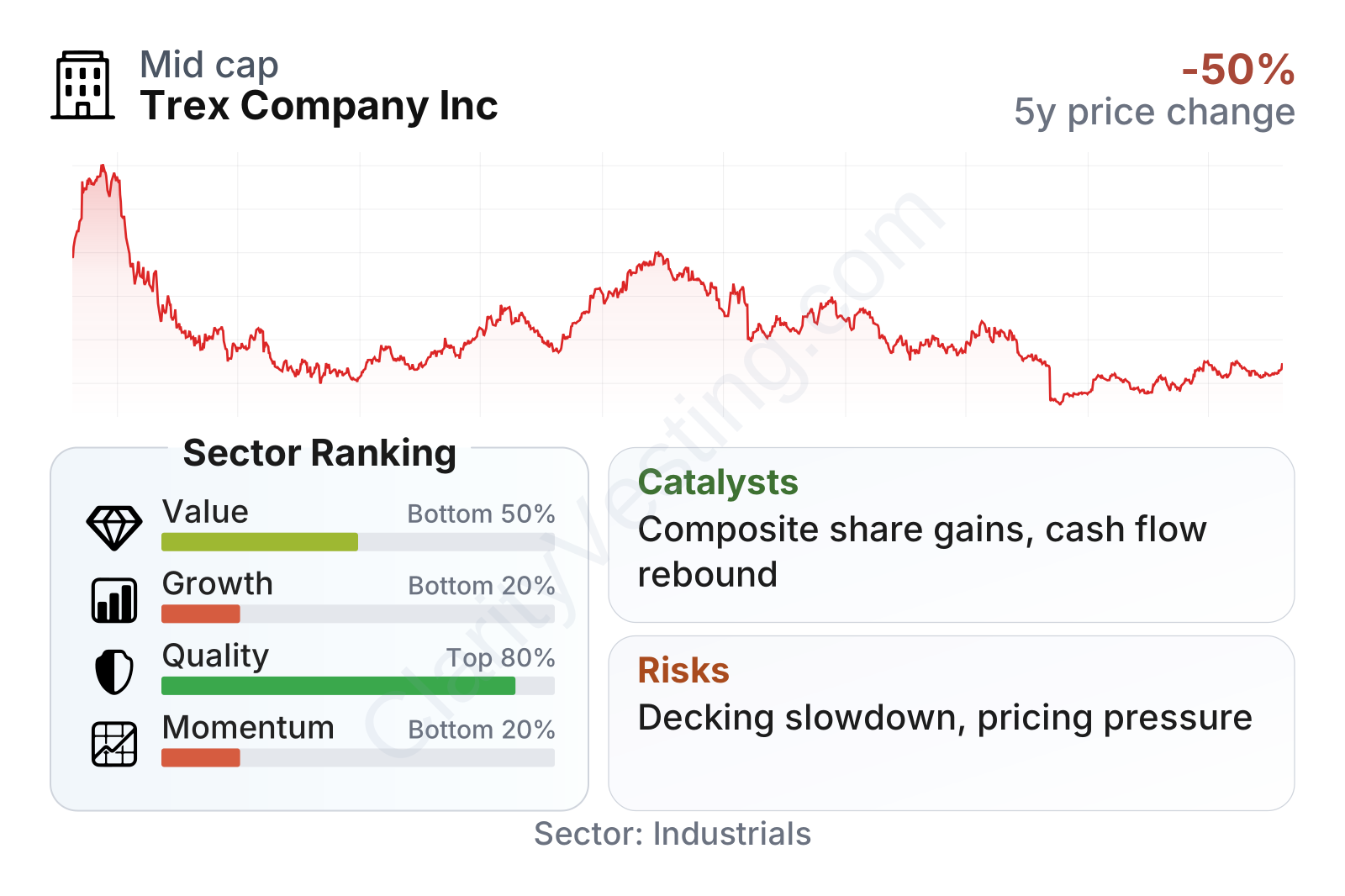
Trex sits in the mid-cap range and shows a mixed overall profile. Quality metrics are clearly stronger than much of the sector, with returns on capital, returns on assets, and operating margins well above typical building-products companies. On the other hand, growth metrics rank weakly relative to peers, and valuation is not obviously cheap, with earnings and book multiples still above sector norms. Share-price behavior has also been volatile, with weaker multi-year performance but a partial rebound in the most recent months.
Growth
Trex operates in a sector with long-term structural support. Outdoor living remains an attractive category in home improvement, and composite decking continues to take share from traditional wood because it generally offers lower maintenance, longer useful life, and better resistance to weathering. That creates a durable replacement and upgrade cycle even when housing activity slows.
The company’s strategy is broadly sensible for future growth. Trex has built a strong brand in composite decking, expanded product tiers to address different price points, and invested in capacity and product innovation to widen adoption. The key strategic idea is simple: make composite products accessible to more homeowners while preserving a premium image and margin structure. If that balance works, Trex can keep gaining share even without rapid overall industry growth.
Recent sales growth has been uneven rather than linear. Quarterly year-over-year comparisons have swung sharply from strong gains to contractions and back again, which reflects the cyclical nature of demand and channel inventory shifts. The latest readings suggest growth has turned positive again, but not at a pace that stands out within the sector. For a company with Trex’s premium valuation history, steady share gains matter more than short bursts of expansion.
Cash generation has also been volatile, with free cash flow moving between positive and negative periods before recovering strongly most recently. That pattern is worth watching, but the broader picture remains constructive: Trex still produces meaningful cash over time and does not appear dependent on aggressive borrowing to fund operations. A recent free-cash-flow recovery is an encouraging sign if demand remains stable.
Important catalysts include continued conversion from wood to composite decking, product mix improvements, and a normalization in dealer and distributor ordering patterns. The company has also highlighted manufacturing initiatives and recycling-based sourcing, which can support both margins and brand differentiation. In addition, if interest rates and housing affordability pressures ease, repair-and-remodel spending could improve and give Trex a meaningful demand tailwind.
Recent company updates have pointed to ongoing product launches, marketing support for the outdoor-living category, and efforts to expand consumer awareness. None of these changes transforms the business overnight, but together they reinforce Trex’s position in a category that still has room for penetration gains.
Risks
This article is for informational purposes only and does not constitute financial advice. Some content is AI-generated. See Disclaimer


