Stock Analysis · First Tracks Biotherapeutics (TRAX)
Overview
First Tracks Biotherapeutics is a clinical-stage biotechnology company. That means it is primarily focused on developing drug candidates rather than selling approved medicines at scale today. In practical terms, the business is built around research, clinical development, and the long process of moving experimental therapies through regulatory review.
Based on the latest available public financial information, the company does not yet appear to have recurring commercial product revenue. Reported revenue has been negligible or zero, while operating spending has been concentrated on research and development. That makes First Tracks more similar to an early platform and pipeline company than to an established pharmaceutical business.
The current economic model is therefore centered less on present-day sales and more on asset value creation. For a company at this stage, the main financial inflows generally come from capital raises, potential partnership payments, and possibly milestone or licensing income if development programs attract larger industry partners. At this point, the revenue mix appears to be:
- Product revenue: 0% based on recent annual results, indicating no meaningful marketed product sales.
- Collaboration, licensing, or milestone revenue: no meaningful recurring contribution visible in recent reported results.
- Financing-related cash inflows: effectively the main source supporting operations, through balance-sheet cash rather than operating revenue.
Spending is heavily tilted toward drug development. Research and development expense has been the largest cost item by far, while administrative expense is much smaller. That profile is typical for a biotech trying to advance pipeline assets before commercialization.
The operating structure shows a company still in investment mode: no meaningful revenue, large research spending, and persistent net losses. One positive angle is that losses are being driven mainly by development work rather than by a bloated commercial structure, which is often what long-term shareholders want to see at this stage.
Key Figures
| Metric | Value | Sector ⓘ |
|---|---|---|
| Date | Oct 17, 2026 | |
| Context | ||
| Sector | Healthcare | |
| Industry | Biotechnology | |
| Market Cap ⓘ | $1.22B | |
| Beta ⓘ | N/A | |
Value (Cheapness) | ||
| P/E Ratio ⓘ | N/A | 24.79 |
| P/B Ratio ⓘ | 7.56 | 3.08 |
| FCF Yield ⓘ | -12.16% | 3.15% |
| Dividend Yield ⓘ | N/A | 1.94% |
| EBIT / EV ⓘ | -16.13% | 0.57% |
| PEG ⓘ | N/A | |
Growth (Business expansion) | ||
| Revenue Growth ⓘ | N/A | 7.45% |
| RPS Growth (5Y CAGR) ⓘ | N/A | 8.61% |
| EPS Growth (5Y CAGR) ⓘ | N/A | -17.81% |
| BVPS Growth (5Y CAGR) ⓘ | -16.24% | 3.72% |
| Margin Growth (5Y Trend) ⓘ | N/A | -0.62% |
| FCF Growth (5Y CAGR) ⓘ | N/A | 1.04% |
| DPS Growth (5Y CAGR) ⓘ | N/A | 6.77% |
Quality (Business durability) | ||
| ROIC (Latest) ⓘ | N/A | 3.24% |
| ROA (Latest) ⓘ | N/A | 3.01% |
| ROIC (5Y Median) ⓘ | N/A | 4.60% |
| ROA (5Y Median) ⓘ | N/A | 1.89% |
| Net Debt / EBIT (Latest) ⓘ | N/A | 1.34 |
| Net Debt / EBIT (5Y Median) ⓘ | N/A | 1.84 |
| Net Debt / EBITDA (Latest) ⓘ | N/A | 1.00 |
| Net Debt / Assets ⓘ | -89.38% | 5.45% |
| EBITDA / Interest ⓘ | N/A | 9.64 |
| Operating Margin (Latest) ⓘ | N/A | 9.27% |
| Operating Margin (5Y Median) ⓘ | N/A | 7.38% |
| Debt to Equity (Latest) ⓘ | 2.57% | 28.58% |
| Profit Margin (Latest) ⓘ | N/A | 3.59% |
| Free Cash Flow (Latest) ⓘ | -$148.24M | |
Momentum (Price trend) | ||
| 3Y Return ⓘ | N/A | +42.80% |
| 12M Return (excl. last month) ⓘ | N/A | +18.50% |
| 6M Return ⓘ | +46.80% | +7.57% |
| Price vs. 200-Day MA ⓘ | N/A | +5.12% |
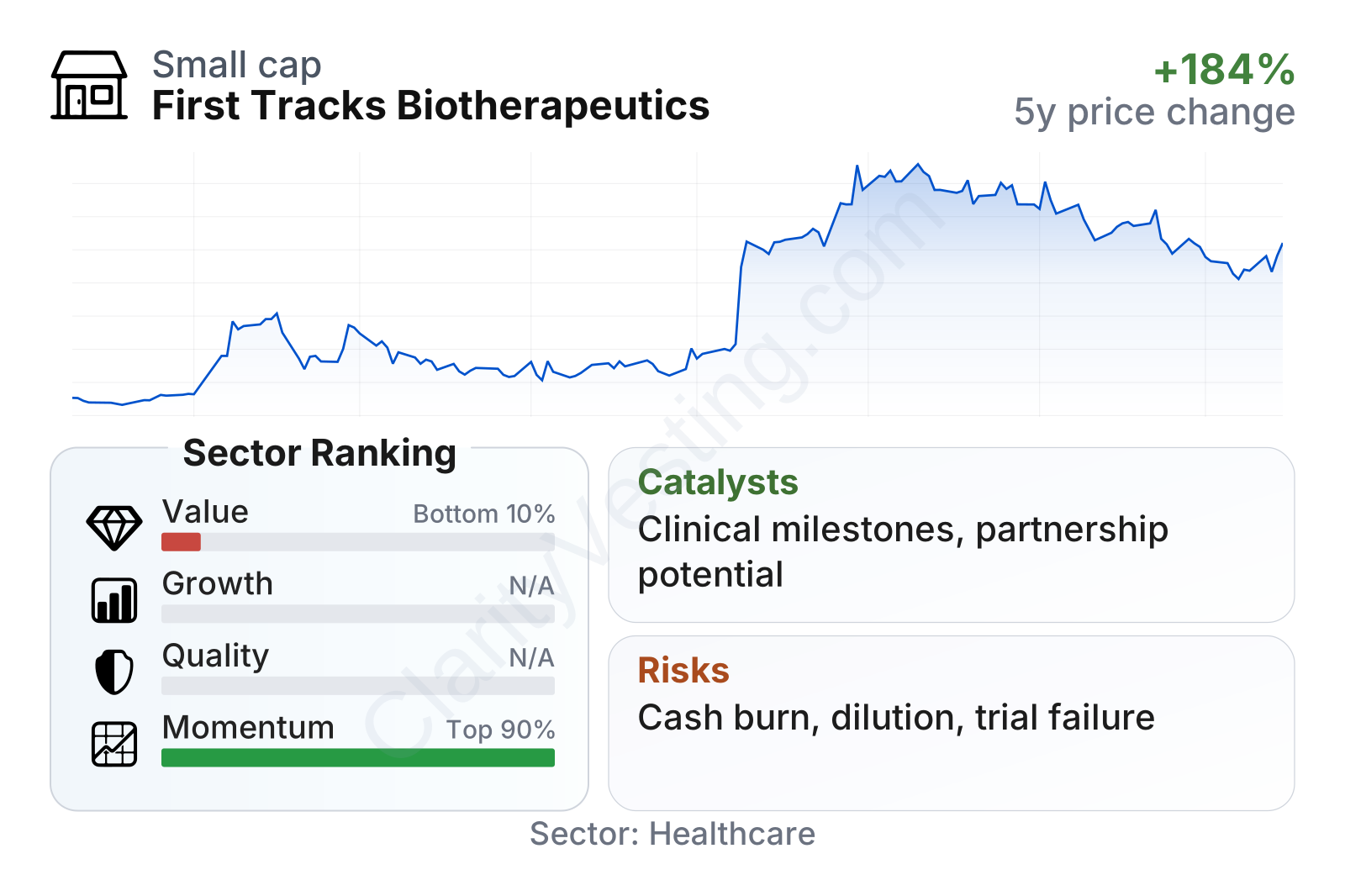
The market profile is unusual but understandable for a clinical-stage biotech. Valuation metrics rank near the bottom of the healthcare group because traditional measures such as earnings yield and free cash flow are negative. Price-to-book is well above the sector median, showing the market is assigning substantial value to future pipeline potential rather than current assets or profits.
Balance-sheet leverage looks light. Debt to equity is only around 3% recently, far below the sector median, and net debt relative to assets is strongly negative, which usually means the company holds more cash than debt. That matters because early-stage biotech companies often live or die by funding flexibility.
Operating quality remains weak in the accounting sense: profit margin is around 0%, free cash flow is deeply negative, and returns on capital are not yet meaningful. Growth factors also look limited in conventional screens because reported revenue is still absent. The standout area is market momentum. The share price has risen sharply over the last six months and now sits far above where it traded earlier in the year, suggesting expectations around the pipeline have improved materially.
Growth
Biotechnology remains a structurally attractive sector for long-term growth because successful therapies can create very large value from a small starting base. Demand drivers such as aging populations, advances in precision medicine, and continued pharmaceutical interest in external innovation all support the space. For a smaller company like First Tracks, the key question is not whether biotech can grow as a sector, but whether its specific programs can generate convincing clinical evidence.
The company’s strategy appears sensible for its stage of development: concentrate capital on research programs, preserve a relatively low-debt balance sheet, and move assets toward milestones that could unlock partnerships, broader investor attention, or eventual regulatory pathways. Since there is no established product business, the growth case depends almost entirely on development progress rather than on scaling an existing sales base.
A strong catalyst can emerge quickly in this industry. Positive clinical data, regulatory designations, the start of a later-stage trial, or a collaboration with a larger pharmaceutical company can all change the market’s view. The stock’s sharp move over recent months indicates that the market may already be anticipating meaningful progress on one or more pipeline fronts. In biotech, that kind of rerating often happens before revenue exists, because investors are trying to discount future probabilities rather than current earnings.
There is also an efficiency angle. Research and development remains the dominant expense, which means most of the company’s spending is aimed at the programs that could eventually create value. While that does not remove scientific risk, it does suggest management is still prioritizing pipeline advancement over commercial overhead.
Risks
This article is for informational purposes only and does not constitute financial advice. Some content is AI-generated. See Disclaimer


