Stock Analysis · Travis Perkins PLC (TPRKY)
Overview
Travis Perkins PLC is a U.K.-based building materials distributor focused on supplying trade professionals, repair and maintenance work, and construction projects. The group operates merchant branches and specialist distribution businesses that sell heavy-side materials such as timber, bricks, drainage, and insulation, along with lighter building products, plumbing and heating items, and tool or equipment-related lines. Its American depositary shares trade in the U.S. under the symbol TPRKY, but the business itself is centered mainly on the U.K. construction and home improvement market.
The company’s revenue base is concentrated in merchanting and distribution rather than manufacturing. Based on the latest reported segment mix, the main sources of revenue are approximately the following:
- Merchanting: about 80% to 85% of revenue. This includes general builders’ merchant branches serving local tradespeople and small-to-medium project work, with products such as timber, landscaping, roofing, insulation, and core building materials.
- Toolstation: about 15% to 20% of revenue. This business focuses on tools, accessories, fixings, electrical supplies, plumbing items, and everyday trade essentials sold through branches and digital channels.
That structure matters because it shows Travis Perkins is primarily exposed to everyday construction activity and repair, maintenance, and improvement demand rather than to one-off large manufacturing contracts. It also means group performance depends heavily on building volumes, price discipline, branch efficiency, and working-capital control.
Over the last several years, the business has remained large in its niche, but profitability has come under pressure. Revenue has drifted down from the post-pandemic peak, while operating income and net income have weakened much more sharply. The broad pattern suggests that lower market activity and thinner margins have had a bigger impact than sales declines alone.
The flow of revenue into profit has narrowed materially since 2021. Sales have eased from the earlier peak, but the more important change is the compression in operating profit and the move into net losses in the most recent periods, showing how sensitive the group is to weaker construction demand and fixed-cost pressure.
Key Figures
| Metric | Value | Sector ⓘ |
|---|---|---|
| Date | Oct 17, 2026 | |
| Context | ||
| Sector | Industrials | |
| Industry | Industrial Distribution | |
| Market Cap ⓘ | $1.53B | |
| Beta ⓘ | 1.27 | |
Value (Cheapness) | ||
| P/E Ratio ⓘ | N/A | 22.10 |
| P/B Ratio ⓘ | 0.92 | 1.97 |
| FCF Yield ⓘ | 28.43% | 6.38% |
| Dividend Yield ⓘ | 2.13% | 1.94% |
| EBIT / EV ⓘ | N/A | 4.79% |
| PEG ⓘ | 0.79 | |
Growth (Business expansion) | ||
| Revenue Growth ⓘ | -1.80% | 9.30% |
| RPS Growth (5Y CAGR) ⓘ | 1.93% | 7.81% |
| EPS Growth (5Y CAGR) ⓘ | -3.15% | -13.06% |
| BVPS Growth (5Y CAGR) ⓘ | -3.18% | 6.14% |
| Margin Growth (5Y Trend) ⓘ | -5.16% | 0.88% |
| FCF Growth (5Y CAGR) ⓘ | 13.70% | 11.01% |
| DPS Growth (5Y CAGR) ⓘ | -26.35% | 9.48% |
Quality (Business durability) | ||
| ROIC (Latest) ⓘ | N/A | 10.84% |
| ROA (Latest) ⓘ | -5.69% | 5.41% |
| ROIC (5Y Median) ⓘ | 6.08% | 9.38% |
| ROA (5Y Median) ⓘ | 0.93% | 4.95% |
| Net Debt / EBIT (Latest) ⓘ | 3.66 | 2.08 |
| Net Debt / EBIT (5Y Median) ⓘ | 4.23 | 2.27 |
| Net Debt / EBITDA (Latest) ⓘ | 1.13 | 1.39 |
| Net Debt / Assets ⓘ | 13.72% | 19.28% |
| EBITDA / Interest ⓘ | 4.40 | 9.58 |
| Operating Margin (Latest) ⓘ | 1.63% | 10.50% |
| Operating Margin (5Y Median) ⓘ | 3.66% | 10.29% |
| Debt to Equity (Latest) ⓘ | 56.92% | 65.48% |
| Profit Margin (Latest) ⓘ | -3.81% | 6.67% |
| Free Cash Flow (Latest) ⓘ | $436.08M | |
Momentum (Price trend) | ||
| 3Y Return ⓘ | -8.70% | +61.68% |
| 12M Return (excl. last month) ⓘ | +0.96% | +12.58% |
| 6M Return ⓘ | -0.99% | 0.00% |
| Price vs. 200-Day MA ⓘ | -2.28% | +0.02% |
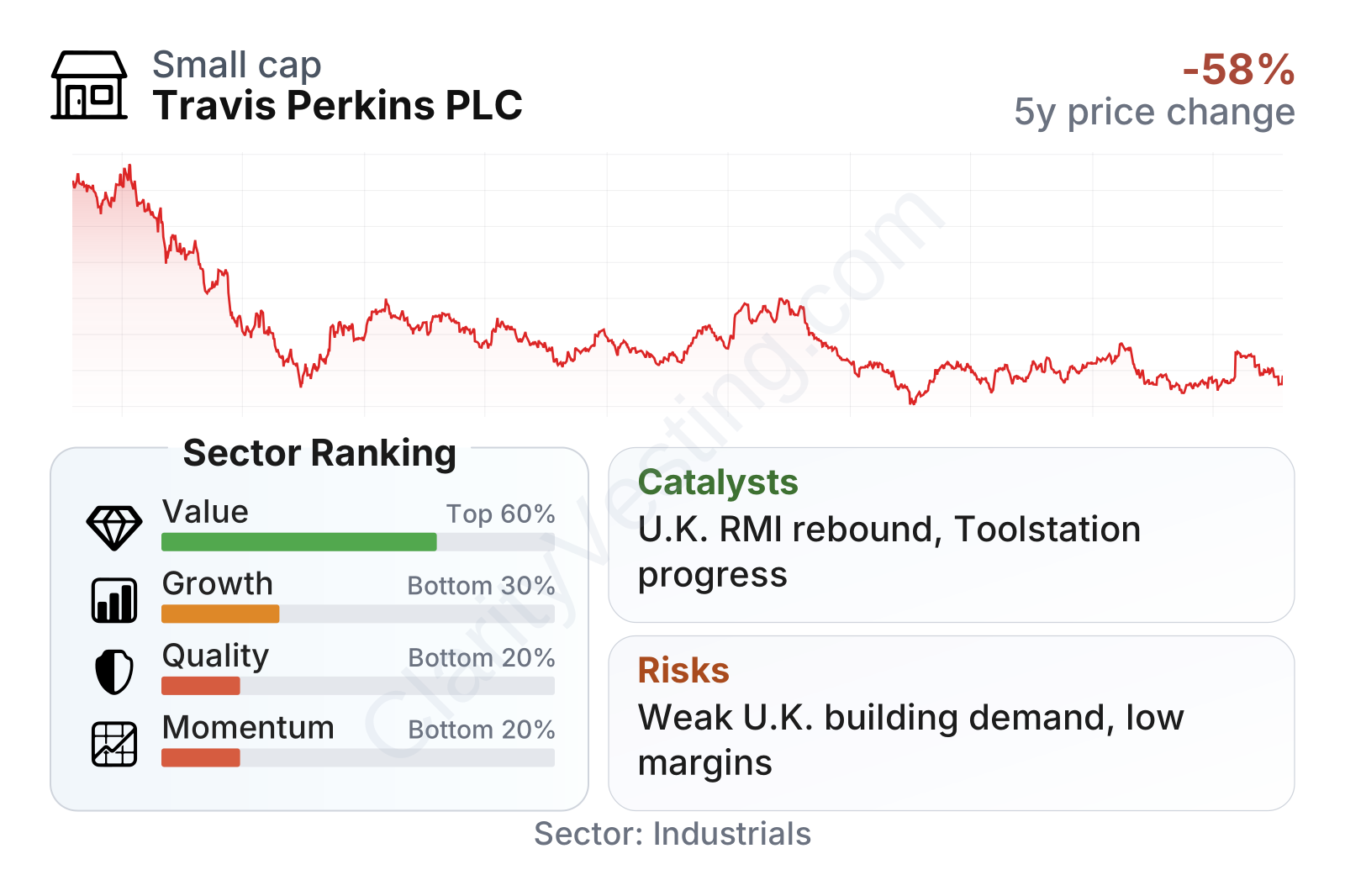
Travis Perkins stands out more on valuation and cash generation than on growth or operating quality. The shares trade around book value and at a much lower earnings multiple than the sector median, while free cash flow yield is unusually high. At the same time, profitability metrics are weak: margins are thin, returns on assets are negative on a trailing basis, and interest coverage is below typical sector levels. In short, the market is assigning a restrained valuation to a business that still generates cash but currently lacks strong earnings quality.
The stock’s multi-year price record reflects that tension. After falling sharply from 2021 highs, the shares have remained volatile, with some recovery periods but no durable rerating. Recent trading has been steadier than the longer-term picture, yet the stock still sits far below earlier levels, which is consistent with a company facing cyclical pressure rather than structural market enthusiasm.
Growth
Travis Perkins operates in a sector that does have long-term relevance. Housing maintenance, energy-efficiency upgrades, infrastructure needs, and the ongoing requirement for repair work all support baseline demand for builders’ merchants over time. In the U.K., a structurally old housing stock and periodic need for retrofitting can create durable demand for many of the products the company sells. That said, this is not a high-growth industry. It is cyclical, closely linked to housing transactions, consumer confidence, contractor activity, and commercial construction levels.
The company’s strategy is logical for that environment. Management has been emphasizing cost control, branch productivity, disciplined capital allocation, and a focus on trade customers. Toolstation also provides an additional growth angle because it adds a more convenience-led, digitally supported format that can expand share even in a softer market. If construction activity stabilizes, operational gearing could help profits recover faster than sales.
Recent revenue growth remains slightly negative, so the business is still working through a subdued market. Even so, the longer-term picture is not entirely weak: free cash flow growth over five years has been better than the sector median, suggesting the group has retained some ability to convert earnings into cash despite difficult trading conditions.
A meaningful catalyst would be any broad improvement in U.K. repair, maintenance, and private housing activity, because Travis Perkins has a strong branch footprint positioned close to local trade customers. Another opportunity is margin recovery if pricing, product mix, and cost savings start to offset the recent weakness in volumes. Recent company updates have continued to stress self-help measures and tighter execution, which matters because even modest sales stabilization can have an outsized effect when margins are currently compressed.
Risks
This article is for informational purposes only and does not constitute financial advice. Some content is AI-generated. See Disclaimer


