Stock Analysis · Tutor Perini Corporation (TPC)
Overview
Tutor Perini Corporation is a U.S. construction company focused on large and complex civil, building, and specialty projects. It works on public infrastructure such as highways, bridges, tunnels, mass transit systems, and airports, while also serving private and institutional customers through building construction and specialized contracting services. The company typically operates through fixed-price, cost-plus, and other negotiated contract structures, which means results depend heavily on project execution, cost control, claims resolution, and the timing of cash collections.
Its revenue comes mainly from three operating segments. Based on the latest annual filing, the mix is approximately:
- Civil: about 49% — transportation infrastructure and other large public works, including roads, bridges, tunnels, rail, and transit systems.
- Building: about 33% — commercial buildings, government facilities, hospitality, healthcare, education, and other vertical construction.
- Specialty Contractors: about 18% — electrical, mechanical, plumbing, concrete, and other specialized construction services, often supporting both internal and third-party projects.
The business model is shaped less by recurring subscriptions or consumer demand and more by project awards, backlog conversion, contract terms, and the company’s ability to complete difficult jobs without major cost overruns. That makes Tutor Perini easier to understand as a contractor with a large pipeline of work rather than as a steady-margin industrial operator.
The multi-year financial flow shows a business that went through a difficult period in 2022 through 2024, when profitability turned negative, followed by a clear rebound in 2025 as revenue, gross profit, and operating income improved materially. That recovery matters because it suggests recent performance is being driven by better project mix and execution rather than by revenue growth alone.
Key Figures
| Metric | Value | Sector ⓘ |
|---|---|---|
| Date | Oct 24, 2026 | |
| Context | ||
| Sector | Industrials | |
| Industry | Engineering & Construction | |
| Market Cap ⓘ | $4.10B | |
| Beta ⓘ | 2.06 | |
Value (Cheapness) | ||
| P/E Ratio ⓘ | 33.58 | 22.29 |
| P/B Ratio ⓘ | 3.58 | 1.98 |
| FCF Yield ⓘ | 15.16% | 6.26% |
| Dividend Yield ⓘ | 0.23% | 1.92% |
| EBIT / EV ⓘ | 6.60% | 4.83% |
| PEG ⓘ | 0.62 | |
Growth (Business expansion) | ||
| Revenue Growth ⓘ | 19.20% | 9.30% |
| RPS Growth (5Y CAGR) ⓘ | 3.52% | 7.76% |
| EPS Growth (5Y CAGR) ⓘ | N/A | -13.17% |
| BVPS Growth (5Y CAGR) ⓘ | -8.84% | 6.13% |
| Margin Growth (5Y Trend) ⓘ | N/A | 0.74% |
| FCF Growth (5Y CAGR) ⓘ | N/A | 10.79% |
| DPS Growth (5Y CAGR) ⓘ | -19.75% | 9.41% |
Quality (Business durability) | ||
| ROIC (Latest) ⓘ | 11.02% | 10.75% |
| ROA (Latest) ⓘ | 2.35% | 5.41% |
| ROIC (5Y Median) ⓘ | -3.37% | 9.37% |
| ROA (5Y Median) ⓘ | -3.78% | 4.95% |
| Net Debt / EBIT (Latest) ⓘ | -1.84 | 2.04 |
| Net Debt / EBIT (5Y Median) ⓘ | N/A | 2.27 |
| Net Debt / EBITDA (Latest) ⓘ | -1.56 | 1.39 |
| Net Debt / Assets ⓘ | -8.83% | 19.27% |
| EBITDA / Interest ⓘ | 5.59 | 9.58 |
| Operating Margin (Latest) ⓘ | 4.32% | 10.49% |
| Operating Margin (5Y Median) ⓘ | -2.05% | 10.30% |
| Debt to Equity (Latest) ⓘ | 36.71% | 64.82% |
| Profit Margin (Latest) ⓘ | 2.08% | 6.67% |
| Free Cash Flow (Latest) ⓘ | $621.33M | |
Momentum (Price trend) | ||
| 3Y Return ⓘ | +1057.39% | +67.77% |
| 12M Return (excl. last month) ⓘ | +31.82% | +12.05% |
| 6M Return ⓘ | -5.65% | 0.00% |
| Price vs. 200-Day MA ⓘ | -1.23% | +0.67% |
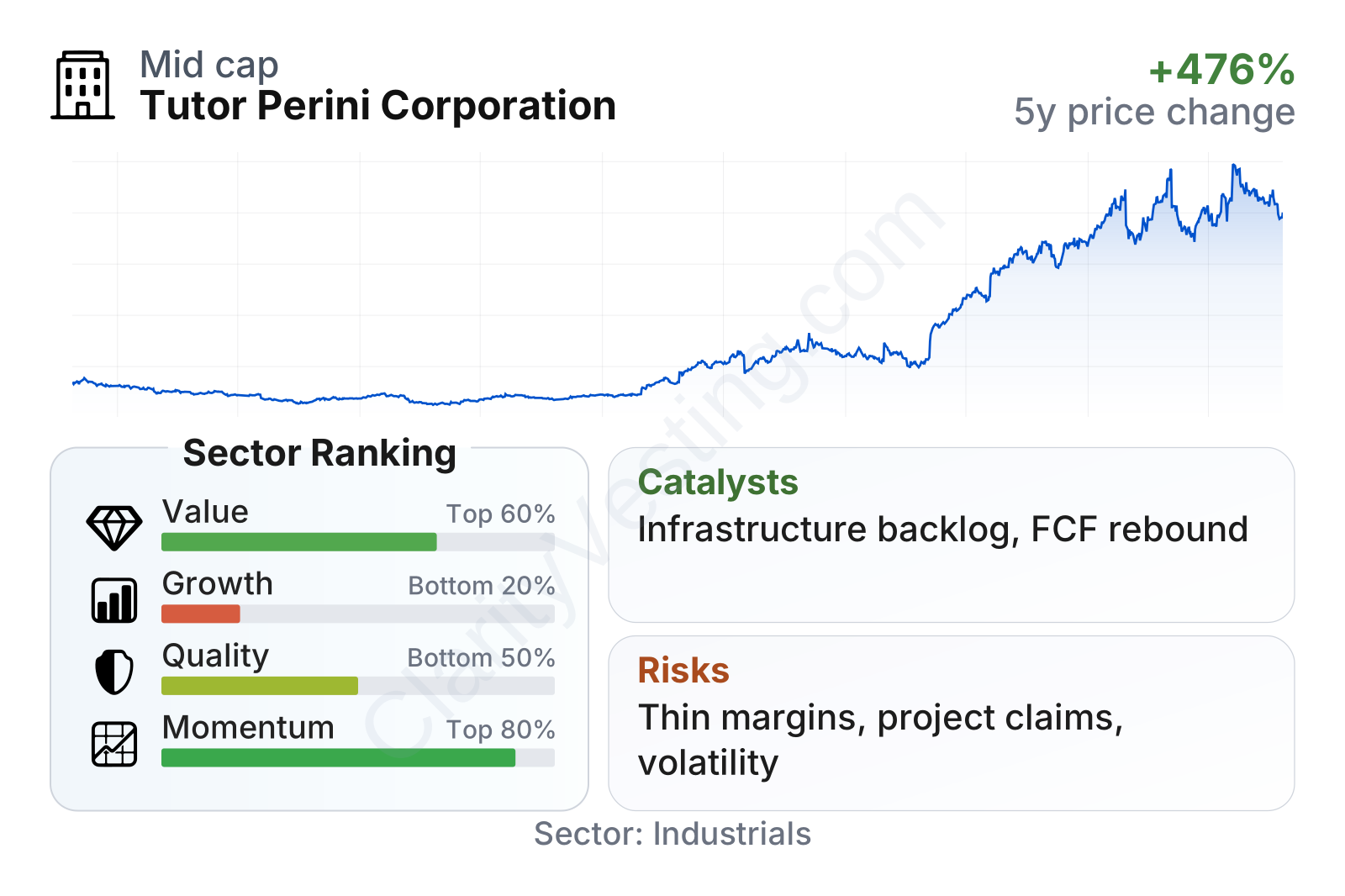
Tutor Perini is now a mid-sized company by market value, and its shares have been unusually volatile, with a beta above 2. The stock performance has been very strong over the last three years and remains well ahead of the broader industrial peer group, which shows that the market has already recognized the turnaround. In the factor breakdown, momentum is a major strength, while growth and quality are less convincing on a longer view.
Valuation metrics send a mixed signal. The earnings multiple and book multiple sit above sector medians, which points to a richer market view than before. At the same time, free cash flow yield and EBIT relative to enterprise value look comparatively strong, reflecting the company’s recent cash generation and improving operating recovery. That combination usually appears when the market believes the rebound is real, but still assigns some caution to the durability of earnings.
Growth
Construction tied to infrastructure remains a favorable long-term market. Public funding for transportation, transit, and other civil works continues to support bidding activity across the United States, and that is important for Tutor Perini because civil construction is its largest segment. Large public projects also tend to have long timelines, which can support revenue visibility when a contractor has a meaningful backlog.
Tutor Perini’s strategy is sensible for this environment: focus on large, technically difficult projects where fewer competitors can bid at scale, be selective on new awards, and convert backlog into cash more efficiently. For a contractor with a history of uneven margins, selectivity matters. Winning more work is not enough on its own; future growth only creates value if projects are priced well and executed with tighter control than in prior years.
Recent revenue growth has clearly improved. After a weak stretch in 2022 and an uneven 2023, year-over-year growth turned positive and accelerated through much of 2024 and 2025, with 2026 still showing healthy expansion around the high-teens range. That suggests the company is moving from recovery into a more active delivery phase on awarded projects.
Cash generation has improved even more dramatically than revenue. Trailing free cash flow moved from negative territory in 2022 to a very strong positive level by 2026. For a construction company, this is especially relevant because accounting earnings can be noisy from claims, reserves, and job timing, while cash collection offers a more grounded view of operating momentum. A strong cash profile also gives the company more flexibility to reduce leverage, support bonding capacity, and absorb working-capital swings on large jobs.
A meaningful catalyst is the company’s large project exposure in civil infrastructure and other complex public works. Another is the turnaround in profitability and free cash flow after several difficult years. Recent corporate updates have also emphasized a sizeable backlog, which can support future revenue conversion if execution remains disciplined. In short, the opportunity is not based on a new invention or a disruptive product; it rests on improved project selection, stronger collections, and sustained delivery in a market with continuing infrastructure demand.
Risks
This article is for informational purposes only and does not constitute financial advice. Some content is AI-generated. See Disclaimer


