Stock Analysis · Towne Bank (TOWN)
Overview
TowneBank is a regional bank headquartered in Virginia that provides traditional banking services along with insurance and mortgage businesses. Its footprint is concentrated in Virginia and North Carolina, and its model is broader than a plain deposit-and-loan bank because it also earns meaningful fee income from non-banking activities. For long-term analysis, that mix matters: it gives the company more than one earnings engine, although banking still drives the overall business.
Based on the company’s recent annual reporting structure, revenue is mainly generated from the following areas:
- Net interest income: approximately 60% to 70%. This is the spread between what TowneBank earns on loans and securities and what it pays on deposits and other funding.
- Insurance commissions and related income: approximately 15% to 20%. This includes commissions and fees from property and casualty, employee benefits, and other insurance services.
- Mortgage banking income: approximately 5% to 10%. This comes from mortgage originations, sales, servicing-related activity, and related fees.
- Service charges, card income, wealth and other fees: approximately 5% to 10%. This includes deposit account fees, bank card activity, asset management, and other customer-related fee income.
The main takeaway is that TowneBank is not only a lender. Its insurance operations are especially important because they add recurring fee income that can help offset some pressure when loan spreads tighten. Over the last several years, total revenue has expanded meaningfully, but higher funding costs and operating expenses have absorbed part of that growth, which helps explain why profit growth has been less impressive than revenue growth.
Revenue has climbed from roughly the low-$700 million range a few years ago to around $1.0 billion recently, but net income has not followed the same path. The business has become larger, yet interest expense and overhead have also risen, so scale has not translated into the same degree of earnings expansion.
Key Figures
| Metric | Value | Sector ⓘ |
|---|---|---|
| Date | Oct 17, 2026 | |
| Context | ||
| Sector | Financial Services | |
| Industry | Banks - Regional | |
| Market Cap ⓘ | $3.18B | |
| Beta ⓘ | 0.73 | |
Value (Cheapness) | ||
| P/E Ratio ⓘ | 17.56 | 12.26 |
| P/B Ratio ⓘ | 1.09 | 1.23 |
| FCF Yield ⓘ | 4.15% | 10.40% |
| Dividend Yield ⓘ | 3.12% | 3.02% |
| EBIT / EV ⓘ | N/A | 8.14% |
| PEG ⓘ | N/A | |
Growth (Business expansion) | ||
| Revenue Growth ⓘ | 117.80% | 9.35% |
| RPS Growth (5Y CAGR) ⓘ | 7.26% | 12.19% |
| EPS Growth (5Y CAGR) ⓘ | -13.52% | -9.53% |
| BVPS Growth (5Y CAGR) ⓘ | -38.49% | 4.99% |
| Margin Growth (5Y Trend) ⓘ | -18.00% | -3.86% |
| FCF Growth (5Y CAGR) ⓘ | -18.83% | 4.81% |
| DPS Growth (5Y CAGR) ⓘ | 7.91% | 8.79% |
Quality (Business durability) | ||
| ROIC (Latest) ⓘ | N/A | 9.49% |
| ROE (Latest) ⓘ | 11.66% | 13.90% |
| ROA (Latest) ⓘ | 1.48% | 1.55% |
| ROIC (5Y Median) ⓘ | 6.67% | 7.86% |
| ROE (5Y Median) ⓘ | 1.75% | 12.17% |
| ROA (5Y Median) ⓘ | 0.95% | 1.30% |
| Net Debt / EBIT (Latest) ⓘ | N/A | 0.96 |
| Net Debt / EBIT (5Y Median) ⓘ | -3.69 | 0.73 |
| Net Debt / EBITDA (Latest) ⓘ | 0.66 | 0.92 |
| Operating Margin (Latest) ⓘ | N/A | 22.30% |
| Operating Margin (5Y Median) ⓘ | 20.86% | 24.63% |
| Debt to Equity (Latest) ⓘ | 15.04% | 58.56% |
| Profit Margin (Latest) ⓘ | 28.56% | 26.57% |
| Free Cash Flow (Latest) ⓘ | $131.77M | |
Momentum (Price trend) | ||
| 3Y Return ⓘ | +72.74% | +88.33% |
| 12M Return (excl. last month) ⓘ | +11.30% | +19.38% |
| 6M Return ⓘ | +3.24% | +4.75% |
| Price vs. 200-Day MA ⓘ | +1.50% | +3.50% |
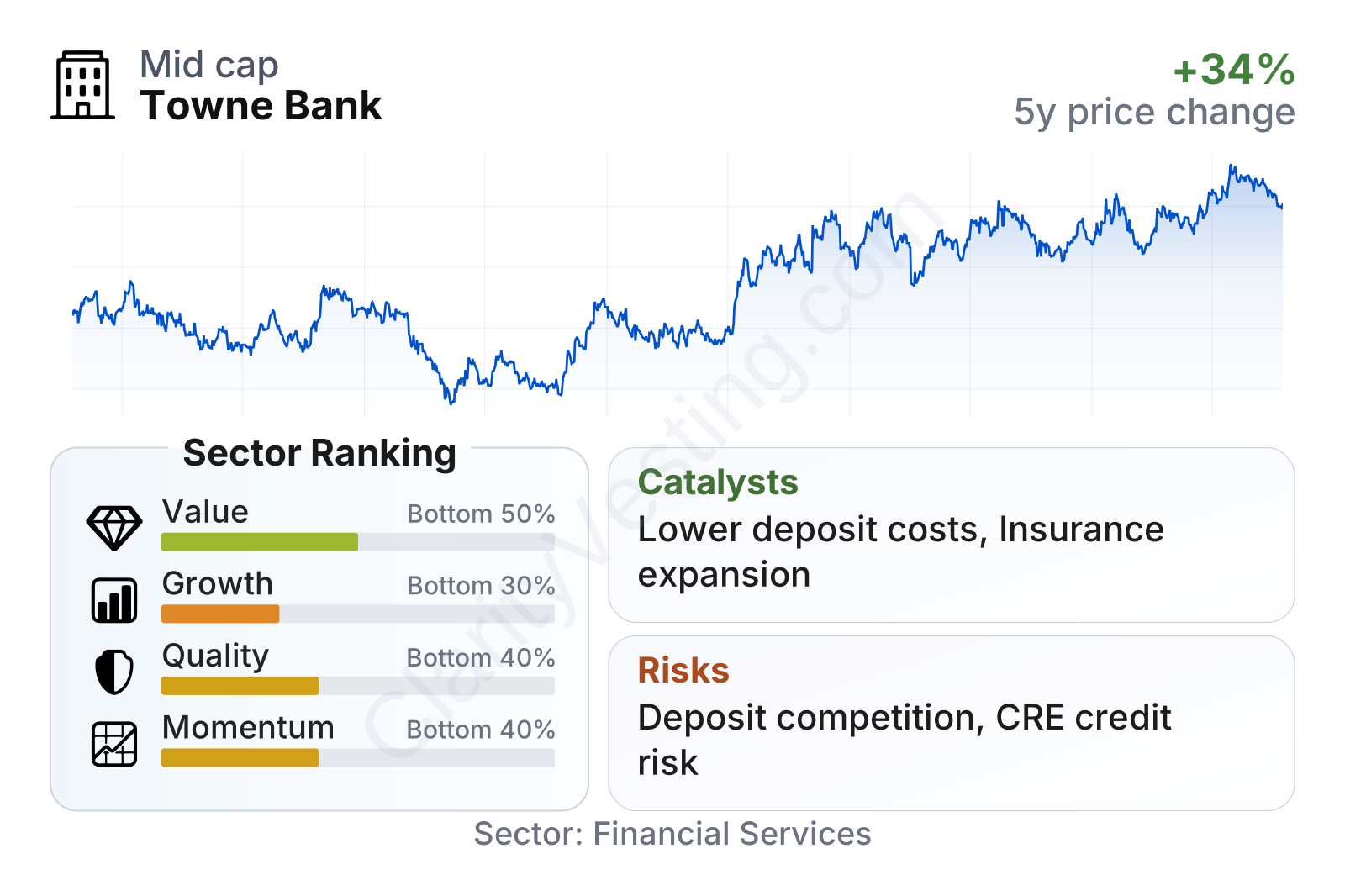
TowneBank sits in the regional bank universe as a mid-sized institution with a market value in the low single-digit billions and a below-market beta, which points to somewhat lower share-price volatility than many stocks. The factor table shows a mixed picture: valuation is not especially cheap on earnings, growth ranks weakly versus peers, and quality is acceptable but not standout. Profit margin is solid and leverage looks conservative, but several multi-year growth and return measures trail the sector median, which suggests a business that is stable yet not currently operating at top-tier efficiency.
The stock price has recovered well from the 2023 regional banking stress period and has trended upward into 2026. That recovery indicates improving confidence in deposit stability, credit quality, and earnings resilience, although the pace has been more moderate than the stronger performers in the sector.
Growth
Regional banking is a mature industry, so growth usually comes less from disruption and more from local market share gains, acquisitions, deposit gathering, and expansion in fee businesses. TowneBank’s strategy fits that pattern. Its combination of community banking, insurance, and mortgage operations gives it several ways to grow at once, particularly in attractive Southeastern markets where population and business activity have generally outpaced the national average over time.
A notable part of the long-term case is the insurance business. Insurance brokerage income is usually less balance-sheet intensive than lending and can produce steadier fees across rate cycles. That makes TowneBank somewhat more diversified than many similarly sized regional banks. If management continues to deepen customer relationships across banking, insurance, treasury services, and wealth offerings, cross-selling can support gradual growth without requiring unusually aggressive lending.
Earnings per share show an uneven path rather than a straight climb. After declining from 2021 through 2023, earnings stabilized and then improved meaningfully in 2025. That pattern suggests the bank has already worked through a difficult period of margin compression and is now showing better earnings power, but the recovery still needs to prove that it can be sustained over multiple years.
Book value per share has also improved in the last two reported years after a disrupted series that likely reflects balance-sheet changes and acquisition accounting effects around 2023. For banks, book value matters because it is a rough indicator of the equity base supporting future growth. A rebuilding trend is generally constructive, especially when paired with improving profitability.
Recent company updates have pointed to continued loan and deposit activity, along with contributions from fee-based businesses. In a more favorable rate environment, one of the clearest catalysts would be easing deposit cost pressure. If funding costs stop rising faster than asset yields, TowneBank could convert a larger share of its revenue base into net income. A second catalyst is further expansion of insurance and other fee businesses, which can raise earnings without requiring the same capital intensity as pure loan growth.
Risks
This article is for informational purposes only and does not constitute financial advice. Some content is AI-generated. See Disclaimer


