Stock Analysis · Tenaris S.A (TNRSF)
Overview
Tenaris S.A. is a global manufacturer and supplier of steel pipes and related services used mainly in the energy industry. Its core role is to provide seamless and welded tubular products for oil and gas drilling, well completion, and production, along with accessories, premium connections, coating, and field support. The company operates across North America, South America, Europe, the Middle East, Asia Pacific, and Africa, serving both major international oil companies and national oil companies.
For long-term analysis, the business is best understood as a specialized industrial supplier tied to energy investment cycles rather than to daily oil price moves alone. Demand depends heavily on drilling activity, offshore developments, unconventional shale programs, and the need for technically demanding pipe in harsh environments. Tenaris also benefits from service revenue around logistics, inventory management, and rig-site support, which can deepen customer relationships beyond the initial pipe sale.
Based on company reporting, revenue is concentrated in tubular products for the oil and gas market, while the rest comes from related industrial and process sectors. A simplified revenue mix looks like this:
- OCTG and line pipe for oil and gas: approximately 80% to 85% of revenue. This includes casing, tubing, and line pipe used in drilling and production, especially for shale, offshore, and international projects.
- Other energy and industrial pipes: approximately 10% to 15%. This includes products for mechanical, industrial, and process applications outside core upstream drilling.
- Services and accessories: approximately 5% to 10%. This includes premium connections, coating, threading, logistics, stock management, and field support.
Geographically, the United States is typically the largest single market because of its large shale and offshore activity, but Tenaris remains broadly international, which helps balance weak periods in one region with stronger demand elsewhere.
The company’s income profile also shows how cyclical the business can be. Revenue climbed sharply from 2021 through 2023 as energy investment recovered, then eased in 2024 and remained relatively stable in 2025. Even with that cooling phase, profitability stayed solid, suggesting that Tenaris kept pricing discipline and cost control better than many commodity-linked manufacturers.
The multiyear operating profile highlights a strong expansion phase through 2023, followed by lower sales but still healthy earnings in 2024 and 2025. That pattern matters because it suggests the company did not need extreme leverage or thin margins to produce substantial profits.
Key Figures
| Metric | Value | Sector ⓘ |
|---|---|---|
| Date | Oct 03, 2026 | |
| Context | ||
| Sector | Energy | |
| Industry | Oil & Gas Equipment & Services | |
| Market Cap ⓘ | $28.39B | |
| Beta ⓘ | 0.47 | |
Value (Cheapness) | ||
| P/E Ratio ⓘ | 15.04 | 14.47 |
| P/B Ratio ⓘ | 1.70 | 1.70 |
| FCF Yield ⓘ | 6.18% | 8.66% |
| Dividend Yield ⓘ | 4.23% | 3.77% |
| EBIT / EV ⓘ | 8.95% | 7.46% |
| PEG ⓘ | 3.03 | |
Growth (Business expansion) | ||
| Revenue Growth ⓘ | -3.90% | 27.35% |
| RPS Growth (5Y CAGR) ⓘ | 20.91% | 6.75% |
| EPS Growth (5Y CAGR) ⓘ | -19.62% | -15.45% |
| BVPS Growth (5Y CAGR) ⓘ | 11.21% | 5.85% |
| Margin Growth (5Y Trend) ⓘ | 8.01% | 0.75% |
| FCF Growth (5Y CAGR) ⓘ | N/A | 3.62% |
| DPS Growth (5Y CAGR) ⓘ | 34.64% | 16.85% |
Quality (Business durability) | ||
| ROIC (Latest) ⓘ | 10.79% | 11.33% |
| ROA (Latest) ⓘ | 9.35% | 6.03% |
| ROIC (5Y Median) ⓘ | 11.97% | 10.16% |
| ROA (5Y Median) ⓘ | 9.93% | 5.34% |
| Net Debt / EBIT (Latest) ⓘ | -0.05 | 1.62 |
| Net Debt / EBIT (5Y Median) ⓘ | -0.05 | 1.91 |
| Net Debt / EBITDA (Latest) ⓘ | -0.04 | 1.06 |
| Net Debt / Assets ⓘ | -0.54% | 17.29% |
| EBITDA / Interest ⓘ | 60.50 | 9.64 |
| Operating Margin (Latest) ⓘ | 19.53% | 16.32% |
| Operating Margin (5Y Median) ⓘ | 19.97% | 19.53% |
| Debt to Equity (Latest) ⓘ | 2.63% | 54.41% |
| Profit Margin (Latest) ⓘ | 15.88% | 8.79% |
| Free Cash Flow (Latest) ⓘ | $1.76B | |
Momentum (Price trend) | ||
| 3Y Return ⓘ | +88.26% | +62.93% |
| 12M Return (excl. last month) ⓘ | +52.42% | +44.83% |
| 6M Return ⓘ | +0.97% | -1.62% |
| Price vs. 200-Day MA ⓘ | +16.06% | +5.18% |
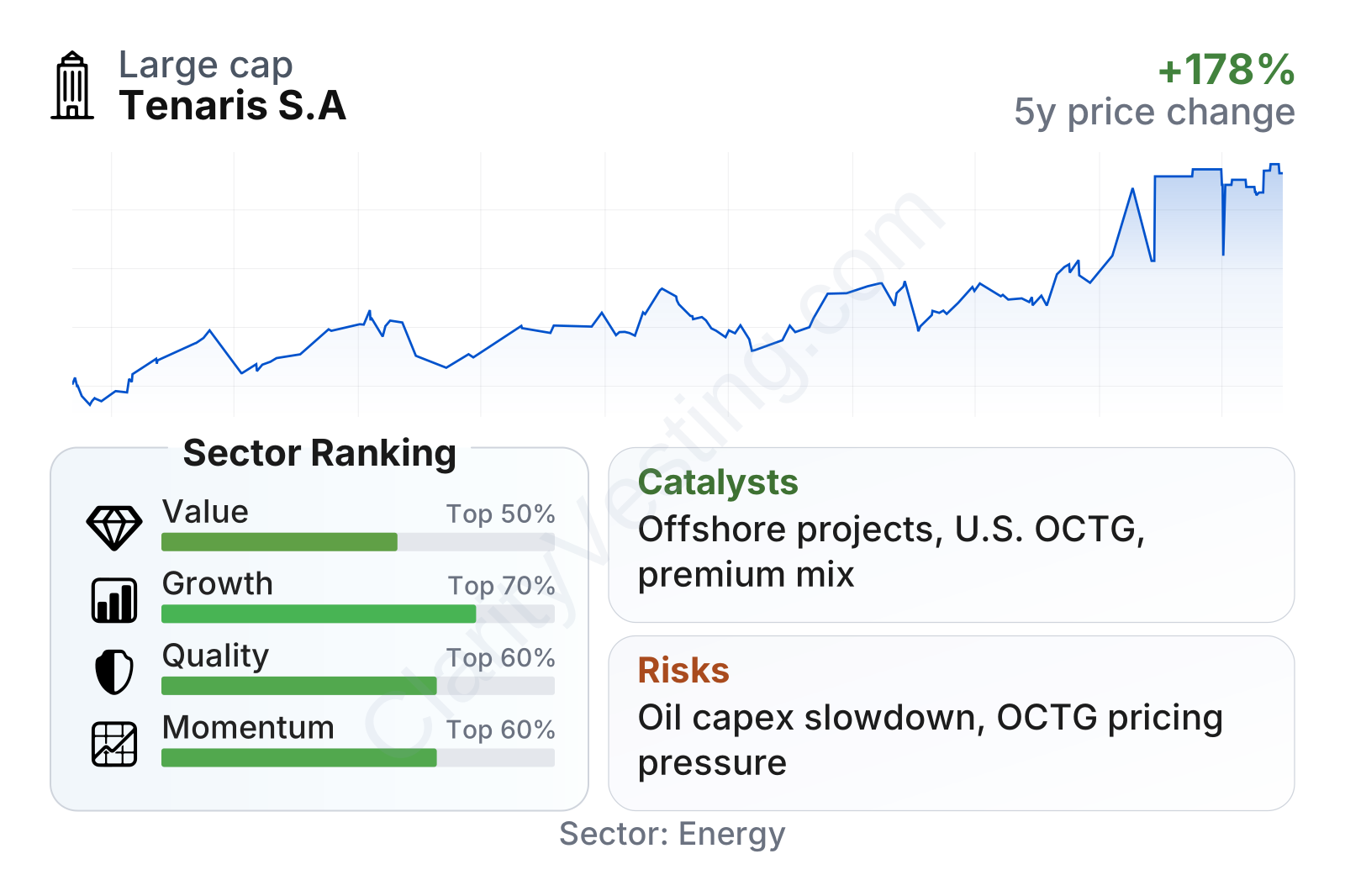
Tenaris stands out more for balance-sheet strength and profitability than for near-term growth. On valuation, the shares trade close to sector norms on earnings and book value, while the EBIT-to-enterprise-value measure is slightly better than the sector median. Quality is supported by strong returns on assets, operating margins near 20%, profit margins around the mid-teens, and exceptionally low leverage. Growth metrics are mixed: five-year revenue-per-share and book value trends are strong, but recent year-over-year revenue has been softer than the broader sector.
The stock’s longer-term price trend has been favorable, with the share price rising materially since 2021. Beta below 0.5 also suggests lower price sensitivity than many energy names, although the company remains exposed to energy spending cycles.
Growth
Tenaris operates in a sector with long-term relevance but uneven short-term demand. Oil and gas will likely remain essential for years in transportation, petrochemicals, heating, and power systems, and that supports ongoing need for drilling and production infrastructure. Within that setting, Tenaris is positioned in the more technical part of the value chain, where reliability, metallurgy, threading technology, and global service capability matter more than simple commodity steel pricing.
The company’s strategy for future expansion is sensible because it combines manufacturing scale, premium products, local finishing capacity, and customer service close to drilling basins. This is especially important in markets where operators want secure supply chains, shorter delivery times, and premium tubular goods designed for deeper, hotter, or more corrosive wells. The acquisition of IPSCO Tubulars in recent years strengthened Tenaris’s industrial footprint in the United States, which remains one of the most important energy markets in the world.
Recent revenue growth has been uneven after the very strong upcycle of 2022 and 2023. The more recent pattern points to normalization rather than collapse, with some quarters returning to modest growth before another soft patch. For a cyclical company, that matters: the business is no longer in a broad surge, so future upside depends more on market share, mix, and project timing than on easy industry tailwinds.
Free cash flow remains an important positive. Even after coming down from the strongest period, trailing cash generation still sits in a healthy range above $1.5 billion. That gives Tenaris flexibility to fund capital spending, dividends, share repurchases, and selective expansion without stretching the balance sheet.
Several catalysts could support future activity. Offshore developments, LNG-related infrastructure, Middle East capacity additions, and more technically challenging wells generally favor suppliers with premium tubular expertise. There is also a structural theme around supply-chain localization in North America and other regions, which can benefit established producers with local manufacturing and finishing assets. In addition, if drilling intensity improves in key markets after a period of caution by operators, Tenaris could see a renewed volume tailwind.
Recent company updates have also pointed to continuing shareholder distributions and disciplined capital allocation, which reinforce the idea that management is preparing for a slower but still profitable phase rather than chasing growth at any cost.
Risks
This article is for informational purposes only and does not constitute financial advice. Some content is AI-generated. See Disclaimer