Stock Analysis · Teekay Tankers Ltd (TNK)
Overview
Teekay Tankers Ltd is a marine shipping company focused on transporting crude oil and refined petroleum products. In simple terms, it owns and operates large ocean-going tankers that move oil between producing regions, refineries, storage hubs, and end markets. The company also earns money by commercially managing vessels for third parties and by offering related services tied to tanker operations.
Its business is tied closely to global oil trade rather than to oil production itself. That distinction matters for long-term readers: Teekay Tankers does not depend mainly on finding or drilling oil, but on demand for moving barrels across the world. Freight rates, vessel supply, trade routes, and fleet utilization are the main drivers of results.
The revenue mix is heavily concentrated in tanker shipping. Based on the company’s recent annual reporting structure, the main sources are approximately:
- Voyage charter revenue and pool revenue from owned tankers: about 80% to 90% of total revenue. This includes spot market voyages, revenue earned through tanker pools, and short-term charter activity on the company’s fleet.
- Time-charter revenue: about 5% to 15%. This comes from vessels leased to customers for a defined daily rate over a set period.
- Commercial management and other operating revenue: generally 0% to 5%. This covers fees and other shipping-related services provided to third-party ship owners.
That concentration makes the company easy to understand: this is primarily a pure-play tanker operator. Financially, the business has changed sharply since 2021, moving from losses to very strong profitability as tanker markets tightened and debt fell dramatically.
The multi-year trend shows a major improvement in economics. Revenue and profit rose strongly from 2022 onward, while interest expense fell to very low levels as debt was paid down. Even though annual revenue eased after the 2023 peak, profitability remained unusually strong for a shipping company.
Key Figures
| Metric | Value | Sector ⓘ |
|---|---|---|
| Date | Oct 04, 2026 | |
| Context | ||
| Sector | Energy | |
| Industry | Oil & Gas Midstream | |
| Market Cap ⓘ | $3.57B | |
| Beta ⓘ | -0.22 | |
Value (Cheapness) | ||
| P/E Ratio ⓘ | 6.08 | 14.57 |
| P/B Ratio ⓘ | 1.52 | 1.71 |
| FCF Yield ⓘ | 10.27% | 8.63% |
| Dividend Yield ⓘ | 0.97% | 3.77% |
| EBIT / EV ⓘ | 28.67% | 7.46% |
| PEG ⓘ | 1.10 | |
Growth (Business expansion) | ||
| Revenue Growth ⓘ | 63.00% | 27.35% |
| RPS Growth (5Y CAGR) ⓘ | 14.33% | 6.75% |
| EPS Growth (5Y CAGR) ⓘ | 10.35% | -15.45% |
| BVPS Growth (5Y CAGR) ⓘ | 24.12% | 5.85% |
| Margin Growth (5Y Trend) ⓘ | 75.37% | 0.75% |
| FCF Growth (5Y CAGR) ⓘ | N/A | 3.62% |
| DPS Growth (5Y CAGR) ⓘ | N/A | 16.85% |
Quality (Business durability) | ||
| ROIC (Latest) ⓘ | N/A | 11.33% |
| ROA (Latest) ⓘ | 25.16% | 6.03% |
| ROIC (5Y Median) ⓘ | 25.05% | 10.16% |
| ROA (5Y Median) ⓘ | 16.66% | 5.34% |
| Net Debt / EBIT (Latest) ⓘ | -1.18 | 1.62 |
| Net Debt / EBIT (5Y Median) ⓘ | -0.70 | 1.91 |
| Net Debt / EBITDA (Latest) ⓘ | -1.04 | 1.06 |
| Net Debt / Assets ⓘ | -27.43% | 17.29% |
| EBITDA / Interest ⓘ | 260.69 | 9.64 |
| Operating Margin (Latest) ⓘ | 52.10% | 16.32% |
| Operating Margin (5Y Median) ⓘ | 33.48% | 19.53% |
| Debt to Equity (Latest) ⓘ | 1.17% | 54.41% |
| Profit Margin (Latest) ⓘ | 51.35% | 8.79% |
| Free Cash Flow (Latest) ⓘ | $366.92M | |
Momentum (Price trend) | ||
| 3Y Return ⓘ | +184.80% | +63.02% |
| 12M Return (excl. last month) ⓘ | +88.91% | +44.83% |
| 6M Return ⓘ | +36.15% | -1.02% |
| Price vs. 200-Day MA ⓘ | +39.35% | +5.18% |
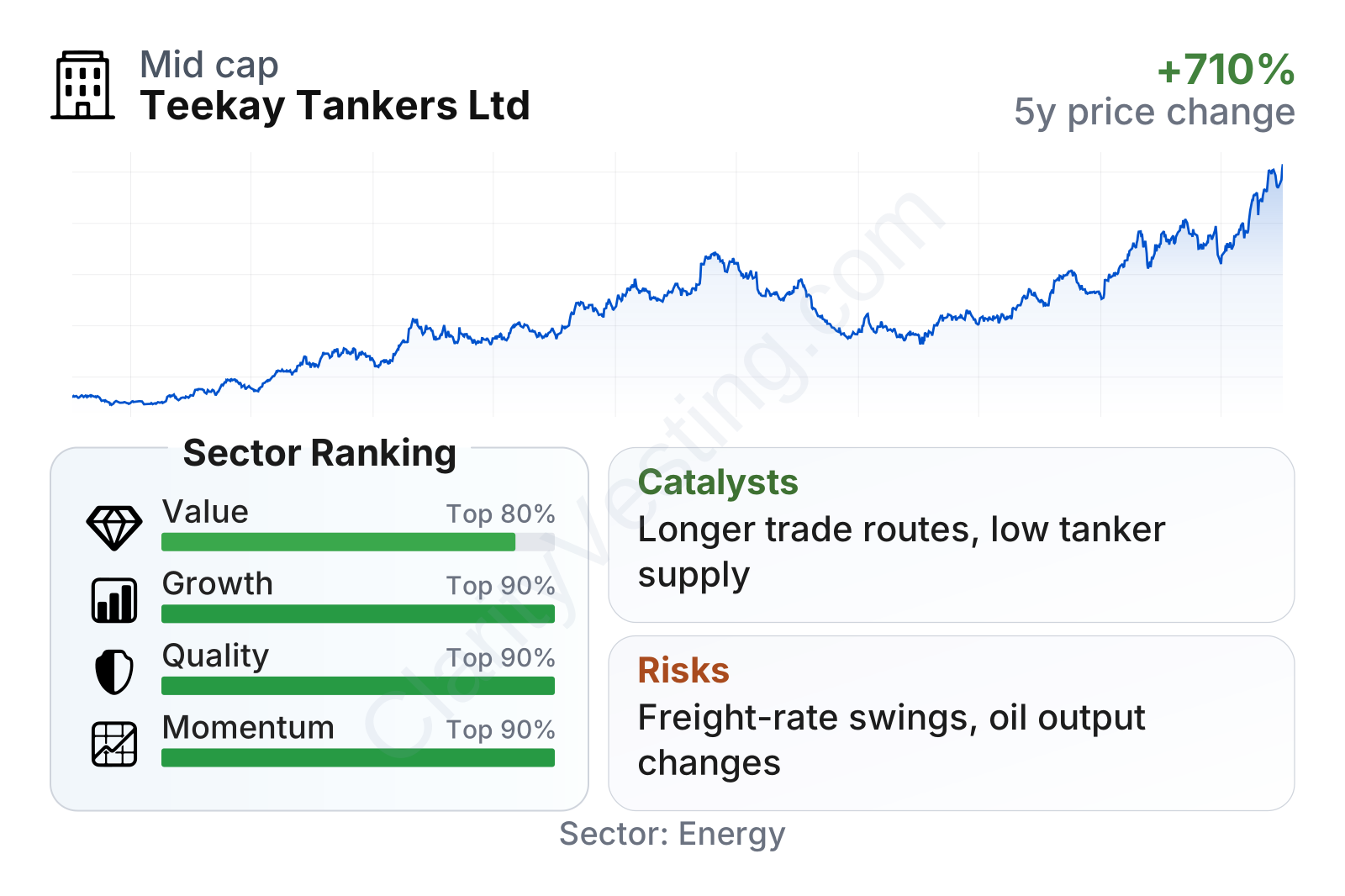
Teekay Tankers stands out on growth, quality, and value versus much of the energy and midstream universe. Profitability metrics are far above sector norms, leverage is exceptionally low, and the earnings multiple remains modest despite the strong share-price run over the past several years. The main point to keep in mind is that shipping profits can swing widely with freight rates, so these strong metrics reflect both company execution and a favorable part of the cycle.
The company is now a mid-sized public shipping operator with an unusual balance-sheet profile for the industry. Debt is close to negligible relative to equity, net debt is negative, and interest coverage is extremely high. That gives Teekay Tankers more flexibility than many peers when rates weaken or when secondhand vessel opportunities appear.
Growth
The tanker market is not a classic secular growth industry like software or healthcare equipment, but it can still benefit from durable structural tailwinds. Oil demand has remained resilient in many regions, and global trade patterns have become less efficient. When cargoes travel longer distances, tanker demand rises even if the number of barrels shipped grows only modestly. This “ton-mile” effect has been an important support for tanker owners in recent years.
Teekay Tankers’ strategy is coherent in that context. The company has focused on operating a sizable fleet in the spot market, maintaining commercial flexibility, reducing leverage, and returning capital while preserving optionality for fleet renewal. That approach allows it to capture upside when freight markets are strong while avoiding the financial strain that has hurt shipping companies in past downturns.
Revenue growth has been volatile, which is normal in tanker shipping. After a very strong expansion phase in 2022 and 2023, comparisons became harder and revenue cooled, then turned positive again in 2026. This pattern suggests that the business is cyclical rather than steadily compounding, but it also shows the company can recover quickly when market conditions improve.
Cash generation has remained positive even after coming down from earlier highs. That matters because free cash flow is what funds debt reduction, dividends, vessel upgrades, and fleet acquisitions. A trailing level in the hundreds of millions of dollars is substantial for a company of this size, even if it is below the recent peak.
Several industry catalysts can support future performance. First, the global tanker order book has remained relatively restrained compared with earlier shipping booms, partly because shipyards are busy with other vessel types and because owners face uncertainty around future fuel rules. Second, sanctions and changing oil trade flows have increased voyage distances in parts of the market. Third, if older vessels exit the fleet faster due to environmental regulation or operating restrictions, supply could stay tighter for longer.
Recent company communications have also highlighted continued capital returns and a balance sheet with significant flexibility. In practical terms, that creates room for Teekay Tankers to act opportunistically if vessel values soften or if charter markets improve further.
Risks
This article is for informational purposes only and does not constitute financial advice. Some content is AI-generated. See Disclaimer