Stock Analysis · Tango Therapeutics Inc (TNGX)
Overview
Tango Therapeutics is a clinical-stage biotechnology company focused on precision cancer medicines. Its research centers on “synthetic lethality,” a drug-development approach that looks for weaknesses created by specific genetic changes in cancer cells. The goal is to design treatments that selectively kill tumor cells while limiting damage to normal cells. This places Tango in a high-risk, high-upside part of biotechnology: it is trying to create future medicines rather than selling established products today.
The business is still in the development stage, so its revenue does not come from marketed drugs. Instead, it has largely come from collaboration and license agreements with larger pharmaceutical companies, along with related research funding and milestone-style payments when available. Based on recent annual results, revenue appears to be concentrated in a small number of partnership arrangements rather than diversified commercial sales.
Main revenue sources are best understood as:
- Collaboration and license revenue: approximately 95% to 100% of total revenue in recent periods. This includes upfront payments recognized over time, research support, and development-related consideration tied to partners.
- Other revenue: typically 0% to 5%, mainly minor items rather than a meaningful operating segment.
That concentration is important. Tango’s current economic model depends on advancing its pipeline and maintaining productive alliances while it funds heavy research spending internally. Over the last several years, operating expenses have remained far above revenue, with research and development clearly representing the largest use of cash. The positive side is that this is normal for an early-stage biotech; the negative side is that progress in the clinic matters far more than current sales figures.
The financial flow shows a familiar biotech pattern: modest revenue, very low cost of revenue, and a cost base dominated by research and development. R&D spending has generally risen much faster than revenue, which explains the persistent operating losses, although revenue improved in 2025 versus prior years.
Key Figures
| Metric | Value | Sector ⓘ |
|---|---|---|
| Date | Oct 24, 2026 | |
| Context | ||
| Sector | Healthcare | |
| Industry | Biotechnology | |
| Market Cap ⓘ | $4.55B | |
| Beta ⓘ | 1.17 | |
Value (Cheapness) | ||
| P/E Ratio ⓘ | N/A | 25.42 |
| P/B Ratio ⓘ | 4.09 | 3.08 |
| FCF Yield ⓘ | -3.17% | 3.12% |
| Dividend Yield ⓘ | N/A | 1.85% |
| EBIT / EV ⓘ | -3.94% | 0.56% |
| PEG ⓘ | N/A | |
Growth (Business expansion) | ||
| Revenue Growth ⓘ | -100.00% | 7.50% |
| RPS Growth (5Y CAGR) ⓘ | -2.59% | 8.60% |
| EPS Growth (5Y CAGR) ⓘ | -14.29% | -17.73% |
| BVPS Growth (5Y CAGR) ⓘ | -14.40% | 3.72% |
| Margin Growth (5Y Trend) ⓘ | N/A | -0.57% |
| FCF Growth (5Y CAGR) ⓘ | N/A | 0.96% |
| DPS Growth (5Y CAGR) ⓘ | N/A | 6.69% |
Quality (Business durability) | ||
| ROIC (Latest) ⓘ | -19.36% | 3.17% |
| ROA (Latest) ⓘ | -19.27% | 2.98% |
| ROIC (5Y Median) ⓘ | -30.35% | 4.56% |
| ROA (5Y Median) ⓘ | -24.25% | 1.87% |
| Net Debt / EBIT (Latest) ⓘ | N/A | 1.34 |
| Net Debt / EBIT (5Y Median) ⓘ | N/A | 1.86 |
| Net Debt / EBITDA (Latest) ⓘ | N/A | 1.00 |
| Net Debt / Assets ⓘ | -29.20% | 5.06% |
| EBITDA / Interest ⓘ | N/A | 9.55 |
| Operating Margin (Latest) ⓘ | -230.03% | 9.25% |
| Operating Margin (5Y Median) ⓘ | -278.18% | 7.33% |
| Debt to Equity (Latest) ⓘ | 3.12% | 26.68% |
| Profit Margin (Latest) ⓘ | -229.92% | 3.34% |
| Free Cash Flow (Latest) ⓘ | -$144.27M | |
Momentum (Price trend) | ||
| 3Y Return ⓘ | +296.17% | +51.61% |
| 12M Return (excl. last month) ⓘ | +242.68% | +19.90% |
| 6M Return ⓘ | +3.67% | +10.10% |
| Price vs. 200-Day MA ⓘ | +27.01% | +6.44% |
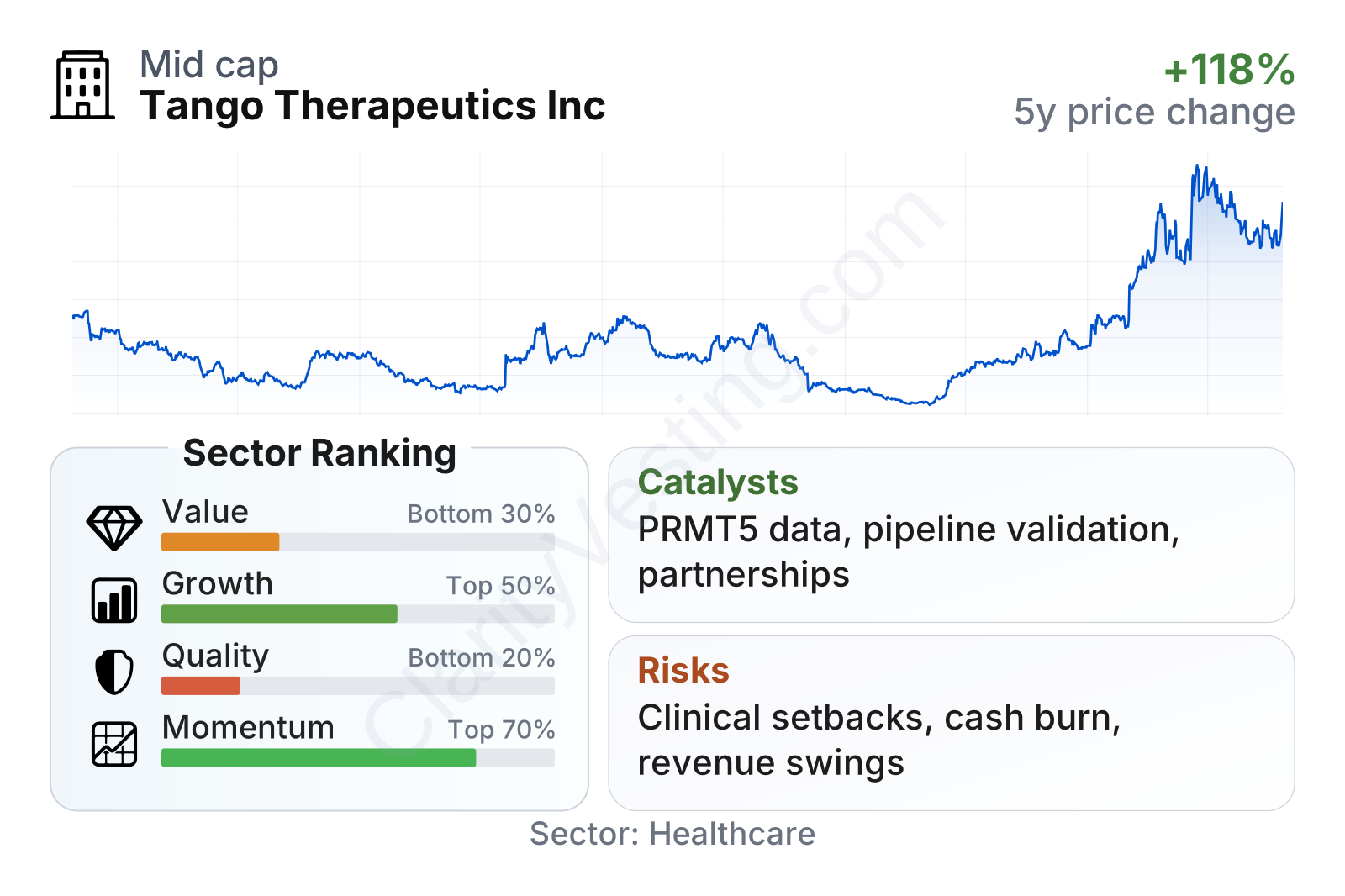
Tango is a mid-sized biotech by market value, but its operating profile still looks like a development company rather than a mature drug business. On valuation measures tied to earnings or cash flow, it ranks weakly because it remains loss-making and free cash flow is negative. Quality metrics are also low versus the healthcare sector, which is expected for a company with no approved product base. By contrast, market momentum has been notably strong, with share-price performance well ahead of many healthcare peers over the past year and over three years.
This combination matters for interpretation: the stock’s market performance has improved much faster than the company’s profitability. In other words, the market has been rewarding expected future clinical value rather than current financial strength.
Growth
Tango operates in a sector with long-term structural growth potential. Precision oncology remains one of the most active areas in drug development because cancer treatment is increasingly moving toward biomarker-based therapies aimed at well-defined patient groups. If Tango can prove that its synthetic lethality programs work in patients, it could participate in an important niche of oncology where large pharmaceutical companies remain active dealmakers.
The strategy is logical for future growth. Rather than competing directly in broad, crowded cancer markets with standard chemotherapy or immunotherapy platforms, Tango is targeting genetically defined tumors where a successful drug can become highly relevant even with a narrower patient population. That can create attractive economics if the science is validated. The company has also used partnerships to extend its reach and reduce some development burden, which is common in biotech and can help support programs before commercialization.
Revenue growth has been uneven, which is normal for companies that depend on collaboration accounting rather than recurring product sales. Some quarters show very large jumps while others fall sharply, so revenue trends should be read cautiously. For Tango, the more meaningful growth signal is pipeline advancement, not smooth top-line expansion.
Cash generation remains negative and the trailing free cash outflow has worsened over time, reflecting the cost of running multiple research and clinical programs. That is not unusual in this industry, but it means future value creation depends on whether those cash outlays produce meaningful clinical data, partnerships, or eventual late-stage assets.
Recent developments have improved the company’s opportunity set. Tango has continued to advance its precision oncology pipeline, including PRMT5-related programs and other genetically targeted candidates, and clinical updates have been a key reason market expectations strengthened. In biotech, credible human data can change a company’s outlook quickly because it may validate both a single asset and the underlying platform approach. For Tango, that platform validation is one of the most important possible catalysts over the next several years.
Risks
This article is for informational purposes only and does not constitute financial advice. Some content is AI-generated. See Disclaimer


