Stock Analysis · Tompkins Financial Corporation (TMP)
Overview
Tompkins Financial Corporation is a regional financial services company based in New York State. Through Tompkins Community Bank and Tompkins Insurance Agencies, it provides traditional banking, wealth management, and insurance services to individuals, businesses, and municipalities. Its footprint is concentrated in New York and Pennsylvania, which makes it a community-focused lender rather than a national banking giant.
For a bank like Tompkins, revenue does not come from selling physical products. It mainly comes from the spread between what it earns on loans and investments and what it pays on deposits and other funding, plus fees from services. Based on the company’s recent annual reporting structure, the main revenue sources are approximately:
- Net interest income: about 75% to 85% of total revenue. This is the core banking business: commercial loans, commercial real estate loans, residential mortgages, consumer lending, and income from securities, minus interest paid on deposits and borrowings.
- Insurance commissions and fees: about 8% to 12%. This comes from property and casualty, employee benefits, and other insurance brokerage activities through its insurance subsidiaries.
- Wealth management and trust fees: about 4% to 7%. This includes investment management, trust, estate, and retirement-related services.
- Service charges, card fees, and other banking fees: about 3% to 6%. This includes deposit account fees, interchange income, and other service-related charges.
That mix matters for long-term analysis. The bank is still primarily driven by lending and deposit gathering, but its insurance and wealth businesses give it fee income that is less tied to short-term interest rate moves. In 2025, total revenue rose strongly versus the prior two years, while net income also recovered sharply after a weak 2023 period. Operating profitability appears to have improved meaningfully as revenue expanded faster than expenses.
The multi-year financial flow shows a clear recovery pattern. Revenue was fairly stable through 2021 to 2023, then accelerated in 2024 and especially 2025, while net income rebounded from a depressed 2023 level. That suggests the earnings pressure from higher funding costs and margin compression was not permanent, although the bank remains exposed to the normal ups and downs of the rate cycle.
Key Figures
| Metric | Value | Sector ⓘ |
|---|---|---|
| Date | Oct 17, 2026 | |
| Context | ||
| Sector | Financial Services | |
| Industry | Banks - Regional | |
| Market Cap ⓘ | $1.38B | |
| Beta ⓘ | 0.74 | |
Value (Cheapness) | ||
| P/E Ratio ⓘ | 7.86 | 12.26 |
| P/B Ratio ⓘ | 1.45 | 1.23 |
| FCF Yield ⓘ | 3.75% | 10.40% |
| Dividend Yield ⓘ | 2.71% | 3.02% |
| EBIT / EV ⓘ | 8.72% | 8.14% |
| PEG ⓘ | 1.61 | |
Growth (Business expansion) | ||
| Revenue Growth ⓘ | 7.20% | 9.35% |
| RPS Growth (5Y CAGR) ⓘ | 16.91% | 12.19% |
| EPS Growth (5Y CAGR) ⓘ | -10.66% | -9.53% |
| BVPS Growth (5Y CAGR) ⓘ | 7.15% | 4.99% |
| Margin Growth (5Y Trend) ⓘ | 2.65% | -3.86% |
| FCF Growth (5Y CAGR) ⓘ | -27.62% | 4.81% |
| DPS Growth (5Y CAGR) ⓘ | 3.28% | 8.79% |
Quality (Business durability) | ||
| ROIC (Latest) ⓘ | 8.50% | 9.49% |
| ROE (Latest) ⓘ | 20.05% | 13.90% |
| ROA (Latest) ⓘ | 2.03% | 1.55% |
| ROIC (5Y Median) ⓘ | 9.68% | 7.86% |
| ROE (5Y Median) ⓘ | 10.26% | 12.17% |
| ROA (5Y Median) ⓘ | 1.10% | 1.30% |
| Net Debt / EBIT (Latest) ⓘ | 3.84 | 0.96 |
| Net Debt / EBIT (5Y Median) ⓘ | 2.46 | 0.73 |
| Net Debt / EBITDA (Latest) ⓘ | 3.66 | 0.92 |
| Operating Margin (Latest) ⓘ | 34.90% | 22.30% |
| Operating Margin (5Y Median) ⓘ | 33.79% | 24.63% |
| Debt to Equity (Latest) ⓘ | 75.85% | 58.56% |
| Profit Margin (Latest) ⓘ | 39.25% | 26.57% |
| Free Cash Flow (Latest) ⓘ | $51.65M | |
Momentum (Price trend) | ||
| 3Y Return ⓘ | +117.46% | +88.33% |
| 12M Return (excl. last month) ⓘ | +48.94% | +19.38% |
| 6M Return ⓘ | +17.81% | +4.75% |
| Price vs. 200-Day MA ⓘ | +11.99% | +3.50% |
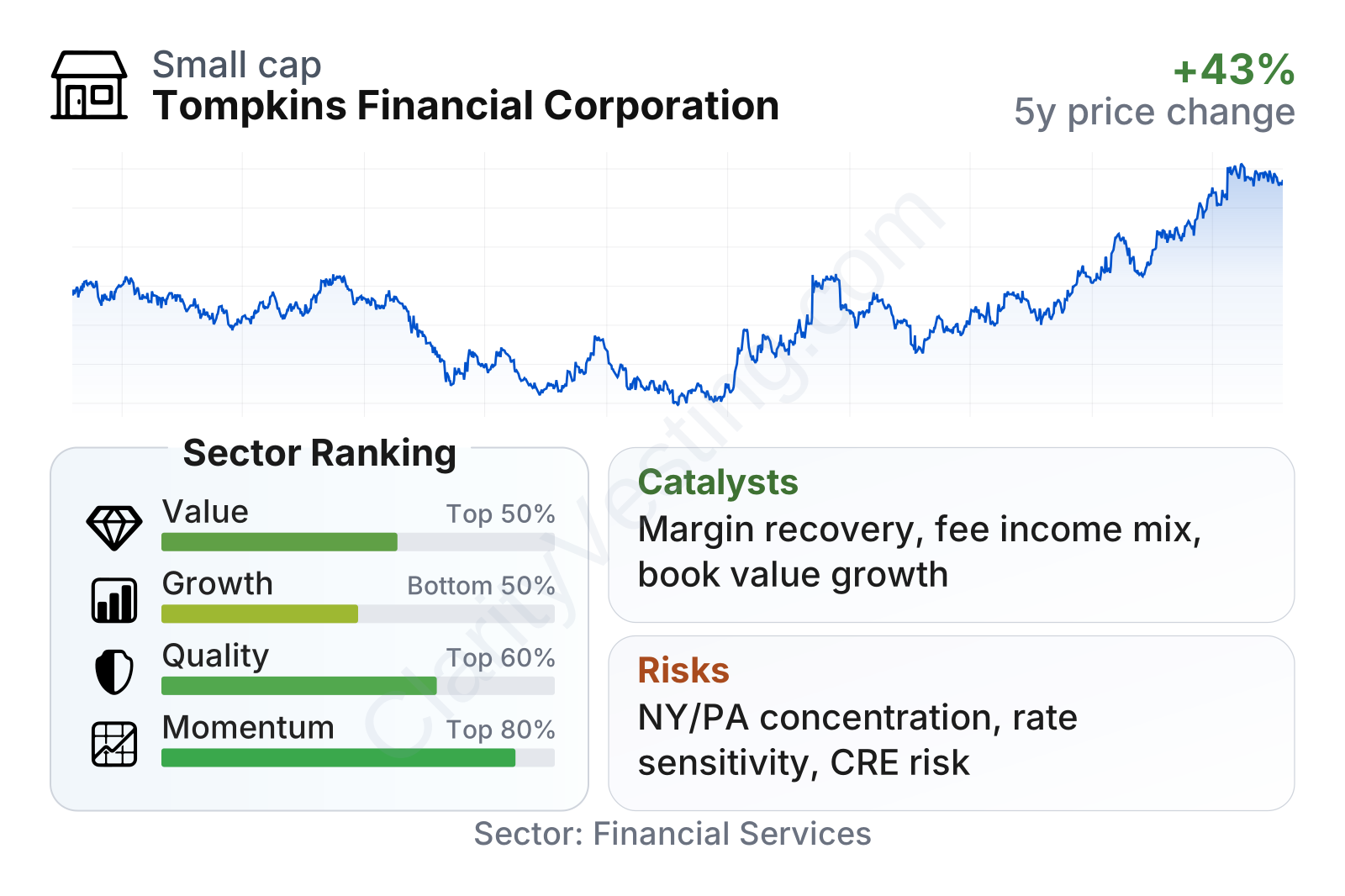
Tompkins is a small-cap regional bank with lower share-price volatility than the broader market, reflected in a beta below 1. On valuation, its earnings multiple sits below the regional bank median, but its price-to-book ratio is above the sector median, which means the market is assigning some premium to the franchise despite the low P/E. Quality metrics look better than growth metrics: returns on equity and assets are currently above sector medians, margins are strong, and recent price momentum has been favorable. The weaker area is growth, where recent revenue growth is positive but not exceptional, and the longer-term earnings trend has been uneven.
Growth
Regional banking is a mature industry, not a fast-growing one, but it remains essential. Long-term expansion typically comes from loan growth, deposit gathering, better pricing discipline, acquisitions, and fee businesses such as insurance and wealth management. Tompkins operates in a sector that benefits from population stability, small-business activity, and the ongoing need for local credit and treasury services. That is not a high-excitement market, but it can produce steady value when underwriting is disciplined and funding costs are controlled.
Tompkins’ strategy is sensible for that environment. The company emphasizes relationship banking in local markets and supplements that with insurance and wealth management. That combination can deepen customer relationships and create cross-selling opportunities. A business client, for example, may use the bank for deposits and loans, the insurance arm for employee benefits or commercial coverage, and the wealth unit for retirement plans or trust services. This creates a more diversified revenue base than a pure-play community bank.
Earnings per share show why the stock needs to be viewed through a cycle rather than a single year. EPS fell from 2021 into 2023, then recovered in 2024 and again in 2025 to above the earlier level. That pattern is consistent with the pressure many regional banks experienced when deposit costs rose faster than asset yields. The rebound is encouraging because it shows the business could restore profitability rather than remain stuck at the lower 2023 level.
Book value per share has also improved over the last several years after a dip in 2022. That matters for banks because book value is a rough measure of the equity base supporting lending activity. The rise through 2025 suggests the company rebuilt capital value while returning to stronger earnings. Over five years, book value growth has been better than the sector median, which supports the case that underlying franchise value has been compounding even though EPS growth has been uneven.
Potential catalysts for future growth are fairly specific. First, if deposit pricing becomes less aggressive across the industry, net interest margin can improve. Second, Tompkins’ fee businesses can keep gaining weight, reducing reliance on spread income alone. Third, the bank has room to benefit from normal loan growth in its local markets without needing a dramatic macroeconomic boom. Recent company updates in 2026 have also pointed to continued operating performance and dividend continuity, which reinforces the picture of a bank that is stabilizing after a difficult rate period rather than one still in repair mode.
Risks
This article is for informational purposes only and does not constitute financial advice. Some content is AI-generated. See Disclaimer


