Stock Analysis · TransMedics Group Inc (TMDX)
Overview
TransMedics Group is a medical technology company focused on organ transplantation. Its main product platform is the Organ Care System, or OCS, which keeps donor organs warm, functioning, and monitored outside the body during transport. This is different from the traditional cold-storage method that has been used for decades. The company’s goal is to increase the number of usable donor organs and improve transplant logistics, especially for heart, lung, and liver procedures.
Over time, TransMedics has expanded from being mainly a device maker into a broader transplant-services company. That matters because the business is no longer only about selling equipment to hospitals. It is increasingly tied to the full workflow of organ recovery, preservation, transportation, and clinical support. This wider role can deepen customer relationships and create more recurring revenue, but it also makes the company more operationally complex.
Based on company disclosures, revenue is primarily generated from the following sources:
- Product revenue from OCS transplant usage and related disposables: likely the largest component overall. This includes organ-specific perfusion sets and other consumables used in each transplant procedure. Because each transplant needs a new set of disposable components, this portion can scale with procedure volume.
- Service revenue from the National OCS Program: now a major and fast-growing contributor. This includes logistics, organ procurement support, transport coordination, and clinical services tied to the use of the OCS platform.
- Capital equipment and other revenue: a smaller component, including placement or sale of OCS consoles and certain ancillary items.
In recent years, the mix appears to have shifted toward a more balanced model between products and services, with service activity becoming much more important as the National OCS Program expanded. Exact percentages can vary by quarter, but the broad picture is that the business is increasingly driven by procedure-related recurring activity rather than one-time equipment sales.
The company’s financial profile has changed quickly. Revenue rose from about $30 million in 2021 to more than $600 million in 2025, while profitability moved from deep losses to meaningful net income. That transition suggests TransMedics has crossed from an early commercialization phase into a much more mature operating stage, although it is still relatively small compared with large diversified medical-device groups.
The financial flow shows a sharp improvement in scale and profitability over the last several years. Revenue has expanded far faster than operating expenses, and operating income turned positive after years of losses. Selling and administrative costs remain large, which fits the company’s service-heavy expansion model, but margins have improved enough to change the earnings profile materially.
Key Figures
| Metric | Value | Sector ⓘ |
|---|---|---|
| Date | Oct 24, 2026 | |
| Context | ||
| Sector | Healthcare | |
| Industry | Medical Devices | |
| Market Cap ⓘ | $2.51B | |
| Beta ⓘ | 1.93 | |
Value (Cheapness) | ||
| P/E Ratio ⓘ | 19.36 | 25.42 |
| P/B Ratio ⓘ | 5.66 | 3.08 |
| FCF Yield ⓘ | 3.15% | 3.12% |
| Dividend Yield ⓘ | N/A | 1.85% |
| EBIT / EV ⓘ | 2.75% | 0.56% |
| PEG ⓘ | 0.75 | |
Growth (Business expansion) | ||
| Revenue Growth ⓘ | 20.70% | 7.50% |
| RPS Growth (5Y CAGR) ⓘ | 92.14% | 8.60% |
| EPS Growth (5Y CAGR) ⓘ | N/A | -17.73% |
| BVPS Growth (5Y CAGR) ⓘ | 47.63% | 3.72% |
| Margin Growth (5Y Trend) ⓘ | N/A | -0.57% |
| FCF Growth (5Y CAGR) ⓘ | N/A | 0.96% |
| DPS Growth (5Y CAGR) ⓘ | N/A | 6.69% |
Quality (Business durability) | ||
| ROIC (Latest) ⓘ | 18.85% | 3.17% |
| ROA (Latest) ⓘ | 12.59% | 2.98% |
| ROIC (5Y Median) ⓘ | -2.79% | 4.56% |
| ROA (5Y Median) ⓘ | -5.09% | 1.87% |
| Net Debt / EBIT (Latest) ⓘ | 4.21 | 1.34 |
| Net Debt / EBIT (5Y Median) ⓘ | N/A | 1.86 |
| Net Debt / EBITDA (Latest) ⓘ | 3.03 | 1.00 |
| Net Debt / Assets ⓘ | 26.98% | 5.06% |
| EBITDA / Interest ⓘ | 6.13 | 9.55 |
| Operating Margin (Latest) ⓘ | 14.03% | 9.25% |
| Operating Margin (5Y Median) ⓘ | -6.57% | 7.33% |
| Debt to Equity (Latest) ⓘ | 167.50% | 26.68% |
| Profit Margin (Latest) ⓘ | 22.69% | 3.34% |
| Free Cash Flow (Latest) ⓘ | $79.04M | |
Momentum (Price trend) | ||
| 3Y Return ⓘ | +74.44% | +51.61% |
| 12M Return (excl. last month) ⓘ | -29.63% | +19.90% |
| 6M Return ⓘ | -37.15% | +10.10% |
| Price vs. 200-Day MA ⓘ | -25.39% | +6.44% |
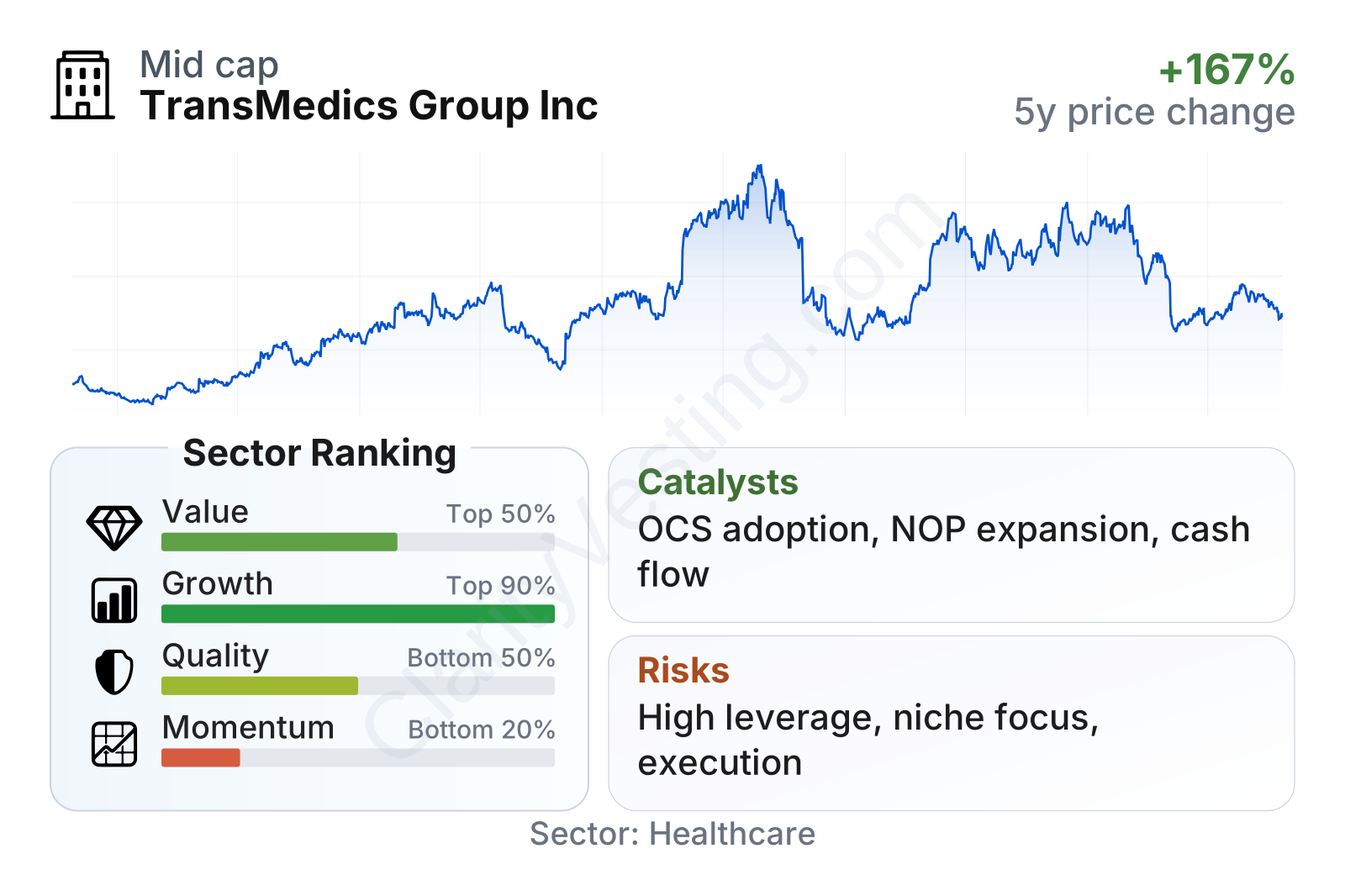
TransMedics stands out for strong growth and improving business quality, while recent stock performance has been weaker than much of the healthcare sector. Growth metrics rank near the top of the peer group, and current profitability measures are now clearly above sector medians. Valuation signals are mixed: the earnings multiple is not stretched relative to the sector, but the price-to-book ratio remains elevated, which reflects expectations for continued expansion. The company is also more volatile than average, as shown by its high beta and sharp share-price swings.
Growth
TransMedics operates in a part of healthcare with attractive long-term demand. Organ transplantation is a highly specialized market, but the need is clear and persistent: there are far more patients needing transplants than available usable organs. A technology that helps preserve organs better, extend transport times, and increase utilization addresses a real bottleneck rather than a discretionary preference. That gives the company exposure to a structurally growing segment of healthcare.
The strategy also has a logic that goes beyond selling a device. By building the National OCS Program, TransMedics has positioned itself closer to the full transplant process. That can make adoption easier for hospitals because it reduces logistical friction, not just technical challenges. It also creates a more integrated platform that may be harder to replace once transplant centers embed it into workflows.
Revenue growth has remained strong even after the explosive early ramp. The pace has naturally slowed from triple-digit increases as the company became larger, but growth still remains well above the healthcare sector median. A year-over-year increase around 20% at the current scale suggests the business is still expanding meaningfully rather than simply cycling off an easy comparison period.
Cash generation has improved sharply. Free cash flow was negative during the earlier buildout phase, which is common for a company funding commercialization and operational expansion. More recently, it has turned decisively positive, showing that revenue growth is now translating into cash rather than being consumed entirely by expansion needs. That is an important shift because it gives the company more flexibility to invest in growth without relying as heavily on outside capital.
Recent company updates have continued to point toward expansion in transplant volume, growing use of the OCS platform, and ongoing development of the service network around it. The strongest catalyst remains simple but powerful: if more transplant centers rely on OCS and more donor organs become viable through the platform, both product usage and service revenue can rise together. That kind of two-layer growth model is more compelling than a device business that depends only on equipment placements.
Another important opportunity is international and procedural expansion. Heart, lung, and liver are already approved and commercialized markets for the company, but there is still room to deepen penetration across transplant centers and geographies. In a niche market with high clinical barriers, wider adoption can still create a long runway.
Risks
This article is for informational purposes only and does not constitute financial advice. Some content is AI-generated. See Disclaimer


