Stock Analysis · TMC the metals company Inc (TMC)
Overview
TMC the metals company Inc is a deep-sea minerals development company focused on collecting polymetallic nodules from the Pacific Ocean’s Clarion-Clipperton Zone. These nodules contain several metals used in batteries, electrical infrastructure, and industrial applications, especially nickel, copper, cobalt, and manganese. Rather than operating an established mine today, TMC is still in the development and permitting stage. That means the business is centered on proving resources, advancing engineering, working with regulators, and positioning itself to supply future metal demand if commercial collection is allowed.
At this stage, the company does not have a stable operating revenue base from metal sales. Recent financial statements show little to no recurring commercial revenue, which is typical for a pre-production resource company but very different from a producing miner. Historically, reported revenue has mainly reflected non-recurring arrangements and accounting items rather than a mature sales business.
The economic value proposition, if the project reaches production, would come from metals contained in nodules. Based on the company’s project materials, the future revenue mix would be tied primarily to:
- Nickel — expected to be one of the largest value contributors, used heavily in stainless steel and some battery chemistries.
- Copper — another major contributor, important for power grids, electrification, and industrial equipment.
- Manganese — likely a meaningful contributor by volume, with use in steelmaking and some battery technologies.
- Cobalt — smaller by volume but often important by value because of its higher unit price and use in batteries and specialty alloys.
Because TMC is not yet producing nodules commercially, reliable current revenue percentages by source are not available in the way they would be for an operating mining company. For long-term analysis, the more relevant point is that the future business would be concentrated in a single project theme: developing seabed nodules as a multi-metal source for energy transition and industrial demand.
The financial flow over recent years also shows a business with minimal revenue and persistent operating losses, reflecting a company funding development work rather than generating cash from production. Expenses have remained substantial while commercial income has not yet arrived.
Key Figures
| Metric | Value | Sector ⓘ |
|---|---|---|
| Date | Oct 03, 2026 | |
| Context | ||
| Sector | Basic Materials | |
| Industry | Other Industrial Metals & Mining | |
| Market Cap ⓘ | $2.12B | |
| Beta ⓘ | 2.10 | |
Value (Cheapness) | ||
| P/E Ratio ⓘ | N/A | 17.61 |
| P/B Ratio ⓘ | N/A | 1.77 |
| FCF Yield ⓘ | -2.07% | 5.87% |
| Dividend Yield ⓘ | N/A | 2.06% |
| EBIT / EV ⓘ | -18.01% | 6.43% |
| PEG ⓘ | N/A | |
Growth (Business expansion) | ||
| Revenue Growth ⓘ | N/A | 11.30% |
| RPS Growth (5Y CAGR) ⓘ | N/A | 4.46% |
| EPS Growth (5Y CAGR) ⓘ | -19.72% | -13.11% |
| BVPS Growth (5Y CAGR) ⓘ | N/A | 5.51% |
| Margin Growth (5Y Trend) ⓘ | N/A | -1.57% |
| FCF Growth (5Y CAGR) ⓘ | -6.54% | 0.55% |
| DPS Growth (5Y CAGR) ⓘ | N/A | 6.02% |
Quality (Business durability) | ||
| ROIC (Latest) ⓘ | N/A | 9.31% |
| ROA (Latest) ⓘ | -171.48% | 4.94% |
| ROIC (5Y Median) ⓘ | -209.00% | 7.91% |
| ROA (5Y Median) ⓘ | -150.03% | 3.93% |
| Net Debt / EBIT (Latest) ⓘ | N/A | 1.40 |
| Net Debt / EBIT (5Y Median) ⓘ | N/A | 1.70 |
| Net Debt / EBITDA (Latest) ⓘ | N/A | 0.91 |
| Net Debt / Assets ⓘ | -54.55% | 13.69% |
| EBITDA / Interest ⓘ | N/A | 11.93 |
| Operating Margin (Latest) ⓘ | -1638.38% | 13.07% |
| Operating Margin (5Y Median) ⓘ | -120.48% | 11.86% |
| Debt to Equity (Latest) ⓘ | N/A | 40.43% |
| Profit Margin (Latest) ⓘ | N/A | 6.57% |
| Free Cash Flow (Latest) ⓘ | -$43.72M | |
Momentum (Price trend) | ||
| 3Y Return ⓘ | +287.41% | +65.06% |
| 12M Return (excl. last month) ⓘ | -11.01% | +36.05% |
| 6M Return ⓘ | -17.77% | +1.89% |
| Price vs. 200-Day MA ⓘ | -28.19% | +1.03% |
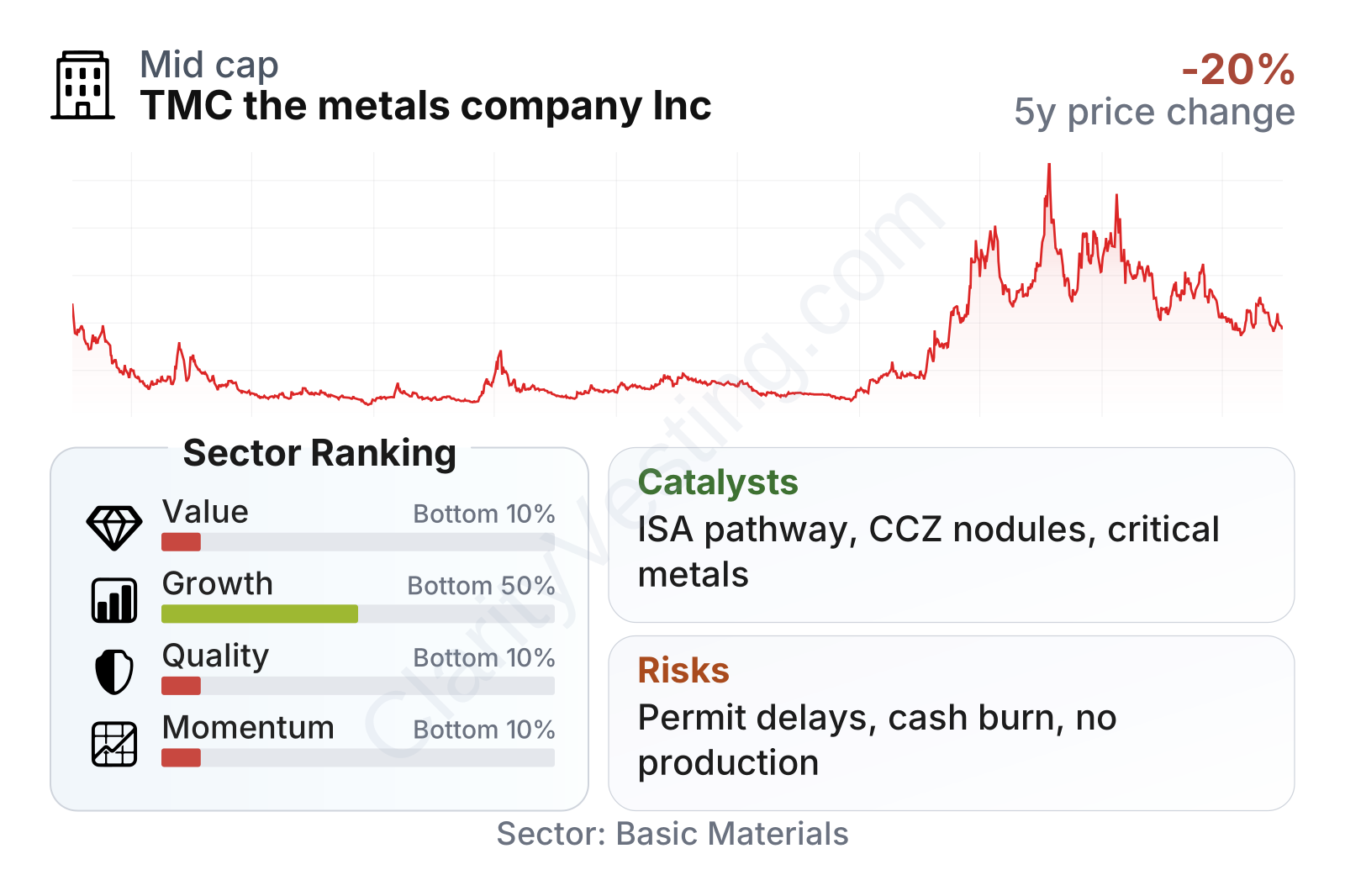
TMC is a mid-sized public company by market value, but its trading profile looks much more volatile than a typical established miner. A beta above 2 points to sharp price swings, which fits the stock’s history: a dramatic rally over the longer three-year period followed by a much weaker trend over the last year and the last six months. The broader quality, value, growth, and momentum picture ranks poorly against most peers in the materials sector, mainly because the company is still pre-revenue or near pre-revenue, loss-making, and dependent on future project execution rather than current operating performance.
Traditional valuation ratios are not very useful here. Negative free cash flow, negative operating earnings, and the absence of recurring profits make standard comparisons with producing miners misleading. In other words, the market is not pricing TMC on current business output; it is pricing the possibility that its resource base eventually becomes commercially and legally exploitable.
Growth
TMC operates in a sector that could become strategically important if the world continues to prioritize electrification, grid expansion, energy storage, and secure supply chains for critical minerals. Nickel, copper, cobalt, and manganese are all linked, directly or indirectly, to those themes. That gives the company exposure to a potentially growing demand backdrop, especially as governments and manufacturers look for additional sources of battery and industrial metals beyond conventional land-based mining regions.
The central question is not whether these metals matter in the future; it is whether deep-sea collection becomes an accepted commercial source. TMC’s strategy is straightforward in concept: control a large resource, partner for processing and engineering, seek a regulatory path, and reach first-mover status before a broad wave of competitors enters. If that pathway works, the upside could be unusually large relative to the company’s current size because the business is being built around a resource platform rather than a single small deposit.
Historical revenue growth figures are of limited use because they come from a period before any stable commercial mining operation existed. The more meaningful operating trend is spending discipline versus project progress. On that front, cash burn has improved from the much heavier levels seen a few years ago, which suggests management has reduced some pressure while continuing development work.
Free cash flow remains negative, but the recent direction has been less severe than in earlier periods. That does not make the business self-funding; it simply means the rate of cash consumption has become somewhat more manageable. For a pre-production company, that matters because every improvement in cash burn can extend the time available to secure permits, financing, and commercial partners.
A major catalyst is the evolving regulatory path for seabed mining under the International Seabed Authority framework and related national-level legal positioning. TMC has also highlighted efforts to move toward an application process for commercial recovery. Any credible step that shortens the timeline to a formal review, pilot activity, or production decision can materially change how the market views the company. Another important opportunity is geopolitical: governments are increasingly focused on non-Chinese and diversified supply chains for strategic minerals, which gives TMC’s proposed resource base a clearer strategic narrative than it had several years ago.
Risks
This article is for informational purposes only and does not constitute financial advice. Some content is AI-generated. See Disclaimer