Stock Analysis · Talen Energy Corporation (TLN)
Overview
Talen Energy Corporation is an independent power producer. In simple terms, it owns and operates power plants and sells electricity into wholesale power markets. Its fleet is centered on nuclear generation through its Susquehanna plant in Pennsylvania, alongside natural gas, coal, oil, and renewable assets. The company has become especially visible because it sits at the intersection of two themes that matter for long-term business analysis: reliable electricity supply and rapidly rising data center power demand.
Talen’s revenue is driven mainly by selling electricity, capacity, and related energy products. Based on the company’s recent business mix and asset base, the largest economic driver is its nuclear generation platform, with wholesale power sales linked to Susquehanna carrying the biggest weight. Exact percentages can move meaningfully from year to year because realized power prices, hedging activity, and plant availability have a large effect on reported revenue.
The main sources of revenue can be understood as follows:
- Wholesale energy and generation sales from nuclear assets — likely the largest contributor, supported primarily by the Susquehanna nuclear facility, which provides large-scale baseload electricity.
- Wholesale energy sales from fossil generation — natural gas, coal, and oil-fired plants that sell power when market prices justify dispatch.
- Capacity market revenue — payments for keeping generation available to support grid reliability, especially important in PJM markets.
- Ancillary and environmental products — smaller contributions from reliability services and environmental attributes tied to certain assets.
- Commercial arrangements tied to large-load customers — an increasingly important area as the company pursues data center and digital infrastructure demand near its generation assets.
Talen is not a traditional regulated utility with predictable customer billing. Its results depend far more on power prices, plant output, operating performance, and commercial contracts. That makes the business potentially more rewarding in favorable markets, but also more volatile than many utility peers.
The multiyear operating picture shows a sharp improvement from deep losses earlier in the decade to positive profitability in 2023 and 2024, followed by weaker reported earnings again in 2025. Revenue has moved within a fairly wide range, while operating income has been much more volatile, showing how sensitive the company is to pricing, costs, and one-off items.
Key Figures
| Metric | Value | Sector ⓘ |
|---|---|---|
| Date | Oct 17, 2026 | |
| Context | ||
| Sector | Utilities | |
| Industry | Utilities - Independent Power Producers | |
| Market Cap ⓘ | $18.08B | |
| Beta ⓘ | 1.62 | |
Value (Cheapness) | ||
| P/E Ratio ⓘ | N/A | 17.28 |
| P/B Ratio ⓘ | 10.33 | 1.51 |
| FCF Yield ⓘ | 2.82% | 0.65% |
| Dividend Yield ⓘ | N/A | 3.77% |
| EBIT / EV ⓘ | 1.58% | 5.01% |
| PEG ⓘ | N/A | |
Growth (Business expansion) | ||
| Revenue Growth ⓘ | 111.20% | 6.10% |
| RPS Growth (5Y CAGR) ⓘ | 9.85% | 3.87% |
| EPS Growth (5Y CAGR) ⓘ | -26.01% | -11.30% |
| BVPS Growth (5Y CAGR) ⓘ | 10.07% | 4.23% |
| Margin Growth (5Y Trend) ⓘ | 59.26% | 3.57% |
| FCF Growth (5Y CAGR) ⓘ | N/A | -8.84% |
| DPS Growth (5Y CAGR) ⓘ | N/A | 4.84% |
Quality (Business durability) | ||
| ROIC (Latest) ⓘ | 3.25% | 6.53% |
| ROA (Latest) ⓘ | -1.75% | 3.20% |
| ROIC (5Y Median) ⓘ | N/A | 5.95% |
| ROA (5Y Median) ⓘ | -2.57% | 2.75% |
| Net Debt / EBIT (Latest) ⓘ | 24.91 | 7.13 |
| Net Debt / EBIT (5Y Median) ⓘ | 5.15 | 7.23 |
| Net Debt / EBITDA (Latest) ⓘ | 12.96 | 4.31 |
| Net Debt / Assets ⓘ | 61.99% | 38.42% |
| EBITDA / Interest ⓘ | 1.44 | 4.58 |
| Operating Margin (Latest) ⓘ | 10.63% | 20.83% |
| Operating Margin (5Y Median) ⓘ | 5.18% | 20.08% |
| Debt to Equity (Latest) ⓘ | 592.33% | 137.69% |
| Profit Margin (Latest) ⓘ | -4.95% | 11.37% |
| Free Cash Flow (Latest) ⓘ | $510.00M | |
Momentum (Price trend) | ||
| 3Y Return ⓘ | +582.70% | +52.37% |
| 12M Return (excl. last month) ⓘ | -28.82% | +8.84% |
| 6M Return ⓘ | +3.66% | -3.95% |
| Price vs. 200-Day MA ⓘ | +1.95% | -0.79% |
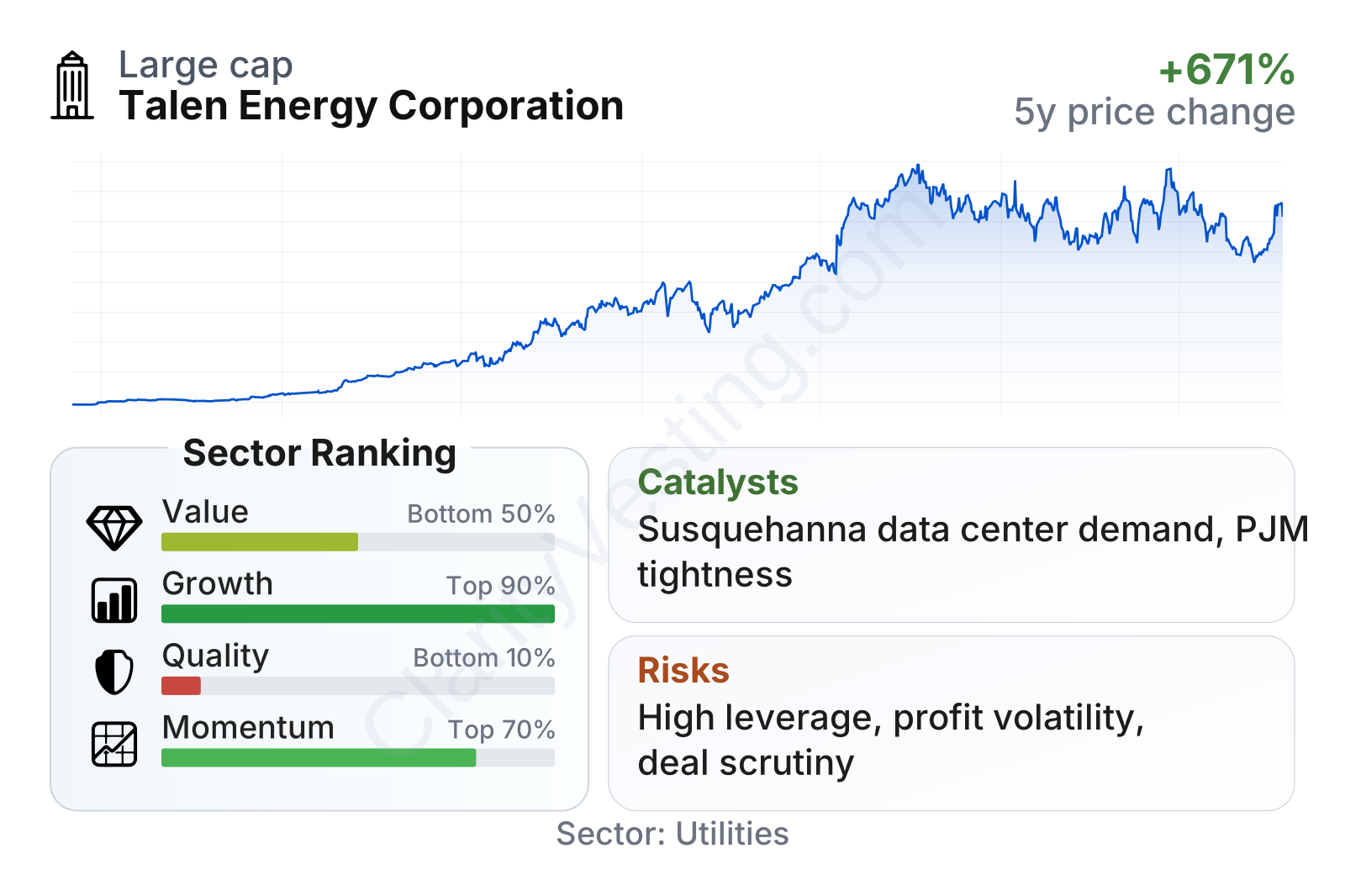
Talen is a mid-to-large sized independent power company with a stock that has been much more volatile than the average utility name, reflected in its elevated beta. The share price has had an exceptional run over the last three years, but recent trading has been much less steady, with the stock below its longer-term trend and weaker than much of the sector over the last year.
The broader quality profile is the clearest weak point. Growth indicators rank very high versus the sector, but profitability, returns on capital, leverage, and interest coverage are noticeably weaker. Value measures are mixed: free cash flow yield looks solid, but traditional valuation ratios do not screen as cheap relative to utility peers.
Growth
Talen operates in a sector with improving long-term demand fundamentals. Electricity demand in parts of the United States is being reshaped by data centers, artificial intelligence computing, industrial reshoring, and the need for around-the-clock reliable power. That backdrop is especially relevant for companies that already own large generating assets in constrained power markets. Talen’s nuclear capacity gives it a strategic position because nuclear plants provide continuous output without the intermittency of wind or solar.
The company’s strategy appears built around monetizing that reliability advantage. The most important strategic point is not simply that Talen generates power, but that it may be able to direct power toward very large customers that need dependable supply near the source. This has made its Susquehanna site a focal point for potential high-value arrangements linked to digital infrastructure and data center development.
Recent corporate developments have reinforced that thesis. Talen has highlighted commercial opportunities around supplying large-load customers and has continued to position its generation portfolio to benefit from stronger power demand and grid tightness. In practical terms, that means the company is trying to move beyond being only a merchant generator exposed to daily market prices and toward capturing more durable economics from premium demand pockets.
Revenue per share has been volatile rather than smooth, which is common for merchant power businesses, but the five-year trend still points upward at a pace well above the sector median. That suggests the company has expanded its earnings power over time even though the path has been uneven.
Cash generation has also been highly uneven. Free cash flow dropped sharply in 2025 and then rebounded strongly in 2026. For a long-term reader, the key takeaway is that Talen can produce substantial cash, but that cash output is not steady in the way many regulated utilities are. If the company converts its power-market position and data center adjacency into more stable contracts, that volatility could become easier to manage.
A further catalyst is the broader tightening of power supply in PJM and nearby markets. When reserve margins become more important, generators with available capacity can benefit through both energy pricing and capacity payments. Talen’s asset mix, especially nuclear generation, gives it direct exposure to that theme.
Risks
This article is for informational purposes only and does not constitute financial advice. Some content is AI-generated. See Disclaimer


