Stock Analysis · Timken Company (TKR)
Overview
Timken Company is an industrial manufacturer best known for engineered bearings and power transmission products. In simple terms, it makes precision components that help machines spin, move power, reduce friction, and keep running reliably. Its products are used in a wide range of end markets including renewable energy, rail, automotive, heavy industry, aerospace, defense, agriculture, construction, and factory equipment.
The business is organized around two main operating segments, and these are also the clearest view of where revenue comes from. Based on recent annual reporting, the revenue mix is approximately:
- Engineered Bearings: about 56% of revenue. This segment includes tapered, spherical, cylindrical, and ball bearings, as well as related products and services. These parts are critical in equipment where durability, precision, and uptime matter.
- Industrial Motion: about 44% of revenue. This includes gear drives, lubrication systems, belts, chains, couplings, linear motion products, and other mechanical power transmission solutions used across industrial applications.
Geographically, Timken is a global business with a large presence in North America and meaningful exposure to Europe and Asia-Pacific. That matters because demand is tied not to one single economy, but to global industrial production, maintenance spending, and capital equipment cycles.
Over the last several years, Timken has expanded beyond its traditional bearing franchise through acquisitions in adjacent motion and automation-related categories. This has made the company broader and somewhat less dependent on one product family, although bearings remain central to its identity and competitive positioning.
The long-term financial pattern shows a business that grew revenue from just above $4.1 billion in 2021 to roughly $4.6 billion in 2025, but with profitability under more pressure recently. Gross profit remained substantial, yet operating income and net income softened from their earlier peaks as costs and interest expense took a larger share of sales.
Key Figures
| Metric | Value | Sector ⓘ |
|---|---|---|
| Date | Oct 17, 2026 | |
| Context | ||
| Sector | Industrials | |
| Industry | Tools & Accessories | |
| Market Cap ⓘ | $7.94B | |
| Beta ⓘ | 1.18 | |
Value (Cheapness) | ||
| P/E Ratio ⓘ | 30.97 | 22.10 |
| P/B Ratio ⓘ | 2.60 | 1.97 |
| FCF Yield ⓘ | 4.85% | 6.38% |
| Dividend Yield ⓘ | 1.22% | 1.94% |
| EBIT / EV ⓘ | 4.13% | 4.79% |
| PEG ⓘ | 1.28 | |
Growth (Business expansion) | ||
| Revenue Growth ⓘ | 7.50% | 9.30% |
| RPS Growth (5Y CAGR) ⓘ | 5.00% | 7.81% |
| EPS Growth (5Y CAGR) ⓘ | -13.47% | -13.06% |
| BVPS Growth (5Y CAGR) ⓘ | 10.64% | 6.14% |
| Margin Growth (5Y Trend) ⓘ | -1.97% | 0.88% |
| FCF Growth (5Y CAGR) ⓘ | 14.17% | 11.01% |
| DPS Growth (5Y CAGR) ⓘ | 3.98% | 9.48% |
Quality (Business durability) | ||
| ROIC (Latest) ⓘ | 5.77% | 10.84% |
| ROA (Latest) ⓘ | 3.80% | 5.41% |
| ROIC (5Y Median) ⓘ | 10.97% | 9.38% |
| ROA (5Y Median) ⓘ | 6.63% | 4.95% |
| Net Debt / EBIT (Latest) ⓘ | 4.07 | 2.08 |
| Net Debt / EBIT (5Y Median) ⓘ | 3.08 | 2.27 |
| Net Debt / EBITDA (Latest) ⓘ | 2.59 | 1.39 |
| Net Debt / Assets ⓘ | 24.57% | 19.28% |
| EBITDA / Interest ⓘ | 6.52 | 9.58 |
| Operating Margin (Latest) ⓘ | 8.65% | 10.50% |
| Operating Margin (5Y Median) ⓘ | 13.39% | 10.29% |
| Debt to Equity (Latest) ⓘ | 64.99% | 65.48% |
| Profit Margin (Latest) ⓘ | 5.44% | 6.67% |
| Free Cash Flow (Latest) ⓘ | $385.50M | |
Momentum (Price trend) | ||
| 3Y Return ⓘ | +66.80% | +61.68% |
| 12M Return (excl. last month) ⓘ | +52.35% | +12.58% |
| 6M Return ⓘ | +5.78% | 0.00% |
| Price vs. 200-Day MA ⓘ | -2.64% | +0.02% |
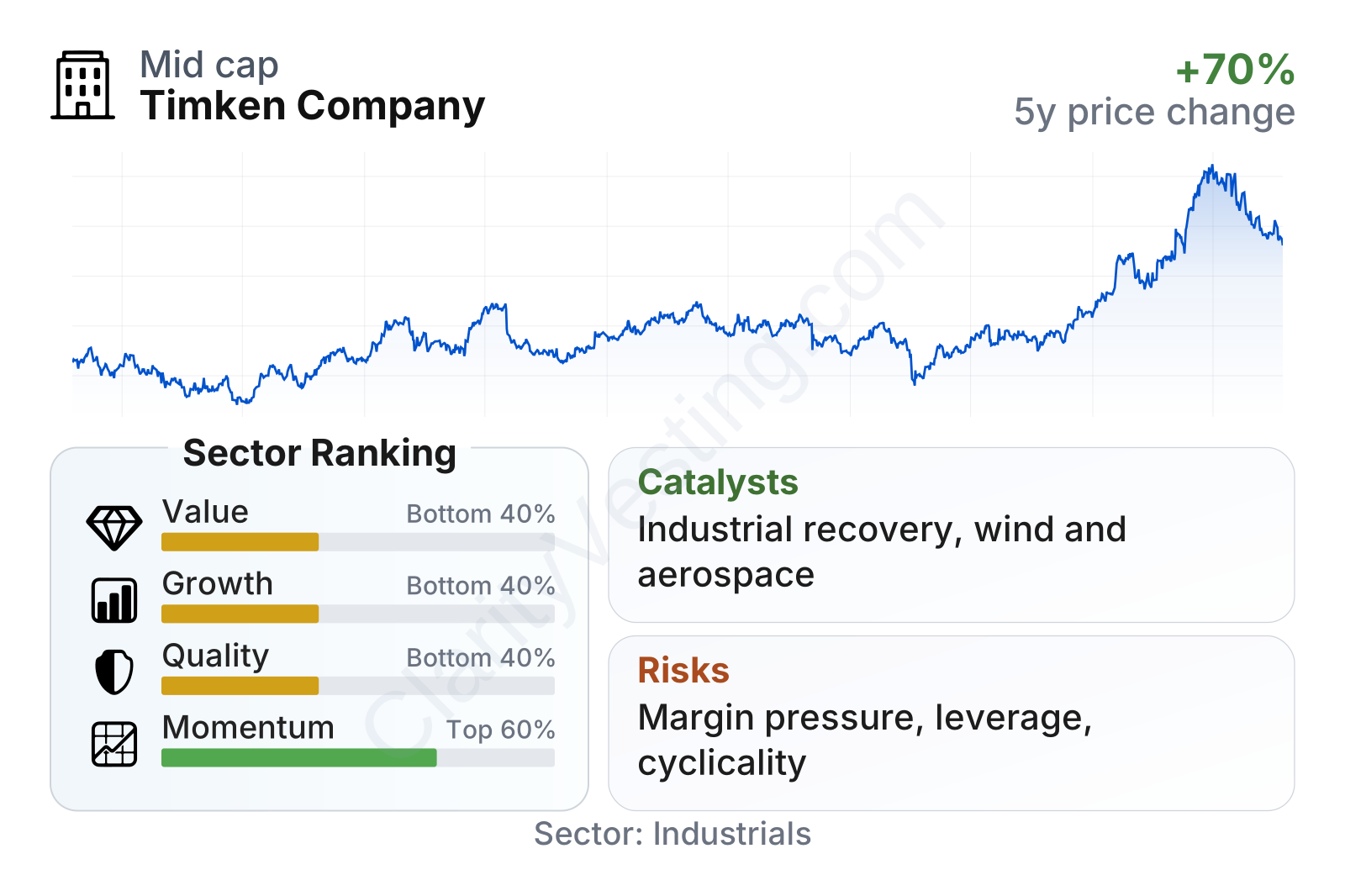
Timken is a mid-to-large industrial company with a market value around $8 billion and a share price that has been strong over the last year. In the factor breakdown, momentum stands out as the clearest strength, while value, growth, and quality rank in the lower part of the industrial peer group. The picture is mixed: free cash flow remains meaningful, but profitability and returns on capital are currently below many sector peers, and the valuation multiples are no longer especially low.
The share price history also shows a major rerating. After trading mostly in a much lower range from 2021 through early 2025, the stock moved sharply higher into 2026. That helps explain why the dividend yield now looks modest and why the earnings multiple has climbed well above its own recent history.
Growth
Timken operates in markets that are mature overall, but still supported by durable long-term demand. Bearings, gear drives, chain, lubrication, and motion components are not fashionable products, yet they are essential to industrial activity. This creates a steady base tied to maintenance and replacement demand, while newer areas such as automation, renewable energy, aerospace, and advanced manufacturing can add growth on top.
The company’s strategy has generally been consistent: strengthen the core bearing franchise, add adjacent motion businesses, build scale in aftermarket and specialty applications, and use engineering know-how to serve demanding industrial uses where customers care more about reliability and total operating cost than the lowest upfront price. That logic makes sense for long-term expansion because it leans on technical depth and recurring replacement demand rather than one-time commodity sales.
Recent sales trends suggest Timken has moved out of a weaker patch. Revenue growth turned negative during much of 2024 and part of 2025, which fits the broader industrial slowdown seen in many cyclical markets. More recently, growth returned to positive territory and improved into the high-single-digit range. That does not prove a full-cycle acceleration on its own, but it does indicate demand conditions have become more supportive again.
Cash generation is an important positive. Free cash flow has held up better than earnings trends might suggest, and the trailing figure has improved into the upper-$300 million range. For an industrial manufacturer, that matters because cash funds debt reduction, acquisitions, dividends, and factory investment without depending entirely on favorable credit markets.
One of the more important catalysts is Timken’s exposure to industries that need highly reliable rotating equipment and motion systems. Wind energy is a notable example, where large bearings and related components play a critical role. Aerospace and defense can also support higher-value demand, while rail, automation, and industrial services can help diversify the cycle. In addition, if global manufacturing activity continues to recover, Timken’s broad installed base gives it a path to benefit through both original equipment sales and replacement parts.
Recent company communication has also continued to emphasize portfolio reshaping and operational discipline rather than chasing volume at any price. For a business like Timken, disciplined pricing, mix improvement, and aftermarket penetration are often more important than raw shipment growth.
Risks
This article is for informational purposes only and does not constitute financial advice. Some content is AI-generated. See Disclaimer


