Stock Analysis · Turk Hava Yollari AO (TKHVY)
Overview
Turk Hava Yollari AO, better known internationally as Turkish Airlines, is a global passenger and cargo airline based in Turkey. Its business is straightforward: it transports people and goods through a large route network that connects Turkey with Europe, Asia, the Middle East, Africa, and the Americas. The company also earns money from related activities such as maintenance services, catering, ground handling partnerships, and loyalty-program-linked operations, but the core engine remains air transportation.
For a long-term view, the most important point is that Turkish Airlines is not a niche carrier. It operates as a full-service network airline built around Istanbul’s hub position between continents. That gives it exposure to tourism, business travel, migrant and diaspora traffic, and transfer passengers who use Istanbul as a connection point. Cargo adds another layer of diversification, especially when passenger markets soften.
The company’s revenue mix is usually dominated by passenger flying, with cargo and other activities making up the rest. Based on recent annual reporting and business disclosures, the broad structure appears to be as follows:
- Passenger revenue: approximately 80% to 85% of total revenue. This includes scheduled passenger tickets, international and domestic travel, and connecting traffic through the Istanbul hub.
- Cargo revenue: approximately 10% to 15%. This covers freight transportation through Turkish Cargo, including general cargo, e-commerce flows, and special shipments.
- Other revenue: approximately 5% to 10%. This generally includes ancillary items and contributions from related aviation services and partnerships.
The recent financial flow also shows a business that expanded strongly after the pandemic recovery phase. Revenue rose from roughly $7 billion in 2021 to more than $24 billion in 2025, although profitability became less efficient in 2025 as operating income fell more sharply than sales growth would suggest. In simple terms, the company got bigger, but each additional dollar of revenue recently produced less operating profit than before.
The long-term pattern is one of major scale expansion, but with clear sensitivity to costs, financing, and airline-cycle swings.
Key Figures
| Metric | Value | Sector ⓘ |
|---|---|---|
| Date | Oct 24, 2026 | |
| Context | ||
| Sector | Industrials | |
| Industry | Airlines | |
| Market Cap ⓘ | $7.63B | |
| Beta ⓘ | -0.02 | |
Value (Cheapness) | ||
| P/E Ratio ⓘ | N/A | 22.29 |
| P/B Ratio ⓘ | 0.35 | 1.98 |
| FCF Yield ⓘ | 31.07% | 6.26% |
| Dividend Yield ⓘ | N/A | 1.92% |
| EBIT / EV ⓘ | 7.90% | 4.83% |
| PEG ⓘ | N/A | |
Growth (Business expansion) | ||
| Revenue Growth ⓘ | 20.50% | 9.30% |
| RPS Growth (5Y CAGR) ⓘ | 34.76% | 7.76% |
| EPS Growth (5Y CAGR) ⓘ | -41.29% | -13.17% |
| BVPS Growth (5Y CAGR) ⓘ | 32.82% | 6.13% |
| Margin Growth (5Y Trend) ⓘ | -5.94% | 0.74% |
| FCF Growth (5Y CAGR) ⓘ | 4.71% | 10.79% |
| DPS Growth (5Y CAGR) ⓘ | N/A | 9.41% |
Quality (Business durability) | ||
| ROIC (Latest) ⓘ | 4.92% | 10.75% |
| ROA (Latest) ⓘ | 5.71% | 5.41% |
| ROIC (5Y Median) ⓘ | 1.65% | 9.37% |
| ROA (5Y Median) ⓘ | 12.56% | 4.95% |
| Net Debt / EBIT (Latest) ⓘ | 10.52 | 2.04 |
| Net Debt / EBIT (5Y Median) ⓘ | 3.80 | 2.27 |
| Net Debt / EBITDA (Latest) ⓘ | 4.20 | 1.39 |
| Net Debt / Assets ⓘ | 35.33% | 19.27% |
| EBITDA / Interest ⓘ | 7.35 | 9.58 |
| Operating Margin (Latest) ⓘ | 6.46% | 10.49% |
| Operating Margin (5Y Median) ⓘ | 18.71% | 10.30% |
| Debt to Equity (Latest) ⓘ | 89.76% | 64.82% |
| Profit Margin (Latest) ⓘ | 10.19% | 6.67% |
| Free Cash Flow (Latest) ⓘ | $2.37B | |
Momentum (Price trend) | ||
| 3Y Return ⓘ | -25.39% | +67.77% |
| 12M Return (excl. last month) ⓘ | -30.67% | +12.05% |
| 6M Return ⓘ | -21.49% | 0.00% |
| Price vs. 200-Day MA ⓘ | -24.69% | +0.67% |
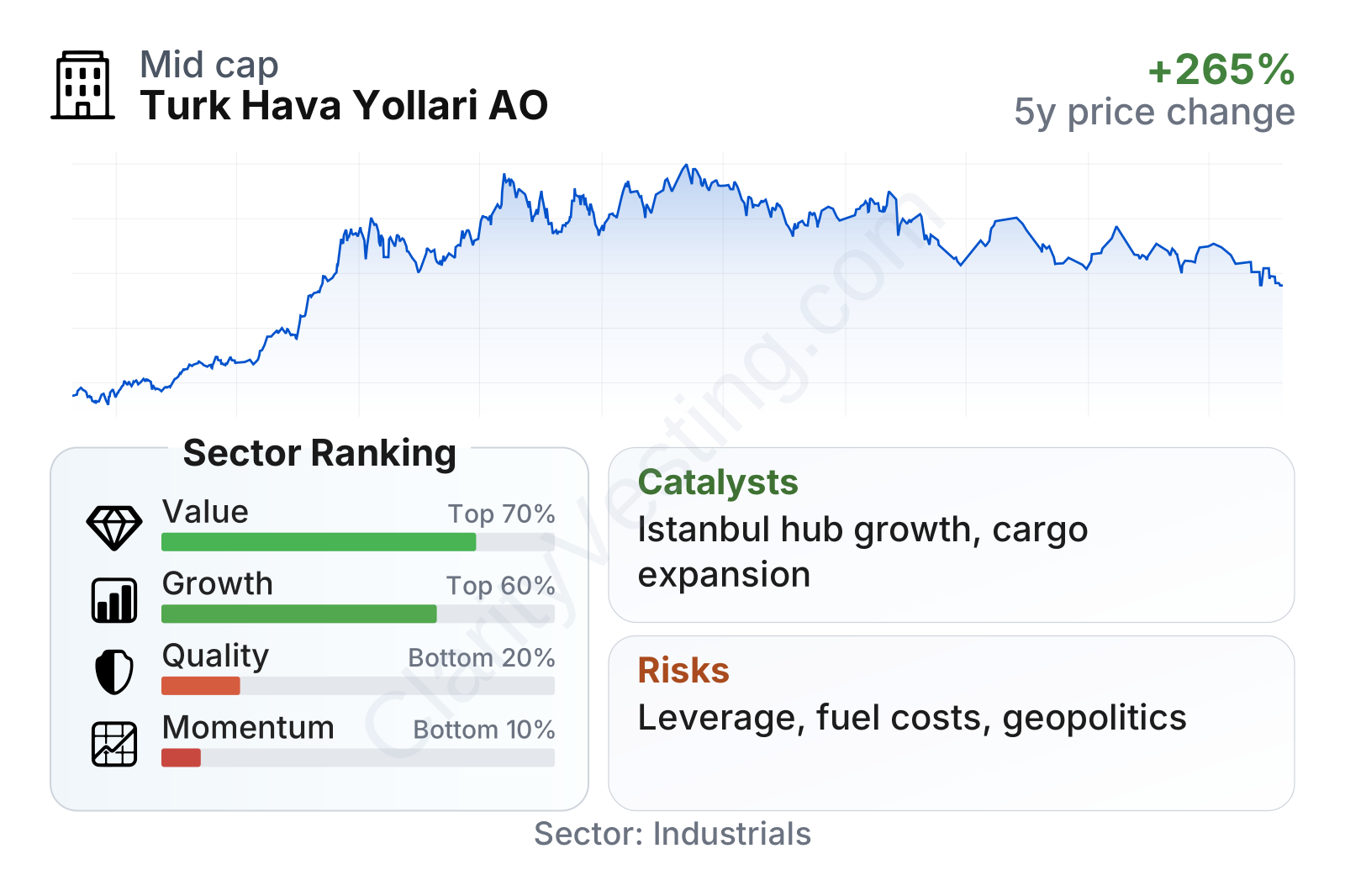
Turkish Airlines stands out on valuation and cash generation more than on balance-sheet strength or recent share-price momentum. The company looks inexpensive compared with much of the broader industrial sector, with a very low earnings multiple, a price-to-book ratio well below the sector median, and a free-cash-flow yield that is far above typical peers. Growth metrics are mixed but generally favorable on revenue and book value expansion, while quality indicators are pulled down by leverage and modest returns on invested capital. Market performance has been weak recently, which helps explain why valuation measures remain compressed despite still-profitable operations.
In market terms, this is a large airline, but not one receiving a premium valuation. The stock has risen dramatically since 2021 in absolute terms, yet it has also retreated noticeably from more recent highs, reflecting softer sentiment toward the name.
Growth
Air travel remains a structurally growing industry over the long run, especially in regions linked to population growth, tourism expansion, and increasing cross-border trade. Turkish Airlines sits in a useful part of that trend because Turkey’s geography supports east-west and north-south connections. Istanbul is one of the few hubs that can naturally bridge Europe, Asia, Africa, and the Middle East in a single network. That positioning matters because network airlines become more valuable when they can fill planes not only with local passengers, but also with transfer traffic.
The company’s strategy for future expansion is logical. It continues to build scale in both passenger and cargo operations, and its broad international footprint reduces dependence on any single destination market. Turkish Cargo is also strategically important because cargo can provide a second growth engine when passenger demand cools. In a business known for cyclicality, having two meaningful traffic streams is a real advantage.
Revenue growth has normalized from the extreme post-pandemic rebound, but the latest readings still point to a business that is expanding at a pace above the sector median. Recent year-over-year growth has been around 20%, which is strong for an airline of this size. Over a five-year period, revenue per share growth has also been far ahead of the broader sector, showing that expansion has not come only from temporary recovery effects.
Cash generation has cooled from earlier peaks but remains substantial. Free cash flow moved down materially after the strong post-reopening period, then improved again in the latest trailing period. That pattern suggests the company is still producing meaningful cash even while investing heavily and operating in a more difficult cost environment. For long-term analysis, that is more important than a single weak quarter because airlines need real cash, not just accounting profits, to renew fleets and manage debt.
A visible catalyst is the continued ramp-up of Istanbul Airport as a global transit center, which supports Turkish Airlines’ hub model. Fleet growth, route additions, and cargo network development also remain important operational drivers. More broadly, if international travel demand stays resilient and Turkey keeps strengthening its role as a transit gateway, the company has room to keep growing faster than many mature Western airlines.
Risks
This article is for informational purposes only and does not constitute financial advice. Some content is AI-generated. See Disclaimer


