Stock Analysis · Tokyu Fudosan Holdings Corp (TKFOY)
Overview
Tokyu Fudosan Holdings Corp is a Japanese real estate group with activities that go well beyond simply owning office buildings. The company develops and sells properties, rents out offices and commercial facilities, operates hotels and resorts, manages residential and office buildings, and also has meaningful exposure to renewable energy. Its business model is diversified across recurring income and asset turnover, which matters in real estate because it can reduce dependence on any one market cycle.
Based on the company’s recent annual reporting structure, revenue is mainly generated from the following segments, listed from largest to smaller contributors. Exact weights can move from year to year depending on property sales and project timing, but the mix below is a useful approximation of the business:
- Urban Development: approximately 35% to 45% of revenue. This includes office buildings, commercial facilities, logistics, and mixed-use development, with income coming from leasing, development, and property sales.
- Strategic Investment: approximately 20% to 30% of revenue. This segment includes property investment, fund-related activities, and sales linked to investment assets.
- Property Management: approximately 15% to 20% of revenue. This includes building management, residential management, and operational services that tend to be more recurring.
- Wellness: approximately 10% to 15% of revenue. This covers hotels, resorts, senior housing, and leisure-related operations.
- Residential: approximately 10% to 15% of revenue. This includes condominium and housing development as well as related sales.
- Renewable Energy and other activities: generally a smaller share of revenue, but strategically important because it expands the group beyond traditional property cycles.
The business has become larger over the last several years, and profitability has also improved. Revenue has climbed steadily since fiscal 2022, while operating income and net income have grown faster than sales. That suggests the group has recently been improving the earnings it extracts from each dollar of revenue, even though real estate remains a capital-intensive business.
The operating picture shows a company that has expanded revenue meaningfully over the last five fiscal years while lifting operating and net profit faster than sales. In other words, scale has improved, but the business still carries the cost structure and financing profile typical of a diversified property owner and developer.
Key Figures
| Metric | Value | Sector ⓘ |
|---|---|---|
| Date | Nov 21, 2026 | |
| Context | ||
| Sector | Real Estate | |
| Industry | Real Estate - Diversified | |
| Market Cap ⓘ | $5.34B | |
| Beta ⓘ | 0.37 | |
Value (Cheapness) | ||
| P/E Ratio ⓘ | 10.84 | 17.59 |
| P/B Ratio ⓘ | N/A | 1.58 |
| FCF Yield ⓘ | 12.43% | 5.76% |
| Dividend Yield ⓘ | 2.15% | 4.81% |
| EBIT / EV ⓘ | 5.71% | 4.97% |
| PEG ⓘ | N/A | |
Growth (Business expansion) | ||
| Revenue Growth ⓘ | -15.30% | 5.70% |
| RPS Growth (5Y CAGR) ⓘ | 7.71% | 5.96% |
| EPS Growth (5Y CAGR) ⓘ | -14.51% | -3.46% |
| BVPS Growth (5Y CAGR) ⓘ | 8.95% | 0.32% |
| Margin Growth (5Y Trend) ⓘ | 5.01% | -0.65% |
| FCF Growth (5Y CAGR) ⓘ | -21.20% | 5.08% |
| DPS Growth (5Y CAGR) ⓘ | 29.03% | 5.00% |
Quality (Business durability) | ||
| ROIC (Latest) ⓘ | 3.49% | 5.13% |
| ROE (Latest) ⓘ | 9.07% | 7.64% |
| ROA (Latest) ⓘ | 2.26% | 3.05% |
| ROIC (5Y Median) ⓘ | 3.56% | 4.20% |
| ROE (5Y Median) ⓘ | 9.81% | 6.03% |
| ROA (5Y Median) ⓘ | 2.38% | 2.41% |
| Net Debt / EBIT (Latest) ⓘ | 12.09 | 7.59 |
| Net Debt / EBIT (5Y Median) ⓘ | 11.68 | 8.34 |
| Net Debt / EBITDA (Latest) ⓘ | 8.07 | 5.43 |
| Net Debt / Assets ⓘ | 51.81% | 38.21% |
| EBITDA / Interest ⓘ | 11.87 | 4.20 |
| Operating Margin (Latest) ⓘ | 12.52% | 34.59% |
| Operating Margin (5Y Median) ⓘ | 10.98% | 37.64% |
| Debt to Equity (Latest) ⓘ | 214.10% | 90.32% |
| Profit Margin (Latest) ⓘ | 6.48% | 20.10% |
| Free Cash Flow (Latest) ⓘ | $664.20M | |
Momentum (Price trend) | ||
| 3Y Return ⓘ | +32.96% | +27.88% |
| 12M Return (excl. last month) ⓘ | +36.45% | +1.16% |
| 6M Return ⓘ | +19.82% | -3.06% |
| Price vs. 200-Day MA ⓘ | +6.44% | -0.73% |
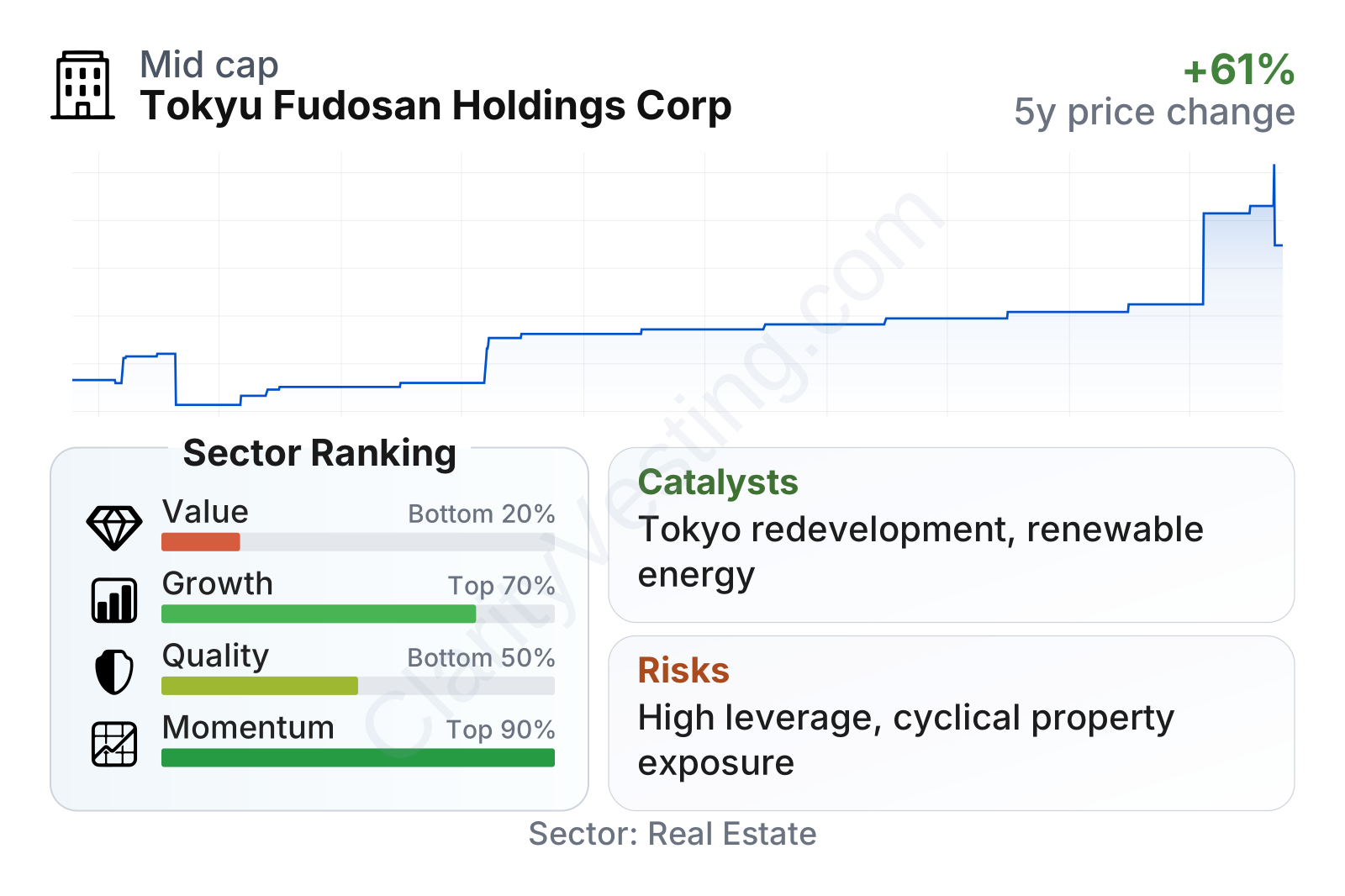
Tokyu Fudosan sits in the mid-sized range by market value and has shown relatively low share-price volatility, with a beta well below 1. On valuation, the earnings multiple is below the sector median, while free cash flow yield and EBIT relative to enterprise value look stronger than many peers. That points to a stock the market is not pricing like a fast-growth real estate name. At the same time, quality measures are mixed: return on equity is decent, but leverage is clearly elevated and returns on assets remain modest, which is common in property-heavy businesses but still important to watch closely.
The market performance trend has been notably stronger than much of the sector over the last year, and the shares have moved well above their longer-term average. That usually signals improving sentiment around earnings, asset values, or strategic progress rather than a purely defensive income profile.
Growth
Tokyu Fudosan operates in areas that still have long-term relevance, even if they are not all high-growth in the usual technology sense. Urban redevelopment in major Japanese cities, hotel and tourism recovery, logistics facilities, senior living, and renewable power are all markets with durable demand drivers. Japan’s large metropolitan areas continue to attract investment in mixed-use projects and office repositioning, while decarbonization policies support solar and other clean-energy development.
The company’s strategy makes sense because it is not tied to a single real estate format. It combines development profits, recurring leasing income, management fees, hospitality exposure, and infrastructure-like energy assets. That mix can create resilience over time: development can lift earnings in strong markets, while managed properties and leased assets can provide a steadier base.
Revenue per share has risen consistently over the last five fiscal years, with growth accelerating into the latest period. That is a constructive sign because it means expansion has not relied only on issuing more shares. It suggests the underlying business has been generating more sales power on a per-share basis.
Dividend per share has also increased sharply over the same period. The pace has been much faster than the sector median over five years, which signals stronger confidence from management in cash generation and balance-sheet capacity than a static payout would imply. The current yield is not the highest in the sector, but the growth profile of the payout has been notable.
A meaningful catalyst is the company’s renewable energy buildout. Tokyu Fudosan has publicly positioned clean energy as an important business pillar, and that matters because it adds a source of growth that is less correlated with office rents or condominium sales. Another catalyst is large-scale redevelopment around Tokyo and other major urban areas, where the company can use its long operating history and broad platform to capture value across planning, construction, leasing, and management.
Recent company disclosures have also emphasized continued progress in profit growth and shareholder return policies. Combined with a stronger share-price trend, that suggests the market is increasingly recognizing the group as more than a traditional Japanese landlord.
Risks
This article is for informational purposes only and does not constitute financial advice. Some content is AI-generated. See Disclaimer


