Stock Analysis · Turkcell Iletisim Hizmetleri AS (TKC)
Overview
Turkcell Iletisim Hizmetleri A.S. is one of Turkey’s largest telecommunications groups. Its core business is mobile connectivity, but the company has expanded well beyond basic voice and text into mobile data, fixed broadband, digital services, data centers, cloud, cybersecurity, TV platforms, and financial technology. In simple terms, Turkcell runs the digital infrastructure that helps consumers and businesses stay connected, while also trying to earn more from software-like and platform-based services built on top of that network.
The business is still centered on Turkey, where Turkcell serves mobile subscribers, home internet users, enterprises, and public-sector customers. It also has operations in surrounding markets through telecom and digital subsidiaries. That mix matters for long-term analysis because telecom networks tend to produce recurring revenue, while digital services can improve growth and margins if they scale well.
Based on the company’s recent annual reporting, revenue is mainly generated from telecom services, with smaller but strategically important contributions from digital infrastructure and technology services.
- Mobile services: approximately 55% to 65% of total revenue. This includes mobile voice, mobile data, messaging, roaming, and subscriber packages for consumers and businesses.
- Fixed broadband and fiber-related services: approximately 15% to 20%. This covers home internet, fiber connections, and fixed-line data services.
- Enterprise, data center, cloud, and digital business services: approximately 10% to 15%. This area includes corporate connectivity, cybersecurity, managed services, cloud, and hosting.
- Digital consumer services and other activities: approximately 5% to 10%. This includes TV and streaming-related offerings, apps, digital platforms, device sales, and other smaller lines.
- Fintech and payment-related activities: a smaller share within the remaining revenue mix, but one of the company’s more closely watched expansion areas because it can deepen customer engagement beyond connectivity.
Over the last few years, Turkcell’s revenue base has broadened, but the network business remains the economic engine. What stands out is that the company is no longer just selling access to a telecom line; it is increasingly trying to monetize data usage, household connectivity, enterprise digitalization, and financial services on the same customer base.
The overall flow of the business has improved meaningfully since 2023. Revenue and gross profit have both expanded sharply, and operating income has risen faster than sales, suggesting better efficiency and stronger pricing rather than growth coming only from volume.
Key Figures
| Metric | Value | Sector ⓘ |
|---|---|---|
| Date | Nov 21, 2026 | |
| Context | ||
| Sector | Communication Services | |
| Industry | Telecom Services | |
| Market Cap ⓘ | $4.19B | |
| Beta ⓘ | 0.72 | |
Value (Cheapness) | ||
| P/E Ratio ⓘ | 8.59 | 17.77 |
| FCF Yield ⓘ | 24.38% | 7.57% |
| Dividend Yield ⓘ | N/A | 2.85% |
| EBIT / EV ⓘ | 12.08% | 6.92% |
| PEG ⓘ | 4.37 | |
Growth (Business expansion) | ||
| Revenue Growth ⓘ | 6.20% | 6.30% |
| RPS Growth (5Y CAGR) ⓘ | 22.18% | 4.62% |
| EPS Growth (5Y CAGR) ⓘ | -54.79% | -14.44% |
| Margin Growth (5Y Trend) ⓘ | 7.10% | 1.03% |
| FCF Growth (5Y CAGR) ⓘ | 64.59% | 5.91% |
| DPS Growth (5Y CAGR) ⓘ | 39.43% | 5.03% |
Quality (Business durability) | ||
| ROIC (Latest) ⓘ | N/A | 8.39% |
| ROIC (5Y Median) ⓘ | 14.73% | 8.33% |
| Net Debt / EBIT (Latest) ⓘ | 3.30 | 1.88 |
| Net Debt / EBIT (5Y Median) ⓘ | 2.94 | 2.83 |
| Net Debt / EBITDA (Latest) ⓘ | 1.09 | 1.22 |
| Net Debt / Assets ⓘ | 17.80% | 20.70% |
| EBITDA / Interest ⓘ | 3.67 | 8.41 |
| Operating Margin (Latest) ⓘ | 17.05% | 15.44% |
| Operating Margin (5Y Median) ⓘ | 10.95% | 13.32% |
| Debt to Equity (Latest) ⓘ | 67.88% | 60.11% |
| Profit Margin (Latest) ⓘ | 6.95% | 8.06% |
| Free Cash Flow (Latest) ⓘ | $1.02B | |
Momentum (Price trend) | ||
| 3Y Return ⓘ | +0.54% | +35.91% |
| 12M Return (excl. last month) ⓘ | -14.43% | +2.79% |
| 6M Return ⓘ | -24.05% | 0.00% |
| Price vs. 200-Day MA ⓘ | -22.83% | +0.03% |
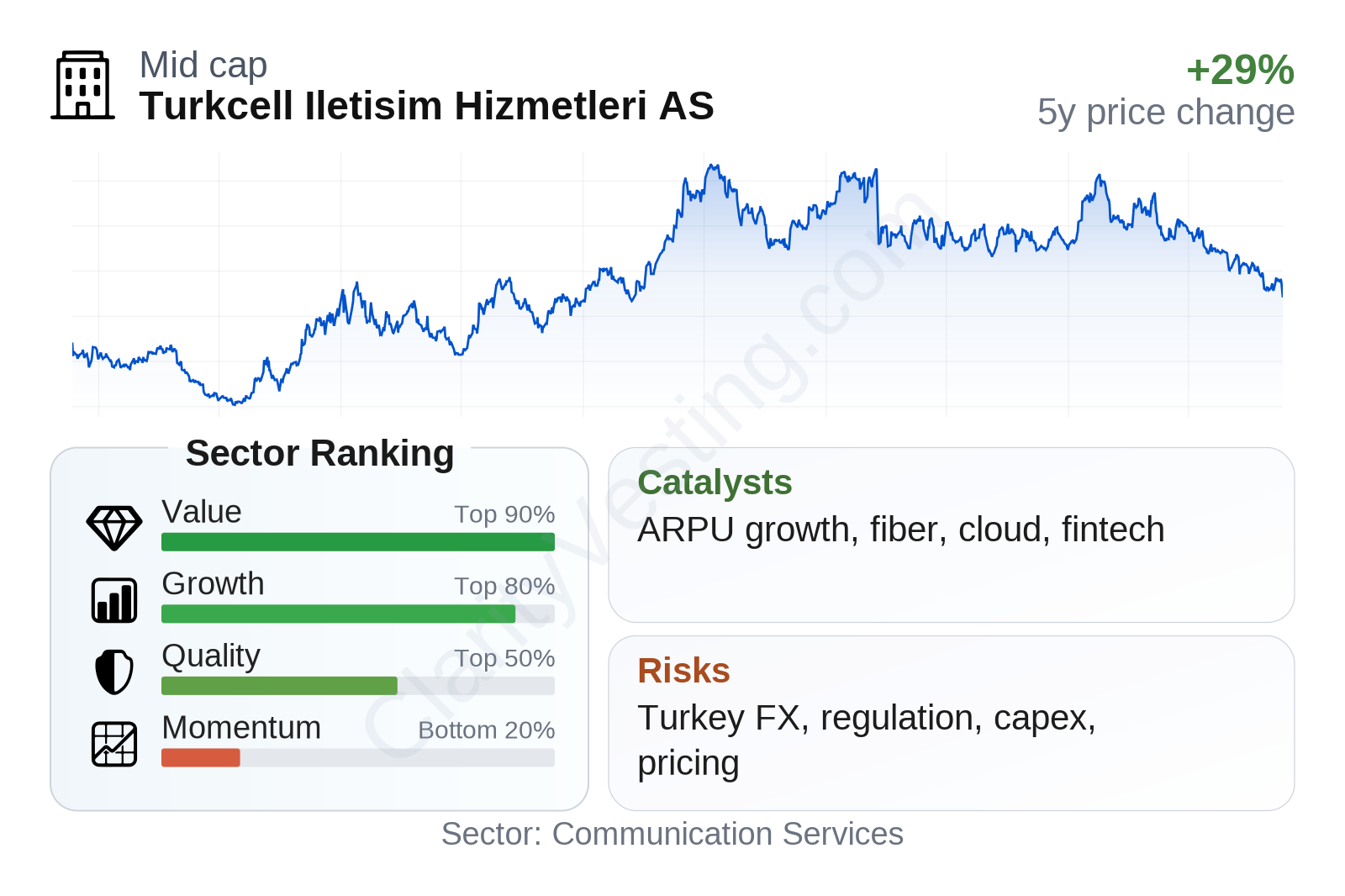
Turkcell currently looks inexpensive on classic earnings and cash flow measures relative to much of the communication services sector. The company ranks strongly on value and growth factors, helped by a low earnings multiple, unusually high free cash flow yield, and very strong multi-year growth in revenue per share and free cash flow. Quality is more mixed: margins and long-term returns on capital are respectable, but interest coverage is weaker than the sector median and leverage is not especially low. Share price momentum has been poor, which helps explain why valuation metrics remain compressed.
The stock’s recent trading pattern also shows a common feature of emerging-market telecom names: fundamentals can improve while the share price stays volatile because investors are also weighing currency, country, and sentiment risks.
Growth
Turkcell operates in a sector with durable long-term demand. Mobile data consumption keeps increasing, fiber broadband remains underpenetrated in many markets, enterprise cloud and cybersecurity spending continue to expand, and digital payments are becoming more embedded in everyday life. That gives the company a sensible strategic map: defend the core mobile franchise, cross-sell fixed broadband, and move into higher-value digital services that use the same infrastructure and customer relationships.
A telecom operator does not usually produce explosive growth, but it can produce steady expansion if it has pricing power, network quality, and room to increase revenue per user. Turkcell appears to have all three to some extent. In Turkey, inflationary conditions have pushed operators to reprice packages more frequently, while data demand and postpaid migration support larger customer spending over time. In parallel, enterprise and digital infrastructure services can add growth that is less tied to traditional voice revenues.
Revenue growth has been volatile, which is typical in a high-inflation accounting environment, but the broader direction remains positive. The most recent year-over-year growth rates are still strong, landing around the high-30% to low-40% range in 2026. That indicates demand and pricing are still supporting expansion even after unusually sharp swings in earlier periods.
Cash generation is another encouraging point. Free cash flow improved sharply from the low point seen in 2024 and remains solid on a trailing basis. For a telecom company, this is important because network businesses require heavy ongoing investment. When free cash flow holds up despite that spending, it suggests the company has room to fund infrastructure, manage debt, and continue shareholder distributions without relying entirely on external financing.
Turkcell’s strategy for future growth also makes practical sense. The company has been emphasizing fiber, data centers, cloud, cybersecurity, and fintech rather than relying only on mature mobile voice services. These activities generally have better long-term demand drivers and can strengthen customer stickiness. A household using Turkcell for mobile, home internet, TV, and digital payments is harder to lose than a customer using only a basic SIM card.
Recent company communications have also highlighted continued network investment, digital service development, and a focus on operational efficiency. The bigger opportunity is not just subscriber growth, but extracting more value from each user and from business clients through bundled services and digital infrastructure.
Risks
This article is for informational purposes only and does not constitute financial advice. Some content is AI-generated. See Disclaimer