Stock Analysis · Teekay Corporation (TK)
Overview
Teekay Corporation is a marine transportation and energy infrastructure company focused mainly on moving and storing crude oil and liquefied natural gas. After years of restructuring, the company is much simpler than it used to be. Its main economic exposure now comes from its controlling ownership in Teekay Tankers, a publicly listed tanker company, while it also keeps a smaller direct business in offshore services through marine support vessels.
In practical terms, Teekay earns money from shipping services tied to oil and gas markets. Tanker revenue is generated by transporting crude oil and refined products under a mix of spot market exposure and time-charter contracts. Its marine services activities include offshore support and operational services connected to energy production and logistics.
Based on the latest annual disclosures, revenue is concentrated in a small number of operating areas, with the tanker business clearly dominant.
- Tanker operations: approximately 85% to 95% of revenue. This includes crude oil and product tanker transportation, where earnings depend heavily on charter rates, vessel utilization, and fleet availability.
- Marine services and other activities: approximately 5% to 15% of revenue. This includes offshore support and related services that are much smaller than the tanker segment.
The broader financial picture also shows a business that has become leaner. Revenue rose sharply from 2021 to 2023 as tanker markets recovered, then moderated in 2024 and 2025, while operating profitability remained far stronger than in the past. Interest expense has fallen dramatically over the same period, which reflects a much healthier balance sheet.
The most notable trend is not just revenue volatility, but how much more of each dollar of revenue now reaches operating income and net income than a few years ago. That improvement comes from stronger tanker markets, lower financing costs, and a simpler corporate structure.
Key Figures
| Metric | Value | Sector ⓘ |
|---|---|---|
| Date | Oct 17, 2026 | |
| Context | ||
| Sector | Energy | |
| Industry | Oil & Gas Midstream | |
| Market Cap ⓘ | $1.36B | |
| Beta ⓘ | 0.24 | |
Value (Cheapness) | ||
| P/E Ratio ⓘ | 7.47 | 15.44 |
| P/B Ratio ⓘ | 1.68 | 1.73 |
| FCF Yield ⓘ | 24.23% | 8.20% |
| Dividend Yield ⓘ | N/A | 3.59% |
| EBIT / EV ⓘ | N/A | 7.46% |
| PEG ⓘ | 1.49 | |
Growth (Business expansion) | ||
| Revenue Growth ⓘ | 43.50% | 26.90% |
| RPS Growth (5Y CAGR) ⓘ | 13.36% | 6.90% |
| EPS Growth (5Y CAGR) ⓘ | 43.41% | -15.73% |
| BVPS Growth (5Y CAGR) ⓘ | 13.67% | 6.07% |
| Margin Growth (5Y Trend) ⓘ | 68.25% | 0.58% |
| FCF Growth (5Y CAGR) ⓘ | 18.77% | 1.86% |
| DPS Growth (5Y CAGR) ⓘ | 7.67% | 16.79% |
Quality (Business durability) | ||
| ROIC (Latest) ⓘ | N/A | 11.40% |
| ROA (Latest) ⓘ | 9.60% | 6.06% |
| ROIC (5Y Median) ⓘ | 49.49% | 10.30% |
| ROA (5Y Median) ⓘ | 4.31% | 5.42% |
| Net Debt / EBIT (Latest) ⓘ | -1.05 | 1.64 |
| Net Debt / EBIT (5Y Median) ⓘ | -0.98 | 1.83 |
| Net Debt / EBITDA (Latest) ⓘ | -0.91 | 1.08 |
| Net Debt / Assets ⓘ | -28.48% | 17.29% |
| EBITDA / Interest ⓘ | N/A | 9.64 |
| Operating Margin (Latest) ⓘ | 48.60% | 16.27% |
| Operating Margin (5Y Median) ⓘ | 33.56% | 20.39% |
| Debt to Equity (Latest) ⓘ | 4.93% | 54.76% |
| Profit Margin (Latest) ⓘ | 15.78% | 8.82% |
| Free Cash Flow (Latest) ⓘ | $328.48M | |
Momentum (Price trend) | ||
| 3Y Return ⓘ | +317.27% | +67.38% |
| 12M Return (excl. last month) ⓘ | +81.52% | +49.19% |
| 6M Return ⓘ | +31.01% | +7.07% |
| Price vs. 200-Day MA ⓘ | +25.02% | +9.56% |
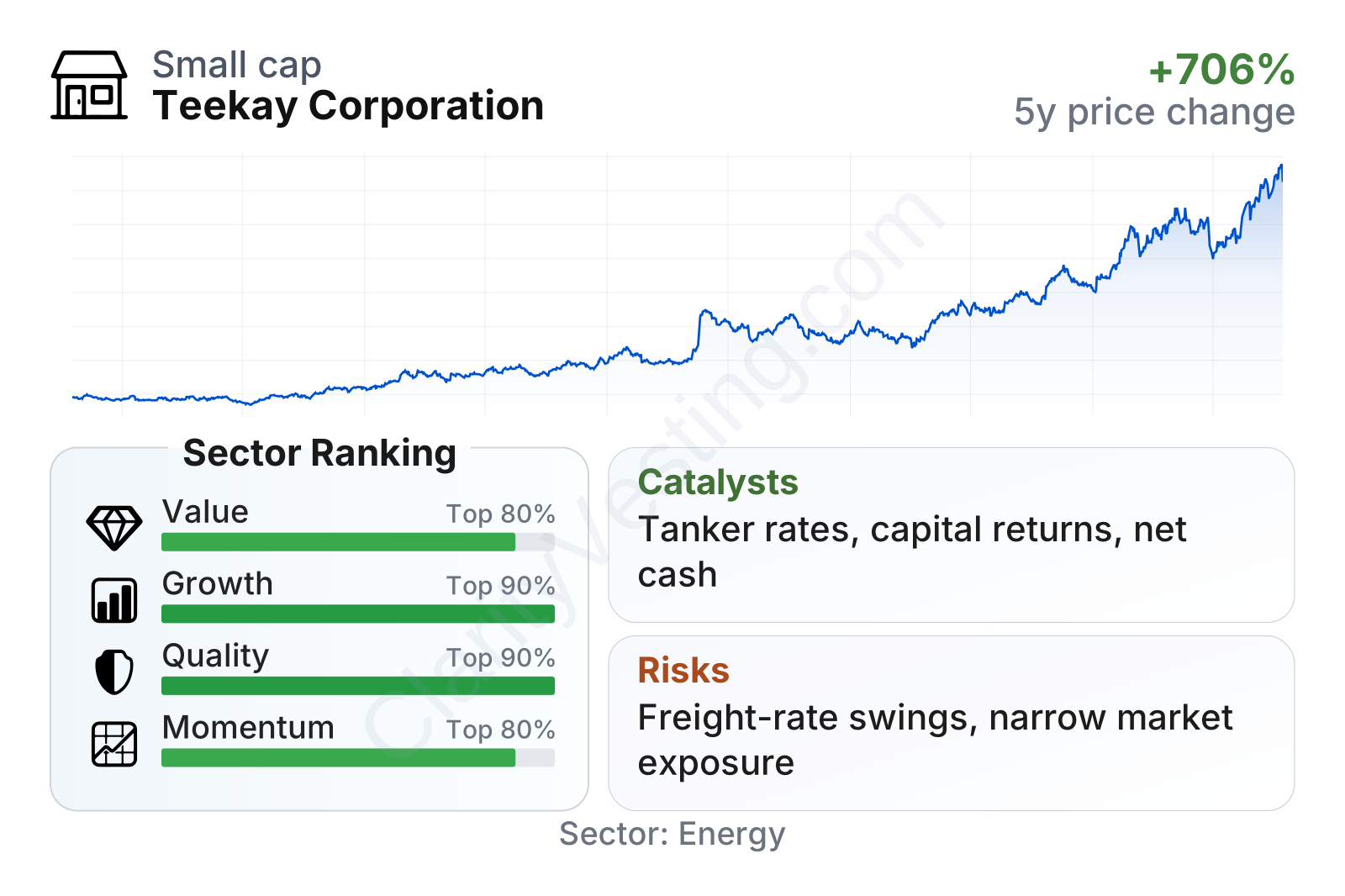
Teekay is now a relatively small public company by market value, but its operating and financial metrics rank well within its sector. Value indicators look favorable, with a low earnings multiple and a free cash flow yield far above the sector median. Quality is also unusually strong for a shipping-related business: debt is very low, margins are high, and net cash metrics are better than most peers. Growth and momentum have also been strong, although these figures should be read with the understanding that shipping cycles can create sharp swings from one year to the next.
The share price has climbed substantially since 2022, which reflects both better industry conditions and balance-sheet repair. Even after that rise, the company still screens as inexpensive on several core measures compared with much of the energy midstream universe.
Growth
Teekay operates in sectors that are not classic high-growth industries, but they can produce powerful earnings upcycles. Crude tanker shipping benefits when oil trade flows become longer, fleet supply stays tight, and vessel demand remains healthy. LNG-related shipping and marine energy services also have support from long-term global energy trade, especially as natural gas remains an important transition fuel in many regions.
Teekay’s strategy appears sensible for this stage of the cycle. Management has spent recent years simplifying the group, reducing debt, and increasing exposure to businesses that can generate cash when shipping conditions are favorable. That matters because shipping companies often destroy value through aggressive expansion during strong markets. Teekay’s recent profile looks more disciplined than that.
Recent revenue growth has been volatile, which is normal for this industry. After a weak patch through much of 2024 and 2025, growth turned sharply positive again in 2026. That suggests the company is still highly sensitive to market conditions, but also capable of strong rebounds when charter rates and utilization improve.
Cash generation is one of the most important positives in the current case. Free cash flow has remained substantial over the last several years, even if it has come down from peak levels. For a capital-intensive shipping business, the ability to produce hundreds of millions of dollars in trailing cash flow is a meaningful advantage because it can support dividends, fleet upgrades, debt reduction, or share repurchases.
A visible catalyst is capital return. Public company releases in 2026 indicate continued shareholder distributions tied to Teekay Tankers and the parent company’s financial strength. Another catalyst is the limited global tanker orderbook relative to the existing fleet, which can support freight rates if oil trade volumes remain resilient. In addition, geopolitical changes in trade routes can increase voyage distances, which often helps tanker demand even when underlying oil consumption grows only modestly.
Risks
This article is for informational purposes only and does not constitute financial advice. Some content is AI-generated. See Disclaimer


