Stock Analysis · Technology One Limited (THNOF)
Overview
Technology One Limited is an Australian enterprise software company that sells business systems mainly to governments, universities, and other large organizations. Its products help customers manage areas such as finance, human resources, payroll, procurement, student administration, assets, property, budgeting, and civic administration. The company has been shifting its customer base toward a software-as-a-service model, where clients use the platform through the cloud and pay recurring fees rather than relying on older on-premise installations.
Its revenue is primarily built around recurring software income and related services. Based on recent annual reporting, the business mix is broadly concentrated in software and subscription income, with services making up the rest.
- Software and recurring platform revenue: approximately 65% to 75% of total revenue. This includes SaaS subscriptions, annual license fees, maintenance, and usage of the company’s enterprise application suite.
- Implementation and consulting services: approximately 20% to 30%. This covers deployment, configuration, project work, training, and customer support tied to new rollouts and upgrades.
- Other revenue: less than 10%. This can include smaller items such as legacy licensing and ancillary service activity.
The important point for long-term analysis is that the company has been increasing the share of predictable recurring revenue as more customers migrate to its cloud platform. That tends to improve visibility, customer retention, and cash generation over time.
Over the last several years, revenue has expanded steadily while profitability remained unusually high for an application software provider. The income flow also shows a large gross profit pool relative to revenue, which is consistent with a software company benefiting from scale. Selling and administrative spending has grown as the business expands, but operating income has continued to rise, suggesting that growth is not coming at the expense of overall discipline.
Key Figures
| Metric | Value | Sector ⓘ |
|---|---|---|
| Date | Oct 17, 2026 | |
| Context | ||
| Sector | Technology | |
| Industry | Software - Application | |
| Market Cap ⓘ | $6.82B | |
| Beta ⓘ | 0.67 | |
Value (Cheapness) | ||
| P/E Ratio ⓘ | 73.57 | 30.28 |
| FCF Yield ⓘ | 6.81% | 4.19% |
| Dividend Yield ⓘ | 1.36% | 1.30% |
| EBIT / EV ⓘ | N/A | 2.79% |
| PEG ⓘ | N/A | |
Growth (Business expansion) | ||
| Revenue Growth ⓘ | 11.50% | 15.70% |
| RPS Growth (5Y CAGR) ⓘ | 17.11% | 8.56% |
| EPS Growth (5Y CAGR) ⓘ | 2.29% | -11.54% |
| Margin Growth (5Y Trend) ⓘ | -0.99% | 0.46% |
| FCF Growth (5Y CAGR) ⓘ | 32.78% | 9.72% |
| DPS Growth (5Y CAGR) ⓘ | 4.52% | 7.73% |
Quality (Business durability) | ||
| ROIC (Latest) ⓘ | N/A | 9.44% |
| ROIC (5Y Median) ⓘ | 35.04% | 8.35% |
| Net Debt / EBIT (Latest) ⓘ | 0.02 | 0.50 |
| Net Debt / EBIT (5Y Median) ⓘ | -0.67 | 0.48 |
| Net Debt / EBITDA (Latest) ⓘ | 0.02 | 0.28 |
| Net Debt / Assets ⓘ | 1.12% | 3.48% |
| EBITDA / Interest ⓘ | 77.46 | 12.91 |
| Operating Margin (Latest) ⓘ | 30.80% | 9.77% |
| Operating Margin (5Y Median) ⓘ | 30.92% | 8.53% |
| Debt to Equity (Latest) ⓘ | 11.55% | 34.51% |
| Profit Margin (Latest) ⓘ | 22.41% | 7.14% |
| Free Cash Flow (Latest) ⓘ | $464.44M | |
Momentum (Price trend) | ||
| 3Y Return ⓘ | +112.09% | +56.52% |
| 12M Return (excl. last month) ⓘ | +42.32% | +13.17% |
| 6M Return ⓘ | +11.65% | +15.38% |
| Price vs. 200-Day MA ⓘ | +1.63% | +7.53% |
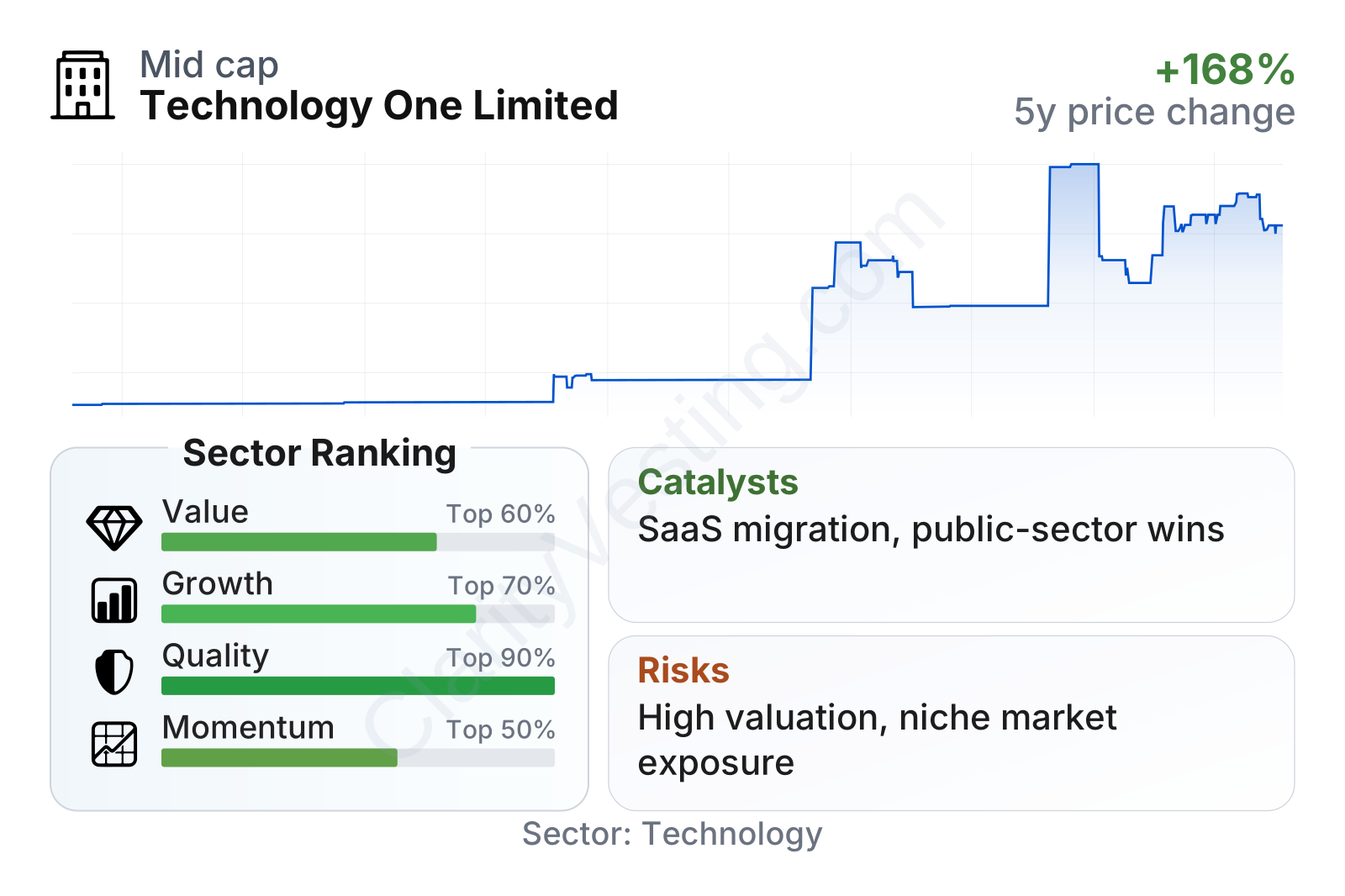
Technology One stands out most on quality. Operating margin is around 31%, far above the sector median near 10%, while profit margin is also materially stronger than typical software peers. The balance sheet is another clear strength: net debt is very low relative to earnings, debt to equity is modest, and interest coverage is exceptionally high. Free cash flow is strong as well, with cash generation comparing favorably against many companies in the same sector.
Growth is solid rather than explosive in the latest year. Revenue growth of roughly 12% is below the sector median, but the longer-term picture is stronger: revenue per share and free cash flow have compounded well over five years. Price performance has also been powerful across the last three years, although the shares have been volatile after a sharp rerating. On valuation, the P/E ratio is elevated versus the sector median, which means the market is already pricing in a premium for quality, resilience, and recurring revenue.
Growth
Technology One operates in a favorable part of the software market: mission-critical enterprise applications for institutions that usually prefer reliability, continuity, and compliance over frequent vendor changes. That matters because public-sector bodies and universities often sign long relationships once a system is embedded in finance, payroll, student management, or property administration. In practical terms, this can support recurring income and lower churn than in more consumer-driven technology markets.
The company’s strategy also fits long-term industry direction. Organizations continue to move from self-managed software toward cloud delivery, and Technology One has been positioning its suite around that transition for years. A successful shift to SaaS can improve revenue visibility, lift lifetime customer value, and create more opportunities to cross-sell additional modules into existing clients. For a company serving complex institutions, a unified software suite can be especially attractive because customers may prefer fewer vendors and tighter system integration.
A major catalyst is the continued migration of legacy customers to the cloud platform together with new customer wins in government, education, and regulated sectors. Another growth lever is geographic expansion, especially outside Australia, where the company still has a much smaller footprint than in its home market. If it proves that its operating model and product suite travel well, the addressable market becomes meaningfully larger.
Recent corporate updates have continued to emphasize SaaS growth, product development, and deeper penetration in core institutional markets. That does not guarantee rapid acceleration, but it does support the view that the company is still benefiting from structural demand rather than a short-lived cycle.
Risks
This article is for informational purposes only and does not constitute financial advice. Some content is AI-generated. See Disclaimer


