Stock Analysis · Tenet Healthcare Corporation (THC)
Overview
Tenet Healthcare Corporation is a large U.S. healthcare services company that operates hospitals and outpatient care facilities. Its business is built around two main activities: running acute care and specialty hospitals, and providing ambulatory services such as same-day surgery centers and related outpatient sites. The company serves patients through emergency care, surgical procedures, diagnostic services, physician-related offerings, and other medical services.
Tenet’s revenue mix is led by its hospital operations, but outpatient care has become increasingly important because it typically requires less capital per site and can support stronger margins. Based on recent company reporting, the business can be understood broadly as follows:
- Hospital operations and related services: approximately 55% to 60% of revenue. This includes acute care hospitals, specialty hospitals, emergency services, inpatient procedures, and other hospital-based patient care.
- Ambulatory care: approximately 40% to 45% of revenue. This includes ambulatory surgery centers, imaging, surgical hospitals held through partnerships, and other outpatient platforms, mainly through United Surgical Partners International.
That mix matters because outpatient care is one of the clearest long-term shifts in U.S. healthcare. Procedures that once had to be done in hospitals are increasingly moving into lower-cost and more convenient settings, and Tenet already has a meaningful presence there.
Over the last several years, the company has also become more focused. Management has continued to emphasize outpatient growth, disciplined hospital portfolio management, and cash generation rather than trying to expand in too many directions at once.
The business profile shows a company whose revenue has been relatively steady while earnings and operating income improved sharply after a weaker 2022 and 2023 period. Interest expense remains material, but its weight in the overall earnings picture has become easier to absorb as profitability improved.
Key Figures
| Metric | Value | Sector ⓘ |
|---|---|---|
| Date | Oct 24, 2026 | |
| Context | ||
| Sector | Healthcare | |
| Industry | Medical Care Facilities | |
| Market Cap ⓘ | $21.67B | |
| Beta ⓘ | 1.20 | |
Value (Cheapness) | ||
| P/E Ratio ⓘ | 10.40 | 25.42 |
| P/B Ratio ⓘ | 36.89 | 3.08 |
| FCF Yield ⓘ | 13.95% | 3.12% |
| Dividend Yield ⓘ | N/A | 1.85% |
| EBIT / EV ⓘ | 12.94% | 0.56% |
| PEG ⓘ | 1.82 | |
Growth (Business expansion) | ||
| Revenue Growth ⓘ | 6.80% | 7.50% |
| RPS Growth (5Y CAGR) ⓘ | 6.93% | 8.60% |
| EPS Growth (5Y CAGR) ⓘ | 13.39% | -17.73% |
| BVPS Growth (5Y CAGR) ⓘ | 608.66% | 3.72% |
| Margin Growth (5Y Trend) ⓘ | 2.57% | -0.57% |
| FCF Growth (5Y CAGR) ⓘ | 29.13% | 0.96% |
| DPS Growth (5Y CAGR) ⓘ | 16.27% | 6.69% |
Quality (Business durability) | ||
| ROIC (Latest) ⓘ | 19.59% | 3.17% |
| ROA (Latest) ⓘ | 7.46% | 2.98% |
| ROIC (5Y Median) ⓘ | 13.57% | 4.56% |
| ROA (5Y Median) ⓘ | 3.34% | 1.87% |
| Net Debt / EBIT (Latest) ⓘ | 2.66 | 1.34 |
| Net Debt / EBIT (5Y Median) ⓘ | 4.73 | 1.86 |
| Net Debt / EBITDA (Latest) ⓘ | 2.19 | 1.00 |
| Net Debt / Assets ⓘ | 36.11% | 5.06% |
| EBITDA / Interest ⓘ | 6.17 | 9.55 |
| Operating Margin (Latest) ⓘ | 19.09% | 9.25% |
| Operating Margin (5Y Median) ⓘ | 14.43% | 7.33% |
| Debt to Equity (Latest) ⓘ | 284.41% | 26.68% |
| Profit Margin (Latest) ⓘ | 10.27% | 3.34% |
| Free Cash Flow (Latest) ⓘ | $3.02B | |
Momentum (Price trend) | ||
| 3Y Return ⓘ | +395.12% | +51.61% |
| 12M Return (excl. last month) ⓘ | +35.04% | +19.90% |
| 6M Return ⓘ | +41.53% | +10.10% |
| Price vs. 200-Day MA ⓘ | +24.06% | +6.44% |
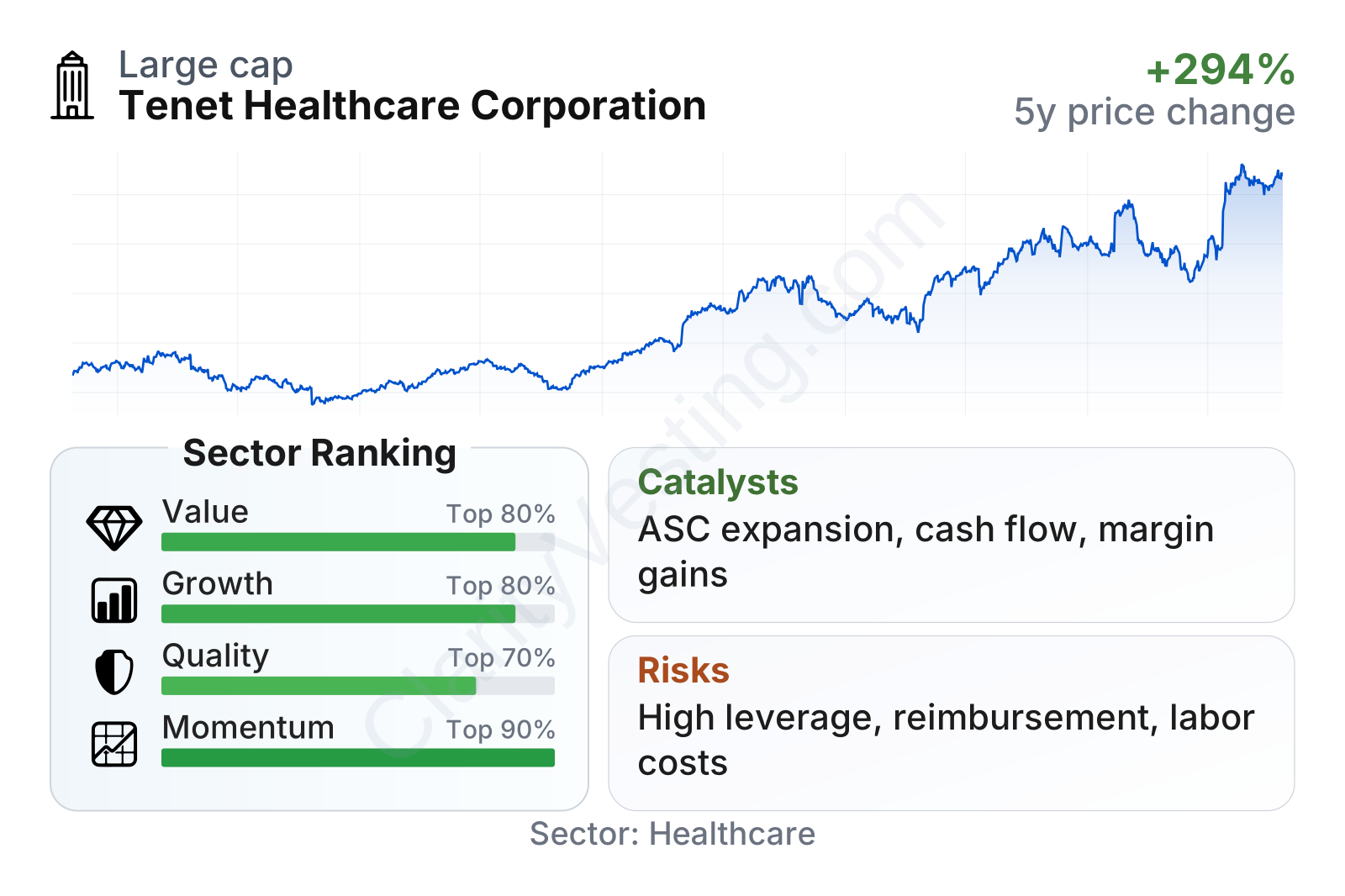
Tenet stands out on profitability, cash generation, and share-price momentum relative to much of the healthcare sector. Returns on capital and assets are well above sector medians, free cash flow is strong, and valuation multiples remain lower than many peers. The main point of caution in the table is leverage: debt-related measures are still elevated even after meaningful improvement from earlier years.
The stock’s long-term move has been strong, but it has not been smooth. The historical path shows that the market has repeatedly re-rated Tenet as margins, cash flow, and confidence in the outpatient strategy improved.
Growth
Tenet operates in a part of healthcare with durable demand. An aging population, steady procedure volumes, chronic disease management, and ongoing need for surgical capacity all support long-term demand. More importantly, the industry is gradually shifting toward outpatient settings, where many procedures can be done more efficiently and at lower cost than in hospitals. That trend supports Tenet’s ambulatory platform.
The company’s strategy makes sense in that context. Rather than relying only on traditional hospitals, Tenet has built a sizable outpatient presence through USPI. This gives it exposure to one of the more attractive parts of healthcare delivery, where convenience, lower payer cost, and physician alignment can create lasting growth opportunities.
Revenue growth has not been perfectly linear, but the pattern points to a business that returned to expansion after a softer period. Recent year-over-year growth has remained positive, and the broader picture is one of moderate top-line progress rather than rapid but unstable expansion.
Cash generation is one of the most notable parts of the current picture. Free cash flow has expanded substantially over the past few years and is now running at a level that gives the company more flexibility. That matters because it can support debt reduction, share repurchases, facility investment, and further outpatient expansion without relying as heavily on external financing.
A recent and significant opportunity is Tenet’s continued push into ambulatory surgery centers and related outpatient assets. Company communications in 2026 continued to highlight surgical volume growth, same-facility momentum in ambulatory care, and portfolio development in outpatient services. In simple terms, this means Tenet is participating in an area where patients, physicians, and payers increasingly want care to be delivered.
Another positive element is that hospital operations have also improved. Better labor conditions than in the post-pandemic disruption period, pricing actions, and operating discipline have supported margins. This reduces the risk that the company’s hospital business becomes a drag while outpatient operations grow.
Risks
This article is for informational purposes only and does not constitute financial advice. Some content is AI-generated. See Disclaimer


