Stock Analysis · TG Therapeutics Inc (TGTX)
Overview
TG Therapeutics is a biotechnology company focused on treatments for B-cell diseases, with its commercial effort centered on multiple sclerosis. Its business has changed sharply over the last few years: it moved from a development-stage biotech with recurring losses to a company driven by one marketed product, Briumvi (ublituximab-xiiy), an anti-CD20 therapy approved in the United States for relapsing forms of multiple sclerosis. The company also maintains an oncology and immunology pipeline, but the current investment case is primarily tied to how far Briumvi can expand in the MS market.
Revenue is highly concentrated today. Based on recent annual and interim filings, the main sources are:
- Net product revenue from Briumvi: approximately 95% to 100%. This is the company’s core commercial engine and includes U.S. sales tied to multiple sclerosis treatment.
- License, collaboration, and other revenue: approximately 0% to 5%. This can include milestone-related or partnership-related items, but it is currently much smaller and less predictable than product sales.
The financial profile also shows a major transition. Revenue has risen from only a few million dollars in 2021 and 2022 to more than $600 million in 2025, while gross profit has scaled quickly. Operating income turned positive in 2023 and improved further after that, showing that the business is no longer purely a research platform but an active commercial company.
The broad takeaway is that TG Therapeutics has become a single-product growth biotech with strong recent operating progress. That creates a clearer business model than in the past, but it also means the company’s fortunes are closely tied to one medicine.
Key Figures
| Metric | Value | Sector ⓘ |
|---|---|---|
| Date | Oct 17, 2026 | |
| Context | ||
| Sector | Healthcare | |
| Industry | Biotechnology | |
| Market Cap ⓘ | $8.32B | |
| Beta ⓘ | 1.80 | |
Value (Cheapness) | ||
| P/E Ratio ⓘ | 19.77 | 24.79 |
| P/B Ratio ⓘ | 14.58 | 3.08 |
| FCF Yield ⓘ | 0.21% | 3.15% |
| Dividend Yield ⓘ | N/A | 1.94% |
| EBIT / EV ⓘ | 1.53% | 0.57% |
| PEG ⓘ | 1.61 | |
Growth (Business expansion) | ||
| Revenue Growth ⓘ | 70.30% | 7.45% |
| RPS Growth (5Y CAGR) ⓘ | 194.75% | 8.61% |
| EPS Growth (5Y CAGR) ⓘ | N/A | -17.81% |
| BVPS Growth (5Y CAGR) ⓘ | 22.32% | 3.72% |
| Margin Growth (5Y Trend) ⓘ | 5141.56% | -0.62% |
| FCF Growth (5Y CAGR) ⓘ | -46.10% | 1.04% |
| DPS Growth (5Y CAGR) ⓘ | N/A | 6.77% |
Quality (Business durability) | ||
| ROIC (Latest) ⓘ | 50.85% | 3.24% |
| ROA (Latest) ⓘ | 33.14% | 3.01% |
| ROIC (5Y Median) ⓘ | 12.46% | 4.60% |
| ROA (5Y Median) ⓘ | 4.84% | 1.89% |
| Net Debt / EBIT (Latest) ⓘ | 2.03 | 1.34 |
| Net Debt / EBIT (5Y Median) ⓘ | 1.35 | 1.84 |
| Net Debt / EBITDA (Latest) ⓘ | 2.02 | 1.00 |
| Net Debt / Assets ⓘ | 16.58% | 5.45% |
| EBITDA / Interest ⓘ | 3.58 | 9.64 |
| Operating Margin (Latest) ⓘ | 16.75% | 9.27% |
| Operating Margin (5Y Median) ⓘ | 10.99% | 7.38% |
| Debt to Equity (Latest) ⓘ | 124.89% | 28.58% |
| Profit Margin (Latest) ⓘ | 55.22% | 3.59% |
| Free Cash Flow (Latest) ⓘ | $17.39M | |
Momentum (Price trend) | ||
| 3Y Return ⓘ | +723.53% | +42.80% |
| 12M Return (excl. last month) ⓘ | +67.06% | +18.50% |
| 6M Return ⓘ | +61.85% | +7.57% |
| Price vs. 200-Day MA ⓘ | +32.17% | +5.12% |
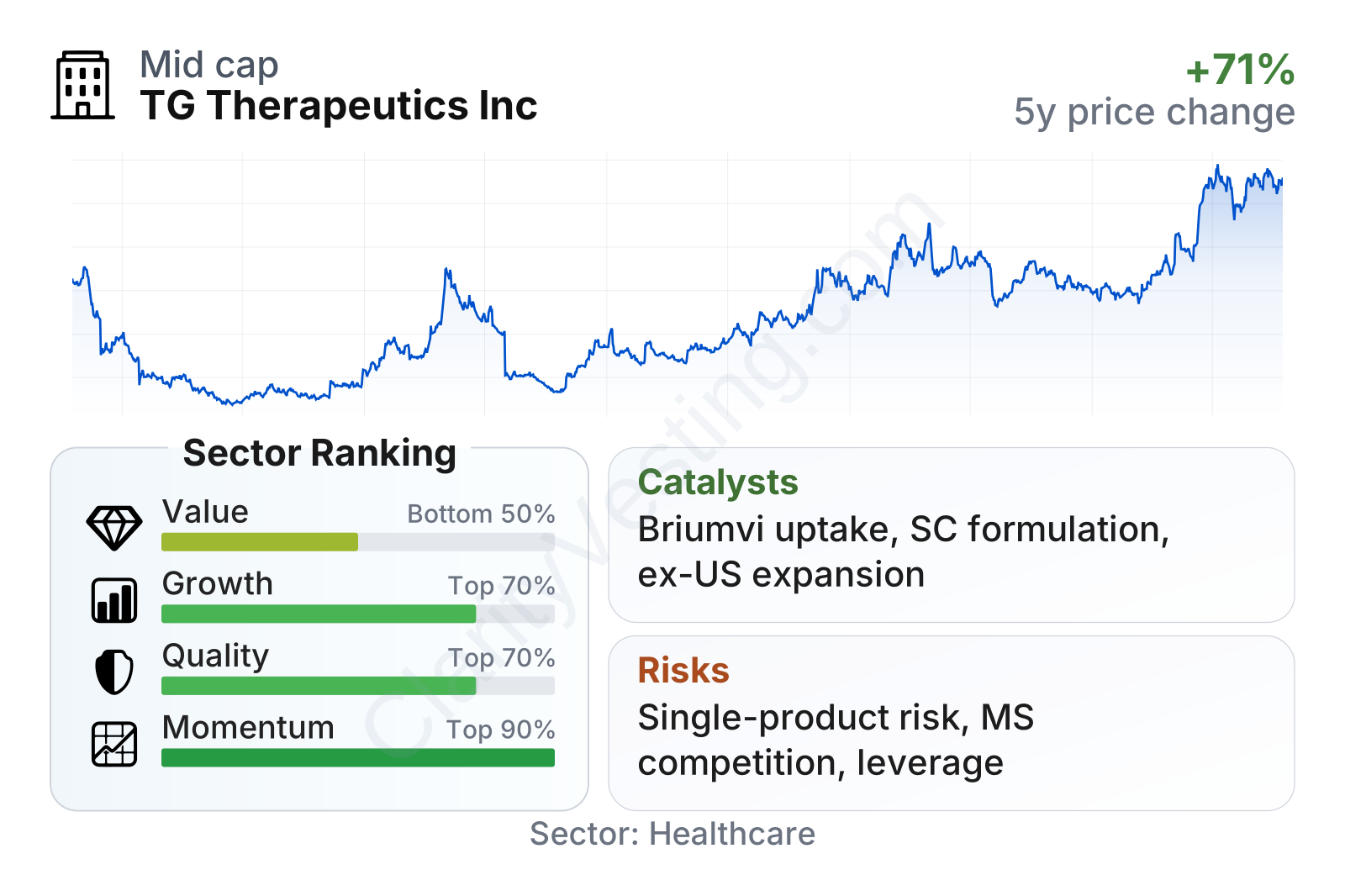
TG Therapeutics is now a mid-sized biotech by market value, and the stock has been extremely volatile, which is common for commercial-stage biotechnology companies but still notable here given the scale of the swings. In the factor breakdown, growth, quality, and momentum rank well versus much of the healthcare sector, reflecting rapid sales expansion, a meaningful improvement in profitability, and very strong share-price performance. Value looks more mixed: the earnings multiple is not especially high relative to the sector, but the price-to-book ratio is elevated and free cash flow remains close to break-even to slightly negative.
Growth
Multiple sclerosis remains a large and durable treatment market, and B-cell-depleting therapies have become an important part of care. That gives TG Therapeutics exposure to a growing and medically relevant area rather than a niche with limited room to expand. The company’s strategy is straightforward and easy to understand: build commercial share for Briumvi in U.S. relapsing MS, broaden physician adoption, support reimbursement access, and use clinical development to extend the product’s relevance over time.
The sales trend has been the company’s strongest fundamental change. Revenue growth has stayed very high even after the first launch phase, with recent year-over-year gains still around 70%. That matters because many young biotech launches show an early spike and then slow abruptly. Here, the growth curve has remained unusually strong, suggesting that uptake is still expanding rather than maturing.
Cash generation is the area where the picture is less clean. Free cash flow improved dramatically from deeply negative levels and briefly turned positive, but it has not yet settled into a consistently strong positive run rate. For a company in commercial buildout mode, that is not unusual, yet it is an important point for long-term analysis because sustained profitability matters more than accounting gains alone.
Recent company updates have also pointed to potential catalysts beyond simple prescription growth. Management has highlighted continued prescriber adoption, infusion-center expansion, and efforts to support a subcutaneous, or under-the-skin, version of ublituximab. If that formulation advances successfully, it could materially improve convenience and help the company compete in a market where ease of administration matters. International expansion is another medium-term opportunity if additional regulatory and partnership progress continues.
Risks
This article is for informational purposes only and does not constitute financial advice. Some content is AI-generated. See Disclaimer


