Stock Analysis · TGS ASA (TGSNF)
Overview
TGS ASA is a Norwegian energy data and services company focused on helping oil and gas producers find, evaluate, and develop offshore and onshore resources. In simple terms, it sells the information and technical support that exploration and production companies use before they commit large amounts of capital to drilling and field development. Its work includes seismic data, subsurface interpretation, imaging, and more recently a broader range of offshore energy services following the combination with PGS.
The business is mainly exposed to upstream energy spending, especially offshore exploration and production. That means results tend to move with customer budgets, licensing rounds, and confidence in long-cycle oil and gas projects. At the same time, TGS is not an oil producer itself, so its revenue comes from selling data, services, and survey capacity rather than directly from commodity production.
Based on recent company reporting after the PGS combination, revenue is now spread across a few main buckets:
- Contract acquisition: approximately 45% to 55% of revenue. This is work performed for specific customers, including proprietary seismic acquisition and related services.
- Multi-client data: approximately 25% to 35% of revenue. This is TGS’s library of seismic and subsurface data that can be licensed to multiple customers over time, usually at attractive margins when demand is healthy.
- Imaging and other services: approximately 15% to 25% of revenue. This includes processing, imaging, interpretation, and related geoscience offerings.
The mix matters because contract acquisition can lift total revenue quickly, while the multi-client library is often the more scalable and strategically valuable part of the business over the long run. The recent expansion has made TGS a more diversified offshore services company, but also one that is somewhat more operationally intensive than the older, lighter-asset TGS model.
The revenue base has expanded sharply over the last few years, especially after the PGS combination, but profitability has been less steady than revenue growth. The broad picture is a larger company with more operating reach, alongside higher costs and interest expense that now deserve close attention.
Key Figures
| Metric | Value | Sector ⓘ |
|---|---|---|
| Date | Oct 17, 2026 | |
| Context | ||
| Sector | Energy | |
| Industry | Oil & Gas Equipment & Services | |
| Market Cap ⓘ | $2.83B | |
| Beta ⓘ | -0.06 | |
Value (Cheapness) | ||
| P/E Ratio ⓘ | 29.98 | 15.44 |
| P/B Ratio ⓘ | 1.45 | 1.73 |
| FCF Yield ⓘ | 6.50% | 8.20% |
| Dividend Yield ⓘ | 4.31% | 3.59% |
| EBIT / EV ⓘ | 2.50% | 7.46% |
| PEG ⓘ | N/A | |
Growth (Business expansion) | ||
| Revenue Growth ⓘ | 11.60% | 26.90% |
| RPS Growth (5Y CAGR) ⓘ | 15.00% | 6.90% |
| EPS Growth (5Y CAGR) ⓘ | -38.54% | -15.73% |
| BVPS Growth (5Y CAGR) ⓘ | 1.35% | 6.07% |
| Margin Growth (5Y Trend) ⓘ | -27.44% | 0.58% |
| FCF Growth (5Y CAGR) ⓘ | 30.17% | 1.86% |
| DPS Growth (5Y CAGR) ⓘ | 2.50% | 16.79% |
Quality (Business durability) | ||
| ROIC (Latest) ⓘ | 2.77% | 11.40% |
| ROA (Latest) ⓘ | -0.63% | 6.06% |
| ROIC (5Y Median) ⓘ | 6.92% | 10.30% |
| ROA (5Y Median) ⓘ | 1.14% | 5.42% |
| Net Debt / EBIT (Latest) ⓘ | 5.55 | 1.64 |
| Net Debt / EBIT (5Y Median) ⓘ | -0.25 | 1.83 |
| Net Debt / EBITDA (Latest) ⓘ | 0.74 | 1.08 |
| Net Debt / Assets ⓘ | 13.33% | 17.29% |
| EBITDA / Interest ⓘ | 9.17 | 9.64 |
| Operating Margin (Latest) ⓘ | 7.33% | 16.27% |
| Operating Margin (5Y Median) ⓘ | 13.89% | 20.39% |
| Debt to Equity (Latest) ⓘ | N/A | 54.76% |
| Profit Margin (Latest) ⓘ | 7.20% | 8.82% |
| Free Cash Flow (Latest) ⓘ | $183.90M | |
Momentum (Price trend) | ||
| 3Y Return ⓘ | +29.22% | +67.38% |
| 12M Return (excl. last month) ⓘ | +110.61% | +49.19% |
| 6M Return ⓘ | +10.92% | +7.07% |
| Price vs. 200-Day MA ⓘ | +21.53% | +9.56% |
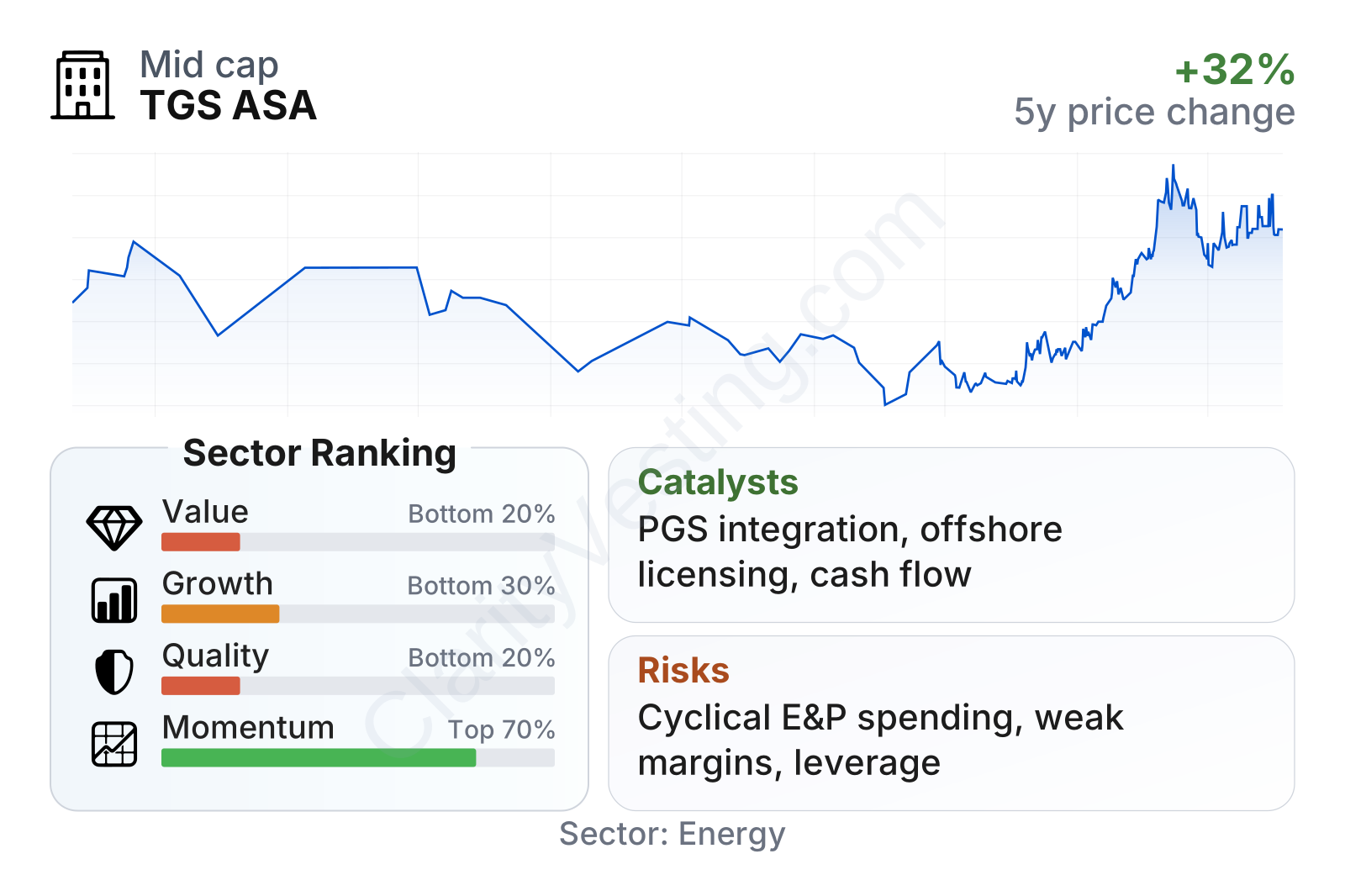
TGS is now a mid-sized energy services company by market value. The table points to a mixed profile. On valuation, it screens weaker than much of the sector, with earnings and enterprise-value-based measures looking richer than peers. On growth, the picture is uneven: long-term revenue per share and free cash flow trends have been solid, but recent year-over-year growth has slowed sharply from the post-merger surge. Quality metrics are also below sector norms, mainly because returns on capital and margins remain modest relative to many peers, while leverage against current EBIT looks elevated. Momentum is the clearest area of strength, with the stock performing well over the last year and trading well above its longer-term average.
Growth
TGS operates in a part of the energy market that still has structural demand. Oil and gas companies continue to need new reserves, and offshore basins remain important because they can support large, long-life projects. Even with energy transition spending rising, global energy systems still rely heavily on hydrocarbons, which supports continued demand for exploration data, seismic reprocessing, and reservoir understanding. That does not make the sector high-growth in a straight line, but it does mean the underlying need for high-quality subsurface data remains real.
The company’s strategy also makes industrial sense. Historically, TGS was known for an asset-light multi-client model. The merger with PGS added marine acquisition capacity and broadened the offering across the seismic chain. In practical terms, that gives customers a more complete service platform and gives TGS more ways to capture spending, from survey collection to data licensing and imaging. The trade-off is that a broader platform usually comes with more fixed costs and more balance-sheet complexity.
Recent revenue growth has been volatile. There was a very strong jump during the integration period, followed by a much softer pattern and even contraction in some periods before a modest return to growth. That suggests the business is still moving through a normalization phase after the merger rather than delivering a smooth organic growth path.
Cash generation has been more encouraging than earnings volatility might suggest. Free cash flow improved strongly over the last few years and remains a useful feature of the case, because it gives the company more flexibility to support dividends, invest in new surveys, and manage debt. The latest trailing figure still indicates meaningful cash generation, even if not all of the earlier acceleration can be assumed to continue.
A major catalyst is the enlarged market position after the PGS transaction. TGS has described itself as a leading provider of energy data and intelligence, with one of the industry’s broadest multi-client libraries and a larger offshore acquisition presence. Another supportive factor is licensing activity in frontier and mature offshore basins, where customers often need fresh data before committing to drilling. The company has also recently announced new survey awards, licensing rounds, and multi-client project activity in areas such as Brazil, the Gulf of America/Gulf of Mexico, Northern Europe, and other offshore provinces, which reinforces that commercial demand is still active.
Risks
This article is for informational purposes only and does not constitute financial advice. Some content is AI-generated. See Disclaimer


