Stock Analysis · Towngas China Company Limited (TGASF)
Overview
Towngas China Company Limited is a city-gas utility operator focused on mainland China. Its core business is distributing piped natural gas to residential, commercial, and industrial customers through local urban gas projects. In practical terms, the company builds or operates gas networks, connects homes and businesses, sells gas volume, and provides related services around energy use.
The business model is relatively easy to understand: revenue mainly comes from selling natural gas and from fees tied to connecting new customers or expanding local gas networks. The company also has smaller contributions from other utility-related and energy service activities. Based on the structure commonly disclosed by city-gas operators and Towngas China’s business mix, the main revenue sources are approximately:
- Gas sales: about 85% to 90% of revenue. This is the largest activity and includes gas supplied to households, restaurants, commercial users, and factories.
- Connection and construction services: about 8% to 12% of revenue. This covers new pipeline connections, installation work, and related infrastructure fees.
- Other businesses: about 1% to 5% of revenue. This may include value-added utility services, equipment-related activities, or smaller energy projects.
That revenue mix matters because gas sales usually provide recurring volume, while connection income can be more cyclical and depends on property development and new project activity. Over the last several years, the company’s total revenue has stayed around the same broad range, while profits have been more sensitive to margins, financing costs, and the pace of new connections. The operating flow also shows a utility with heavy cost of sales and meaningful interest expense, which is typical for an infrastructure business.
The broad pattern is a stable top line with a high cost base, but also a noticeable recovery in operating income after the weaker 2022-2023 period. Interest expense remains significant, which is important for judging earnings resilience.
Key Figures
| Metric | Value | Sector ⓘ |
|---|---|---|
| Date | Oct 17, 2026 | |
| Context | ||
| Sector | Utilities | |
| Industry | Utilities - Regulated Gas | |
| Market Cap ⓘ | $1.52B | |
| Beta ⓘ | 0.80 | |
Value (Cheapness) | ||
| P/E Ratio ⓘ | 8.02 | 17.28 |
| P/B Ratio ⓘ | 0.06 | 1.51 |
| FCF Yield ⓘ | 23.31% | 0.65% |
| Dividend Yield ⓘ | 37.33% | 3.77% |
| EBIT / EV ⓘ | N/A | 5.01% |
| PEG ⓘ | N/A | |
Growth (Business expansion) | ||
| Revenue Growth ⓘ | 8.50% | 6.10% |
| RPS Growth (5Y CAGR) ⓘ | -1.60% | 3.87% |
| EPS Growth (5Y CAGR) ⓘ | -33.93% | -11.30% |
| BVPS Growth (5Y CAGR) ⓘ | -6.00% | 4.23% |
| Margin Growth (5Y Trend) ⓘ | -9.30% | 3.57% |
| FCF Growth (5Y CAGR) ⓘ | N/A | -8.84% |
| DPS Growth (5Y CAGR) ⓘ | 21.42% | 4.84% |
Quality (Business durability) | ||
| ROIC (Latest) ⓘ | N/A | 6.53% |
| ROA (Latest) ⓘ | 5.67% | 3.20% |
| ROIC (5Y Median) ⓘ | 3.33% | 5.95% |
| ROA (5Y Median) ⓘ | 2.93% | 2.75% |
| Net Debt / EBIT (Latest) ⓘ | 3.65 | 7.13 |
| Net Debt / EBIT (5Y Median) ⓘ | 8.70 | 7.23 |
| Net Debt / EBITDA (Latest) ⓘ | 2.23 | 4.31 |
| Net Debt / Assets ⓘ | 26.03% | 38.42% |
| EBITDA / Interest ⓘ | 4.01 | 4.58 |
| Operating Margin (Latest) ⓘ | 9.57% | 20.83% |
| Operating Margin (5Y Median) ⓘ | 8.39% | 20.08% |
| Debt to Equity (Latest) ⓘ | 69.04% | 137.69% |
| Profit Margin (Latest) ⓘ | 6.96% | 11.37% |
| Free Cash Flow (Latest) ⓘ | $353.27M | |
Momentum (Price trend) | ||
| 3Y Return ⓘ | +44.30% | +52.37% |
| 12M Return (excl. last month) ⓘ | +18.31% | +8.84% |
| 6M Return ⓘ | -12.00% | -3.95% |
| Price vs. 200-Day MA ⓘ | +0.38% | -0.79% |
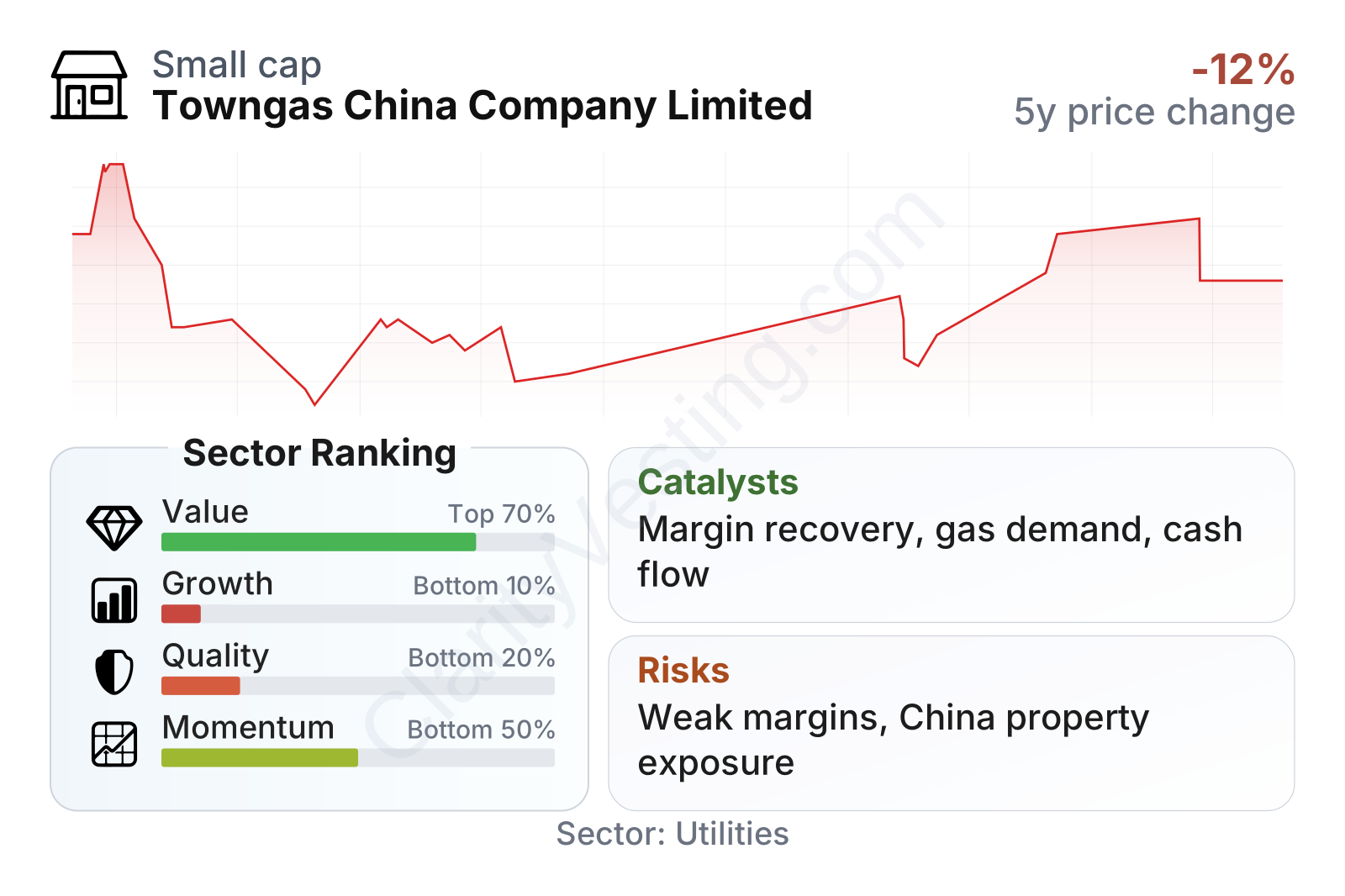
Towngas China sits in the regulated gas utility space, so it naturally tends to look less volatile than many industrial or technology companies. Its beta is below 1, which fits that profile. On valuation measures, the shares screen cheaply relative to many utility peers, with a lower earnings multiple and an unusually high free cash flow yield. The dividend yield also stands far above the sector median.
The more cautious side appears in business quality and long-term growth. Profitability is below the sector median, especially at the operating margin level, and five-year trends in earnings, book value per share, and revenue per share have been weak. Balance-sheet leverage is not extreme for a utility and looks better than the sector median on several debt measures, but interest coverage is only moderate rather than strong.
Recent share-price behavior has been mixed: medium-term performance has been respectable, but the shorter six-month trend has been softer. That combination often reflects a stock the market sees as inexpensive, but not yet clearly re-rated by improving fundamentals.
Growth
Natural gas distribution in China remains tied to long-term structural themes: urban energy demand, replacement of more polluting fuels, industrial fuel switching, and the modernization of local utility networks. Even if the pace is slower than in earlier expansion years, the sector still has a logic for gradual long-duration demand, particularly in established urban concession areas where utility operators already control the customer relationship and pipeline footprint.
Towngas China’s strategy also makes sense within that context. A city-gas business can grow through several channels at once: more connected households, greater gas usage per customer, industrial and commercial demand, and service offerings built around the distribution network. The company’s position in mainland China gives it exposure to a very large end market, and its link to the broader Towngas group supports operating know-how and access to an established utility brand.
The challenge is that growth has not been especially strong on a per-share basis. Revenue growth in the latest year appears positive, but the five-year trend is much weaker, and revenue per share has been broadly flat to slightly down. That suggests the business has been maintaining scale more than compounding it. For long-term analysis, that makes margin improvement and cash generation at least as important as simple sales expansion.
A meaningful catalyst could come from better gas procurement economics and improved mix toward higher-quality customers and service revenue. If the company can keep financing costs contained while lifting margins from recent levels, even modest revenue growth could translate into steadier profit progress. Another useful support is the company’s strong free cash flow profile, which gives it more flexibility than a utility that is growing but consuming cash.
Recent developments in China’s energy system also create a practical opportunity set. Natural gas remains part of the transition away from heavier-emission fuels in many urban and industrial uses, and local gas distributors can benefit when policy emphasis favors cleaner combustion, network efficiency, and secure city-level supply. This is not a high-growth theme in the way emerging technologies can be, but it is a durable infrastructure theme.
Risks
This article is for informational purposes only and does not constitute financial advice. Some content is AI-generated. See Disclaimer


