Stock Analysis · TFS Financial Corporation (TFSL)
Overview
TFS Financial Corporation is the holding company for Third Federal Savings and Loan Association of Cleveland. It is a traditional thrift institution focused mainly on gathering deposits and making residential real estate loans. In simple terms, it takes in money from savers and lends it out largely to homeowners, especially through mortgage products. The business is much narrower and more specialized than a diversified national bank.
The company’s revenue is driven primarily by interest-related activities rather than fee-heavy businesses. Based on recent filings, the largest sources of revenue are:
- Interest income on loans, about 80% to 90%: mainly one- to four-family residential first mortgage loans and, to a smaller extent, home equity and other consumer real estate lending.
- Interest and dividends on securities, about 10% to 20%: income from mortgage-backed securities, U.S. government and agency-related investments, and other investment securities held for liquidity and balance-sheet management.
- Non-interest income, usually a low-single portion of total revenue: deposit-related fees and other smaller banking service income streams. This area is materially smaller than interest income.
That structure makes TFSL relatively easy to understand: performance depends heavily on mortgage demand, deposit costs, and the spread between what it earns on loans and securities and what it pays on funding.
Over the last several years, total revenue has moved higher while net income improved more gradually. At the same time, interest expense expanded sharply as rates rose, showing how much earnings still depend on funding costs even when loan-related revenue remains resilient.
Key Figures
| Metric | Value | Sector ⓘ |
|---|---|---|
| Date | Oct 24, 2026 | |
| Context | ||
| Sector | Financial Services | |
| Industry | Banks - Regional | |
| Market Cap ⓘ | $4.60B | |
| Beta ⓘ | 0.73 | |
Value (Cheapness) | ||
| P/E Ratio ⓘ | 45.53 | 12.46 |
| P/B Ratio ⓘ | 2.38 | 1.25 |
| FCF Yield ⓘ | 1.88% | 9.82% |
| Dividend Yield ⓘ | 6.89% | 2.94% |
| EBIT / EV ⓘ | 1.31% | 8.11% |
| PEG ⓘ | 72.62 | |
Growth (Business expansion) | ||
| Revenue Growth ⓘ | 15.20% | 9.10% |
| RPS Growth (5Y CAGR) ⓘ | 15.40% | 12.31% |
| EPS Growth (5Y CAGR) ⓘ | N/A | -6.97% |
| BVPS Growth (5Y CAGR) ⓘ | 2.15% | 5.02% |
| Margin Growth (5Y Trend) ⓘ | -8.03% | -4.00% |
| FCF Growth (5Y CAGR) ⓘ | -3.49% | 4.71% |
| DPS Growth (5Y CAGR) ⓘ | 1.15% | 8.92% |
Quality (Business durability) | ||
| ROIC (Latest) ⓘ | 1.43% | 9.18% |
| ROE (Latest) ⓘ | 5.30% | 13.93% |
| ROA (Latest) ⓘ | 0.57% | 1.57% |
| ROIC (5Y Median) ⓘ | 1.30% | 7.80% |
| ROE (5Y Median) ⓘ | 4.20% | 12.15% |
| ROA (5Y Median) ⓘ | 0.50% | 1.28% |
| Net Debt / EBIT (Latest) ⓘ | 44.67 | 1.02 |
| Net Debt / EBIT (5Y Median) ⓘ | 43.44 | 0.72 |
| Net Debt / EBITDA (Latest) ⓘ | 37.41 | 0.88 |
| Operating Margin (Latest) ⓘ | 15.83% | 22.30% |
| Operating Margin (5Y Median) ⓘ | 21.25% | 24.50% |
| Debt to Equity (Latest) ⓘ | 296.87% | 59.34% |
| Profit Margin (Latest) ⓘ | 29.39% | 26.42% |
| Free Cash Flow (Latest) ⓘ | $86.27M | |
Momentum (Price trend) | ||
| 3Y Return ⓘ | +93.56% | +95.73% |
| 12M Return (excl. last month) ⓘ | +36.42% | +17.30% |
| 6M Return ⓘ | +16.92% | +6.07% |
| Price vs. 200-Day MA ⓘ | +7.90% | +5.36% |
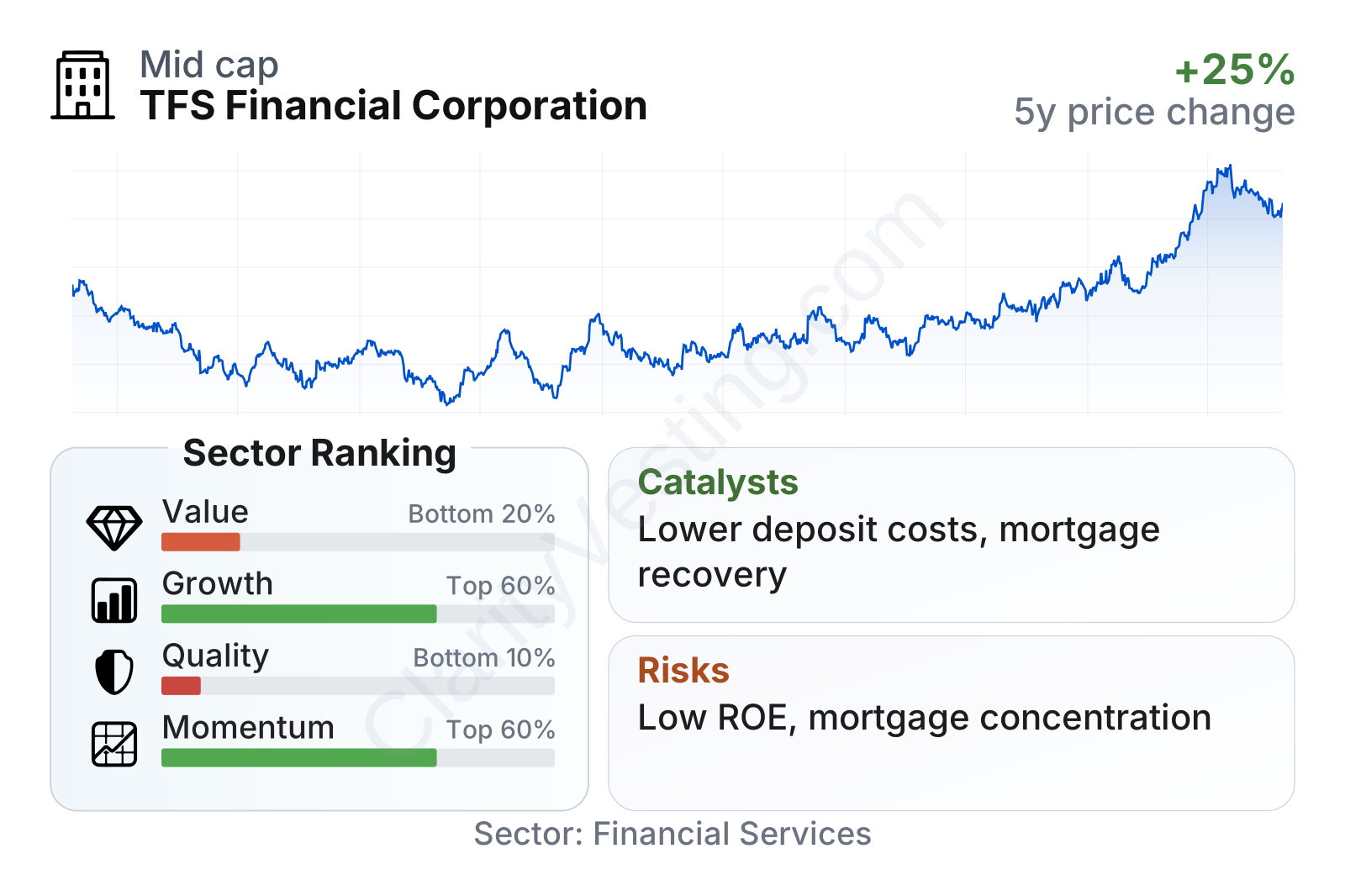
TFSL is a mid-sized regional banking stock with a relatively low beta, which suggests the shares have historically moved less than the broader market. Recent share-price momentum has been strong, but the broader financial profile is mixed. Growth measures look acceptable relative to many regional peers, while quality and valuation metrics look less favorable. The company also stands out for its trailing dividend yield, which is well above the sector median, though the yield has compressed as the share price climbed.
Growth
TFSL operates in a mature part of financial services rather than a high-growth industry. Residential mortgage lending and savings products are essential services, but they usually grow steadily rather than rapidly. That said, the sector can benefit meaningfully when funding conditions improve, housing turnover recovers, or spreads on new lending become more attractive.
The company’s strategy is coherent for its niche. It stays focused on owner-occupied residential lending, a product set it has handled for decades, instead of stretching into many business lines. This specialization can support disciplined underwriting and brand recognition in its markets. It also means management does not need to chase aggressive expansion to produce incremental gains; growth can come from better loan pricing, deposit stability, and efficient balance-sheet management.
Earnings per share have been fairly flat over time, with a temporary lift in fiscal 2025 followed by a return toward earlier levels. That pattern suggests the recent business improvement has not yet turned into a consistently rising earnings base.
Book value per share has inched up over the last several years, but not especially quickly. That matters for a bank because book value is a rough indicator of the capital base supporting future lending and earnings. Slow progress here fits the broader picture: TFSL appears stable, but not structurally fast-growing.
A practical catalyst is the interest-rate backdrop. If deposit costs stabilize or decline faster than asset yields reset downward, profitability could improve. Another possible support is a healthier mortgage market if housing activity recovers from the pressure created by elevated borrowing costs. Recent results also show revenue growth ahead of the sector median, indicating the company has been navigating a difficult rate environment somewhat better than many regional-bank peers on the top line.
One additional point that can matter for long-term relevance is capital return. TFSL has historically been associated with regular dividends, and while dividend growth has been modest, the payout remains an important part of the company’s market profile. That does not create operating growth by itself, but it can reinforce market interest when operating performance is stable.
Risks
This article is for informational purposes only and does not constitute financial advice. Some content is AI-generated. See Disclaimer


