Stock Analysis · TFI International Inc (TFII)
Overview
TFI International Inc is a North American transportation and logistics company. It moves freight across Canada, the United States, and Mexico through a large network of trucking, less-than-truckload, package and courier, and logistics operations. In simple terms, the company helps businesses ship goods, whether that means filling an entire trailer, combining smaller shipments, managing deliveries, or arranging freight through third parties.
TFI’s business model is diversified across several transportation niches, which matters because freight demand can rise or fall by end market. Based on the company’s recent reporting structure, revenue is mainly generated from the following segments:
- Less-Than-Truckload (LTL): approximately 35% to 40% — combines smaller shipments from multiple customers into shared truck capacity. This typically includes regional and long-haul LTL networks.
- Truckload (TL): approximately 30% to 35% — full-trailer shipments, often tied to industrial, retail, and dedicated transportation contracts.
- Logistics: approximately 20% to 25% — freight brokerage, transportation management, and other asset-light services where TFI arranges freight movement rather than always hauling it with its own equipment.
- Package and Courier: approximately 5% to 10% — parcel and last-mile related services, with stronger exposure to Canadian delivery activity.
The broader picture is that TFI is not just a trucking operator. It is a consolidator in a fragmented industry, using acquisitions, cost controls, and decentralized management to build scale. That combination has helped it become one of the larger publicly traded freight operators in North America.
The financial flow also shows a business that converts a large revenue base into meaningful operating income and free cash generation, but with profitability under more pressure than it was a few years ago as interest expense and operating costs have risen.
Key Figures
| Metric | Value | Sector ⓘ |
|---|---|---|
| Date | Oct 24, 2026 | |
| Context | ||
| Sector | Industrials | |
| Industry | Trucking | |
| Market Cap ⓘ | $9.16B | |
| Beta ⓘ | 1.47 | |
Value (Cheapness) | ||
| P/E Ratio ⓘ | 27.44 | 22.29 |
| P/B Ratio ⓘ | 3.39 | 1.98 |
| FCF Yield ⓘ | 8.01% | 6.26% |
| Dividend Yield ⓘ | 1.67% | 1.92% |
| EBIT / EV ⓘ | 4.84% | 4.83% |
| PEG ⓘ | N/A | |
Growth (Business expansion) | ||
| Revenue Growth ⓘ | 12.40% | 9.30% |
| RPS Growth (5Y CAGR) ⓘ | 14.89% | 7.76% |
| EPS Growth (5Y CAGR) ⓘ | -26.42% | -13.17% |
| BVPS Growth (5Y CAGR) ⓘ | 7.21% | 6.13% |
| Margin Growth (5Y Trend) ⓘ | -6.18% | 0.74% |
| FCF Growth (5Y CAGR) ⓘ | 14.14% | 10.79% |
| DPS Growth (5Y CAGR) ⓘ | 29.63% | 9.41% |
Quality (Business durability) | ||
| ROIC (Latest) ⓘ | 9.59% | 10.75% |
| ROA (Latest) ⓘ | 4.97% | 5.41% |
| ROIC (5Y Median) ⓘ | 13.60% | 9.37% |
| ROA (5Y Median) ⓘ | 8.56% | 4.95% |
| Net Debt / EBIT (Latest) ⓘ | 4.47 | 2.04 |
| Net Debt / EBIT (5Y Median) ⓘ | 2.67 | 2.27 |
| Net Debt / EBITDA (Latest) ⓘ | 2.20 | 1.39 |
| Net Debt / Assets ⓘ | 37.94% | 19.27% |
| EBITDA / Interest ⓘ | 7.63 | 9.58 |
| Operating Margin (Latest) ⓘ | 7.19% | 10.49% |
| Operating Margin (5Y Median) ⓘ | 10.00% | 10.30% |
| Debt to Equity (Latest) ⓘ | 111.46% | 64.82% |
| Profit Margin (Latest) ⓘ | 4.14% | 6.67% |
| Free Cash Flow (Latest) ⓘ | $733.65M | |
Momentum (Price trend) | ||
| 3Y Return ⓘ | -0.47% | +67.77% |
| 12M Return (excl. last month) ⓘ | +36.63% | +12.05% |
| 6M Return ⓘ | -16.12% | 0.00% |
| Price vs. 200-Day MA ⓘ | -12.47% | +0.67% |
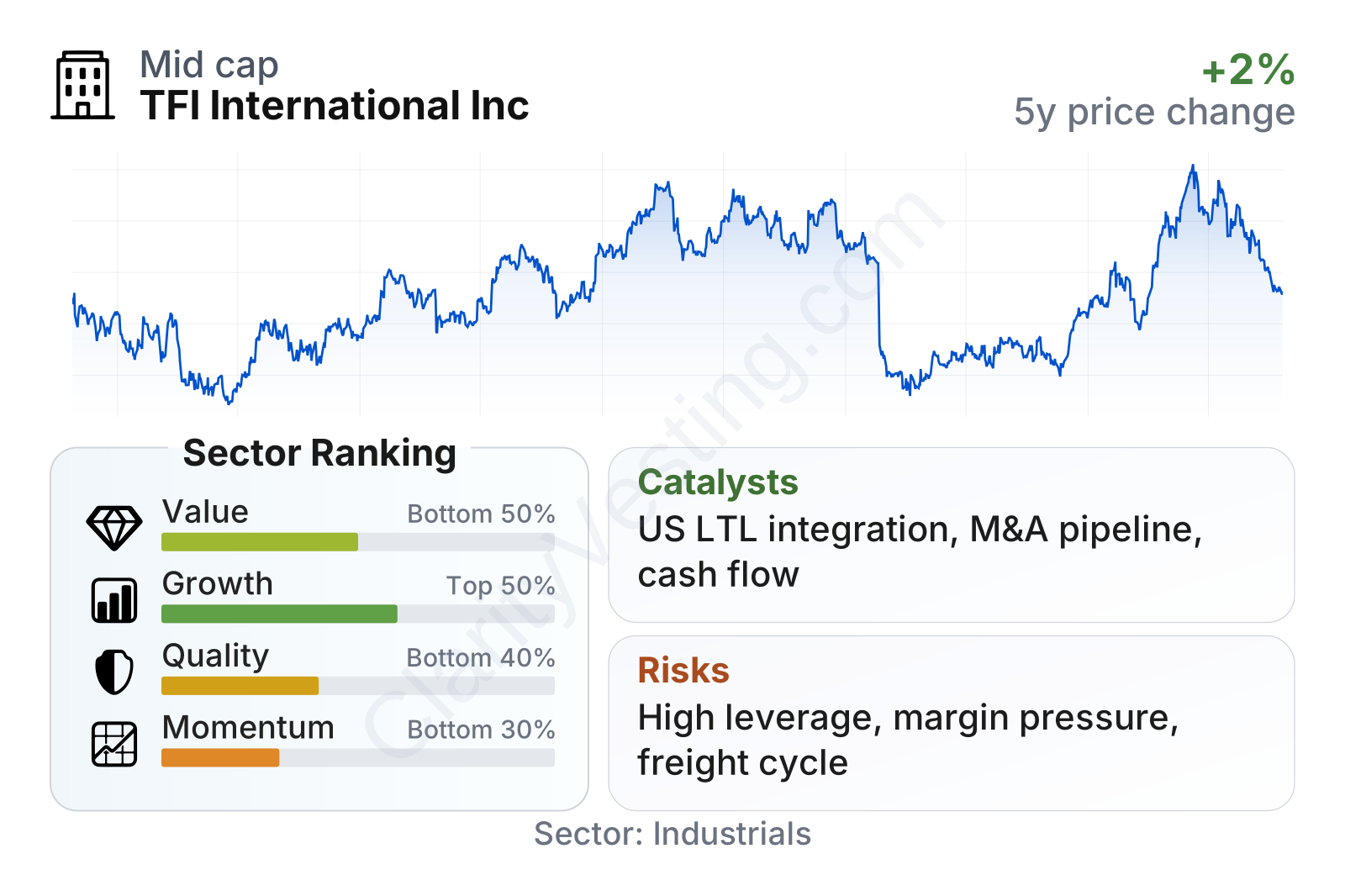
TFI is a large transportation company with a market value around $10 billion, so it is well beyond the small-cap stage and has meaningful scale in its industry. The stock has also been more volatile than the average industrial name, as reflected by a beta above 1.4. In the factor view, growth looks stronger than the sector median, especially on multi-year revenue per share and free cash flow expansion. By contrast, value does not stand out as cheap, and quality is weighed down by higher leverage, lower current margins, and returns that have softened from past levels.
The share price path has been uneven over the last several years, including a sharp drop in 2025 followed by a strong rebound into 2026. That pattern fits the nature of freight businesses: results can be cyclical, and market sentiment can shift quickly when volumes, pricing, or margins change.
Growth
Transportation is a mature industry, but it is still essential and can grow over time with economic activity, e-commerce, supply-chain complexity, and outsourcing. Within that framework, TFI has a strategy that is easier to understand than many industrial growth plans: buy companies, improve their efficiency, keep local accountability, and redeploy capital into areas with better returns.
That approach has worked over long periods. TFI’s five-year revenue per share growth is well above the sector median, and free cash flow has also compounded at a healthy pace. Recent year-over-year revenue growth has been more volatile, which is normal in freight because shipment levels and pricing move with the economy. The latest trend points to renewed top-line improvement after a period of contraction and mixed quarterly comparisons.
One of the more attractive features in TFI’s model is cash generation. Even with margin pressure, the business has continued to produce substantial free cash flow, giving management room to fund acquisitions, repay debt, repurchase shares, and maintain its dividend. That financial flexibility is important in trucking because downturns often create acquisition opportunities.
A meaningful catalyst in recent years has been TFI’s expansion in the United States, especially through larger acquisitions that increased its exposure to the U.S. LTL market. That market is strategically important because scale, density, terminal networks, and service quality can create stronger long-term economics than more commoditized parts of trucking. If integration and efficiency gains continue, that could support better revenue mix and stronger earnings power over time.
Another favorable point is industry structure. Trucking and logistics remain fragmented across North America, leaving room for disciplined consolidators. TFI has repeatedly positioned itself as one of those consolidators. In a softer freight cycle, weaker operators may become easier to acquire or lose market share, which can create openings for larger networks with stronger operational discipline.
Risks
This article is for informational purposes only and does not constitute financial advice. Some content is AI-generated. See Disclaimer


