Stock Analysis · Telecom Argentina SA (TEO)
Overview
Telecom Argentina S.A. is one of Argentina’s largest telecommunications companies. It provides mobile phone services, fixed broadband, pay TV, fixed-line telephony, data transmission, and digital solutions for businesses and public-sector clients. The company operates under well-known brands in Argentina and also has operations in Paraguay through its telecom subsidiary there. In simple terms, Telecom Argentina runs the networks that connect people and companies through mobile, internet, voice, and entertainment services.
Its revenue mix is led by connectivity services, with mobile and broadband representing the core of the business. Based on recent annual reporting, the company’s main sources of revenue are approximately the following:
- Mobile services: about 45% to 50% of revenue. This includes prepaid and postpaid mobile plans, data usage, voice, and related services.
- Fixed internet and data services: about 25% to 30%. This includes residential broadband, fiber-based internet access, and corporate connectivity.
- Pay TV and subscription television: about 10% to 15%. This covers cable and content distribution packages.
- Fixed-line telephony: about 5% to 10%. This is the traditional voice business, which remains relevant but is structurally mature.
- Equipment sales and other services: about 10%. This includes handset sales, ICT solutions, installation, and other business services.
The business model is fairly easy to understand: recurring monthly service revenue pays for the network, customer support, spectrum use, and ongoing investment in infrastructure. For a telecom operator, scale matters a lot, because once the network is built, adding users and upselling faster plans can improve profitability. Over the last few years, the company has also been pushing fiber expansion, 4G and 5G-related upgrades, and enterprise digital services, which are all important for keeping revenue resilient in a market where traditional fixed voice is gradually losing relevance.
Profitability has been uneven over time, reflecting Argentina’s inflation, regulation, currency effects, and accounting distortions, but the broader operating picture shows a business that returned to positive operating income in 2024 after losses in 2022 and 2023. Revenue also rebounded strongly in 2025 after a softer 2024. That combination makes Telecom Argentina more than just a defensive telecom utility; it is also a company shaped by a volatile macroeconomic environment.
The long-term pattern is striking: revenue and gross profit have expanded materially, but the path from operating income to net income has been inconsistent. That highlights both the earnings power of the core network business and the importance of financing costs, taxes, and Argentina-specific volatility when reading the bottom line.
Key Figures
| Metric | Value | Sector ⓘ |
|---|---|---|
| Date | Nov 21, 2026 | |
| Context | ||
| Sector | Communication Services | |
| Industry | Telecom Services | |
| Market Cap ⓘ | $4.55B | |
| Beta ⓘ | 0.41 | |
Value (Cheapness) | ||
| P/E Ratio ⓘ | 6.53 | 17.77 |
| FCF Yield ⓘ | 19.19% | 7.57% |
| Dividend Yield ⓘ | 0.43% | 2.85% |
| EBIT / EV ⓘ | 16.16% | 6.92% |
| PEG ⓘ | 1.41 | |
Growth (Business expansion) | ||
| Revenue Growth ⓘ | 30.60% | 6.30% |
| RPS Growth (5Y CAGR) ⓘ | 34.03% | 4.62% |
| EPS Growth (5Y CAGR) ⓘ | N/A | -14.44% |
| Margin Growth (5Y Trend) ⓘ | -10.71% | 1.03% |
| FCF Growth (5Y CAGR) ⓘ | 82.78% | 5.91% |
| DPS Growth (5Y CAGR) ⓘ | 137.41% | 5.03% |
Quality (Business durability) | ||
| ROIC (Latest) ⓘ | 10.33% | 8.39% |
| ROIC (5Y Median) ⓘ | 2.18% | 8.33% |
| Net Debt / EBIT (Latest) ⓘ | 2.60 | 1.88 |
| Net Debt / EBIT (5Y Median) ⓘ | 1.73 | 2.83 |
| Net Debt / EBITDA (Latest) ⓘ | 1.08 | 1.22 |
| Net Debt / Assets ⓘ | 26.15% | 20.70% |
| EBITDA / Interest ⓘ | 8.15 | 8.41 |
| Operating Margin (Latest) ⓘ | 19.70% | 15.44% |
| Operating Margin (5Y Median) ⓘ | 3.46% | 13.32% |
| Debt to Equity (Latest) ⓘ | 68.11% | 60.11% |
| Profit Margin (Latest) ⓘ | 11.84% | 8.06% |
| Free Cash Flow (Latest) ⓘ | $873.63M | |
Momentum (Price trend) | ||
| 3Y Return ⓘ | +54.72% | +35.91% |
| 12M Return (excl. last month) ⓘ | +86.00% | +2.79% |
| 6M Return ⓘ | -19.29% | 0.00% |
| Price vs. 200-Day MA ⓘ | -22.92% | +0.03% |
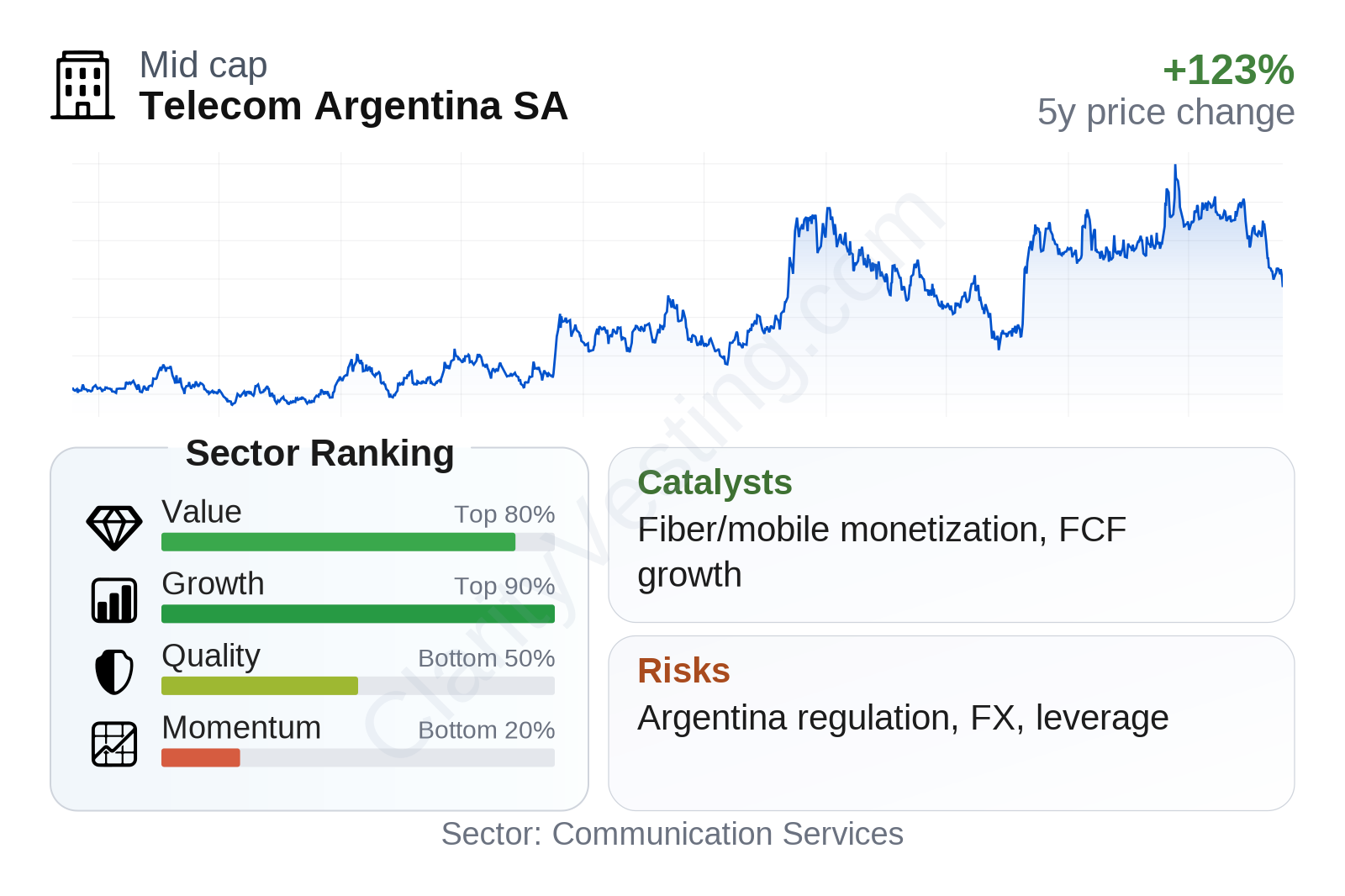
Telecom Argentina currently stands out more for value and growth than for consistency. The valuation multiples are well below the sector median, while free cash flow yield and EBIT relative to enterprise value are much stronger than typical telecom peers. Revenue growth has also been far above the sector median over both the last year and the last five years. On the other hand, quality metrics are more mixed: current profitability looks solid, but the longer record is uneven, and leverage is somewhat above the sector median. Price performance has been strong over the last one to three years, yet the recent six-month trend has cooled, which fits a stock that has already rerated but remains volatile.
In broad terms, this is a mid-sized telecom operator with a relatively low beta, meaning the stock has historically moved less than the broader market. Even so, that does not make it low-risk, because company-specific and country-specific factors matter much more here than market swings alone.
Growth
The telecom sector is not usually a fast-growth industry in mature economies, but in emerging markets it can still offer meaningful expansion through higher data consumption, migration to fiber, bundling, enterprise services, and pricing normalization after periods of regulation or inflation dislocation. Telecom Argentina sits in that more dynamic category. Demand for mobile data, home broadband, streaming capacity, and digital business solutions continues to rise, and that gives the company room to grow even without dramatic subscriber increases.
Its strategy makes sense for long-term growth because it is centered on assets that are hard to replicate: spectrum, access networks, fiber deployment, mobile towers, billing relationships, and a large installed customer base. The company has been focusing on convergent offers that combine mobile, broadband, and entertainment, which can reduce churn and raise revenue per customer. In telecom, keeping customers is often just as important as adding new ones.
Recent sales growth has been unusually strong, even after accounting for a very volatile Argentine backdrop. The pace seen in 2025 was exceptionally high and has moderated in 2026, but it still remains well above the sector median. That suggests the business is not only benefiting from inflation-linked pricing effects, but also from continued demand for connectivity and digital services.
Free cash flow is another encouraging point. It has climbed sharply over the last several years and is now at a level that gives the company more flexibility to fund capital expenditures, manage debt, and potentially support shareholder distributions over time. For telecom operators, cash generation matters more than headline accounting earnings because networks require constant investment. On that measure, Telecom Argentina has recently looked much healthier than its earnings volatility might suggest.
As for catalysts, the most important ones are practical rather than speculative: further monetization of fiber and mobile data usage, better pricing conditions in Argentina, continued recovery in margins, and growth in business-to-business digital and connectivity solutions. Public company communications have also highlighted ongoing network modernization and service development, which supports the idea that management is investing behind future traffic growth rather than simply harvesting legacy assets.
Risks
This article is for informational purposes only and does not constitute financial advice. Some content is AI-generated. See Disclaimer