Stock Analysis · Tsakos Energy Navigation Limited (TEN)
Overview
Tsakos Energy Navigation Limited is a Greek-based international shipping company focused on transporting crude oil, refined petroleum products, and liquefied natural gas by sea. In simple terms, it owns and operates tankers that energy producers, traders, and refiners hire to move cargo around the world. The business is highly tied to global energy trade: when oil and gas move longer distances or freight markets tighten, tanker owners can benefit through higher charter rates.
The company’s revenue mainly comes from chartering its vessels to customers under a mix of spot exposure, short- to medium-term contracts, and longer-term time charters. Based on the company’s fleet profile and public disclosures, the largest economic drivers are the tanker segments below.
- Crude oil tankers: approximately 45% to 55% of revenue. This includes larger vessels such as Suezmax and Aframax/LR2 ships that carry unrefined oil between producing and consuming regions.
- Product tankers: approximately 25% to 35% of revenue. These vessels transport refined fuels such as diesel, gasoline, jet fuel, and similar petroleum products.
- Shuttle tankers and specialized employment: approximately 10% to 20% of revenue. These ships typically serve offshore fields or more specialized transport arrangements and can provide steadier contract coverage.
- LNG carriers: approximately 5% to 10% of revenue. This is a smaller but strategically important business tied to natural gas trade and multi-year charters.
TEN’s model is not only about owning ships; it is also about balancing contracted revenue with market exposure. That matters because long-term charters can support visibility, while spot-linked earnings can rise sharply during strong shipping cycles. Over the last several years, the company’s revenue base and profitability have improved materially from the weak conditions seen earlier in the decade, although cash generation has remained uneven because vessel acquisitions and fleet renewal require heavy capital spending.
The financial flow over recent years shows a business that moved from losses in 2021 to much stronger operating profitability in 2022 and 2023, then moderated but remained profitable in 2024 and 2025. Revenue stayed near the high hundreds of millions of dollars, while interest expense remained meaningful, highlighting how important financing costs are in this industry.
Key Figures
| Metric | Value | Sector ⓘ |
|---|---|---|
| Date | Oct 17, 2026 | |
| Context | ||
| Sector | Energy | |
| Industry | Oil & Gas Midstream | |
| Market Cap ⓘ | $1.70B | |
| Beta ⓘ | -0.09 | |
Value (Cheapness) | ||
| P/E Ratio ⓘ | 5.71 | 15.44 |
| P/B Ratio ⓘ | 0.80 | 1.73 |
| FCF Yield ⓘ | -21.38% | 8.20% |
| Dividend Yield ⓘ | 3.66% | 3.59% |
| EBIT / EV ⓘ | 11.73% | 7.46% |
| PEG ⓘ | 2.53 | |
Growth (Business expansion) | ||
| Revenue Growth ⓘ | 54.40% | 26.90% |
| RPS Growth (5Y CAGR) ⓘ | -0.85% | 6.90% |
| EPS Growth (5Y CAGR) ⓘ | 0.05% | -15.73% |
| BVPS Growth (5Y CAGR) ⓘ | -1.39% | 6.07% |
| Margin Growth (5Y Trend) ⓘ | 35.21% | 0.58% |
| FCF Growth (5Y CAGR) ⓘ | N/A | 1.86% |
| DPS Growth (5Y CAGR) ⓘ | 2.28% | 16.79% |
Quality (Business durability) | ||
| ROIC (Latest) ⓘ | N/A | 11.40% |
| ROA (Latest) ⓘ | 7.84% | 6.06% |
| ROIC (5Y Median) ⓘ | 6.31% | 10.30% |
| ROA (5Y Median) ⓘ | 4.98% | 5.42% |
| Net Debt / EBIT (Latest) ⓘ | 4.88 | 1.64 |
| Net Debt / EBIT (5Y Median) ⓘ | 5.13 | 1.83 |
| Net Debt / EBITDA (Latest) ⓘ | 3.48 | 1.08 |
| Net Debt / Assets ⓘ | 37.37% | 17.29% |
| EBITDA / Interest ⓘ | 5.32 | 9.64 |
| Operating Margin (Latest) ⓘ | 34.92% | 16.27% |
| Operating Margin (5Y Median) ⓘ | 30.14% | 20.39% |
| Debt to Equity (Latest) ⓘ | 102.31% | 54.76% |
| Profit Margin (Latest) ⓘ | 33.81% | 8.82% |
| Free Cash Flow (Latest) ⓘ | -$363.34M | |
Momentum (Price trend) | ||
| 3Y Return ⓘ | +199.74% | +67.38% |
| 12M Return (excl. last month) ⓘ | +137.69% | +49.19% |
| 6M Return ⓘ | +43.58% | +7.07% |
| Price vs. 200-Day MA ⓘ | +43.49% | +9.56% |
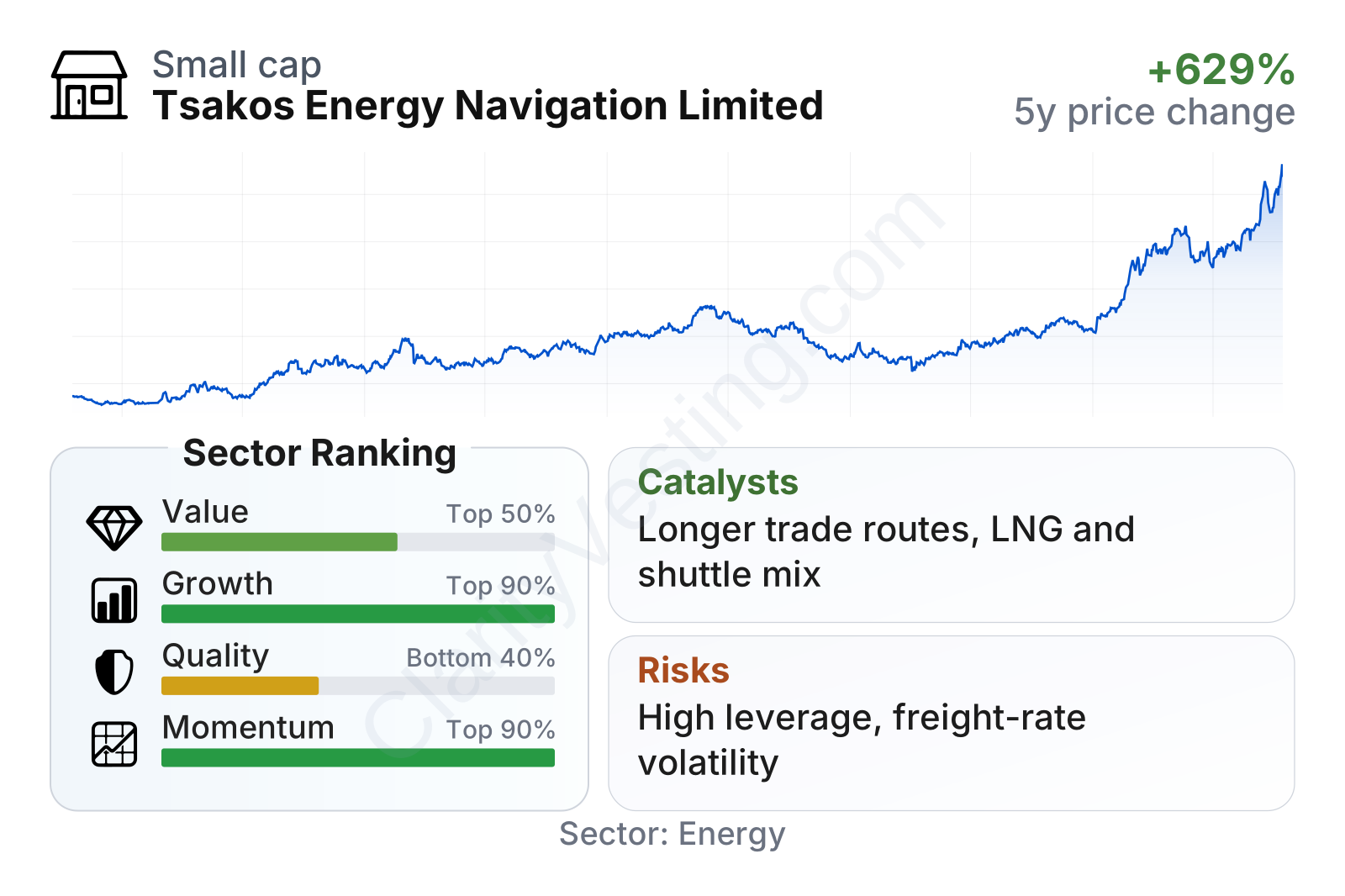
TEN is a mid-sized public shipping company. The stock’s recent performance has been much stronger than the broader energy sector, while valuation multiples still look low relative to sector medians. At the same time, the quality profile is mixed: operating and profit margins are strong, but leverage is clearly above normal for the sector and free cash flow is currently negative because this is a capital-intensive fleet business.
The contrast is important for long-term analysis. On earnings and asset value, the shares screen as inexpensive. On balance-sheet strength and cash conversion, the picture is less comfortable. That combination often appears in shipping, where profits can look strong during favorable cycles even as debt and vessel investment remain heavy.
Growth
Tanker shipping remains a relevant long-term industry because the world still depends heavily on seaborne energy trade. Even with the gradual build-out of renewable energy, oil and refined products continue to move globally, and natural gas shipping has become more important since trade routes shifted after the energy disruptions of recent years. This is not a classic high-growth industry in the technology sense, but it can deliver strong earnings growth when vessel supply is tight and ton-mile demand rises.
TEN’s strategy broadly makes sense for that environment. The company has maintained exposure across crude, product, shuttle, and LNG shipping rather than relying on only one niche. That diversification reduces dependence on a single freight market. It has also emphasized contracted employment for part of the fleet, which can create more stable revenue than a pure spot-market model.
Recent revenue momentum has improved again after a softer 2024 and parts of 2025. The latest year-over-year growth rate is well above the sector median, suggesting the company is benefiting from stronger charter conditions, vessel mix, or both. However, the longer-term record is much less smooth, which is typical for shipping companies whose results can swing sharply with freight rates.
Free cash flow is where the growth case becomes more complicated. TEN has shown that it can produce substantial cash in strong markets, but recent trailing cash flow remains negative. That does not automatically signal operating weakness, because fleet renewal and vessel deliveries can consume large amounts of cash before generating future earnings. Still, for long-term owners, it means growth currently depends not just on charter rates but also on disciplined capital allocation and successful deployment of new ships.
A meaningful catalyst is the continued reshaping of global oil and gas trade routes. Longer voyage distances can increase vessel demand even if total cargo volumes do not rise dramatically. TEN’s presence in both conventional tanker markets and LNG adds exposure to this trend. In addition, if the company secures more multi-year contracts for specialized or gas-related tonnage, that could improve revenue visibility compared with pure spot exposure.
Risks
This article is for informational purposes only and does not constitute financial advice. Some content is AI-generated. See Disclaimer


